
Reviewed · MIYAJIMA TOURS
Hiroshima & Miyajima 6.5h Guided Tour – Dome, Park & Shrine
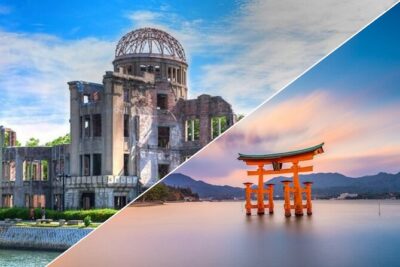
The striking feature here is the contrast: you begin with Miyajima’s sacred island scenery, then spend the afternoon facing Hiroshima’s painful modern history. In one long day, you see the red torii of Itsukushima Shrine, ride a ferry, walk a shopping street, and visit the Atomic Bomb Dome and Peace Memorial Museum.
I like the small group, limited to 10 people, because it gives you room to ask questions. I also like the local guides, including Shion, Bo, and Rie, who have been praised for clear English, useful recommendations, and personal knowledge of Hiroshima. The main drawback is time. Six and a half hours covers the essentials, but Miyajima and the museum can both deserve more than the schedule allows.
In This Review
- Key points to know before booking
- A day built around Hiroshima’s sharpest contrast
- Finding the guide at Hiroshima Station
- Train and ferry: useful travel, not dead time
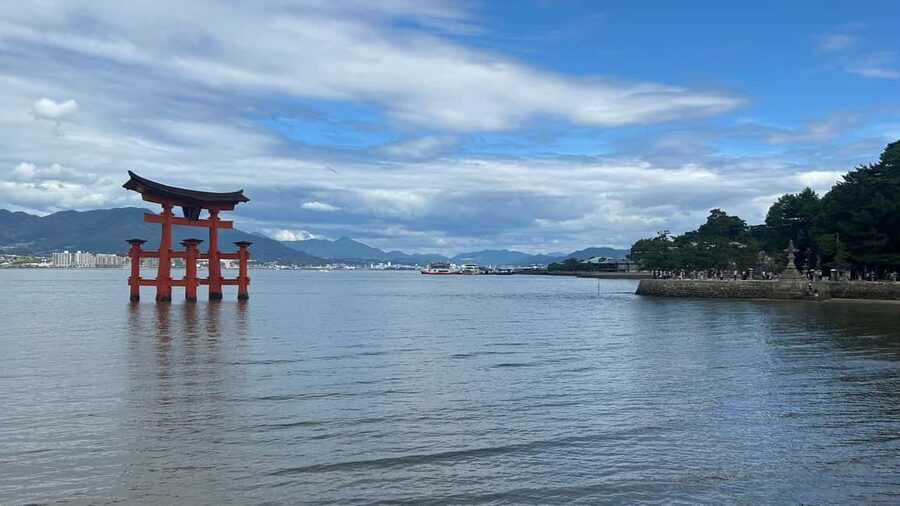
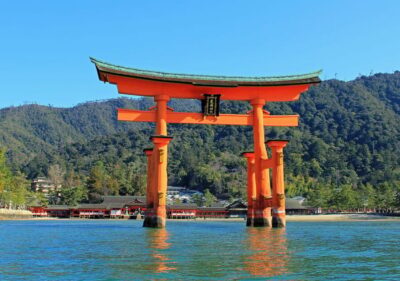
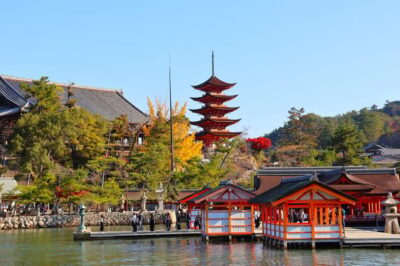
- Itsukushima Shrine and the famous red torii
- Omotesando Street, oysters, and momiji manju
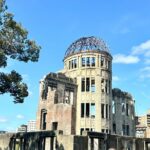
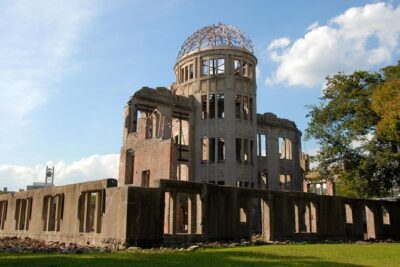
- Returning to Hiroshima for the Atomic Bomb Dome
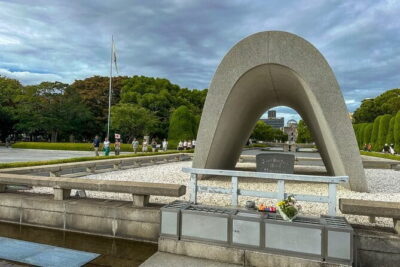
- Peace Memorial Park and its many monuments
- One hour inside the Peace Memorial Museum
- What the guides add to the day
- Walking, weather, and group comfort
- Who gets the best value from $96
- Small details that make the day easier
- Should you book the Hiroshima and Miyajima tour?
- FAQ
- Where does the tour meet?
- How can I identify the guide?
- What language is the tour offered in?
- How large is the group?
- Are transportation and meals included?
- How long is the tour?
- Is the Peace Memorial Museum always included?
- Is the tour suitable for wheelchair users?
Key points to know before booking
- Two UNESCO World Heritage Sites in one day: Visit Itsukushima Shrine and the Atomic Bomb Dome.
- Public transportation is part of the tour: You ride a train for about 25 minutes, take a 15-minute ferry to Miyajima, then return by ferry and train.
- A small English-speaking group: The maximum group size is 10, allowing more direct contact with your guide.
- The museum visit is powerful but brief: You have about one hour inside the Peace Memorial Museum, and busy periods may make that feel short.
- Miyajima’s torii depends on the tide: The gate may appear surrounded by water or accessible from the shore, depending on conditions.
- Bring yen and good shoes: Transportation, food, and shopping are not included, and the day involves extended walking.
A day built around Hiroshima’s sharpest contrast
This tour works because it joins two places that feel very different. Miyajima offers shrines, sea views, food stalls, and the easy pleasure of wandering. Hiroshima’s Peace sites ask for quiet attention and emotional room.
I find that pairing useful. You do not see Hiroshima only as a museum destination, and you do not visit Miyajima as just a pretty island. The two sides give each other context. After the solemnity of Peace Memorial Park and the museum, the island’s shrine and open views can provide a gentler change of pace. After Miyajima, Hiroshima’s memorial sites bring the city’s past into sharper focus.
The price is $96 per person. That is a fair figure for a guided small-group day with admission fees included, especially if you want help connecting the sites and using local trains and ferries. Still, you need to budget separately for transportation and meals, so the advertised price is not your final cost.
A few more Hiroshima tours and experiences worth a look

Finding the guide at Hiroshima Station
Your meeting point is precise, but Hiroshima Station has more than one exit, so take this seriously. Go to the North Exit, also called the Shinkansen Exit, on the second floor. Do not go to the South Exit, which serves the tram and bus side.
Look for the benches between the JR Green Ticket Office, called Midori no Madoguchi, and the Starbucks directly opposite it. Your guide will have a fluorescent green band attached to their bag.
I like this meeting arrangement because it uses two easy landmarks. Give yourself enough time to reach the North Exit, particularly if you arrive by train with luggage or are still learning the station layout. Large bags and oversize luggage are not allowed on the tour, so this is best done with a day bag.
Train and ferry: useful travel, not dead time
The first train ride takes about 25 minutes. Then you board a ferry for roughly 15 minutes to Miyajima.
These rides are part of the day rather than mere transfers. You get a look at how Hiroshima connects to its island communities, and the ferry gives you a scenic approach to Miyajima. The schedule also means you are not confined to a coach. You walk through stations, board public transport, and move at the pace of a normal day in Japan.
That has a benefit and a cost. You receive practical help from the guide, but you must be comfortable walking, keeping up with the group, and handling changes in public transport. Bring cash in Japanese yen for fares, food, and purchases. Transportation is not included, and no meal is provided.
Itsukushima Shrine and the famous red torii
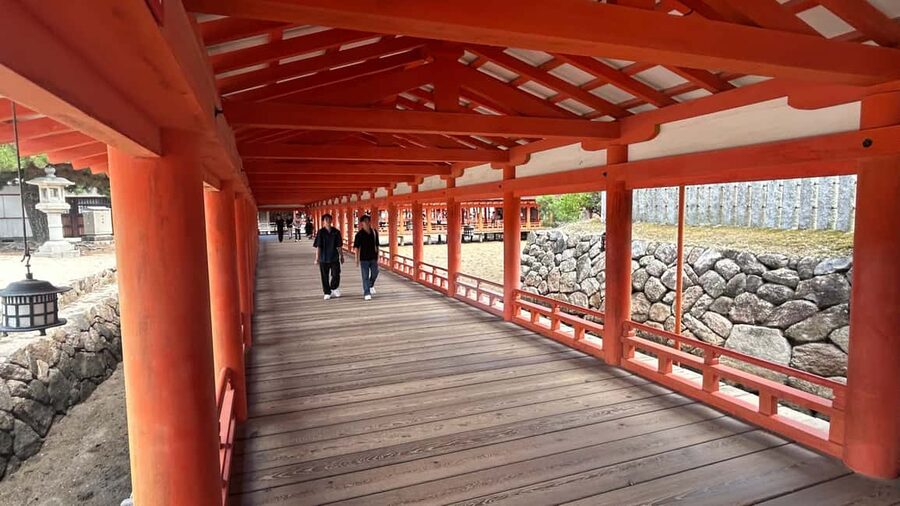
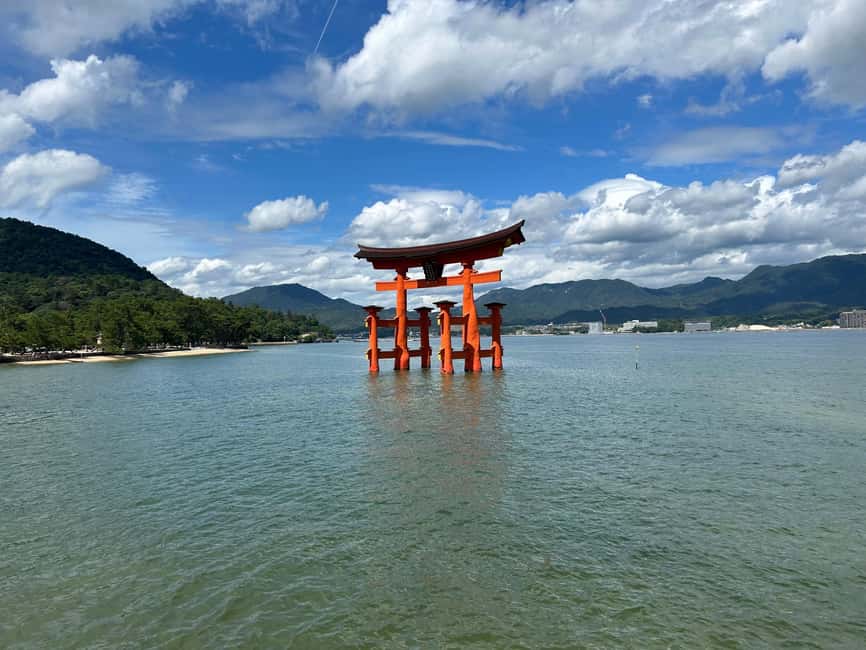
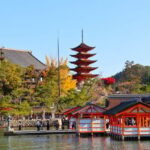
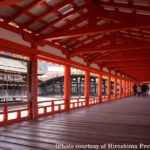
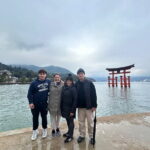
You have about 80 minutes at Itsukushima Shrine, including guided sightseeing and time for photographs. This is the centerpiece of Miyajima, with its bright red torii gate positioned in the sea.
The gate’s appearance changes with the tide. At higher water, it can look as if it floats offshore. At lower water, the shoreline may look quite different, and you may see the gate from a closer land-based position. Do not arrive with a single postcard view in mind. The tide decides how the scene looks that day.
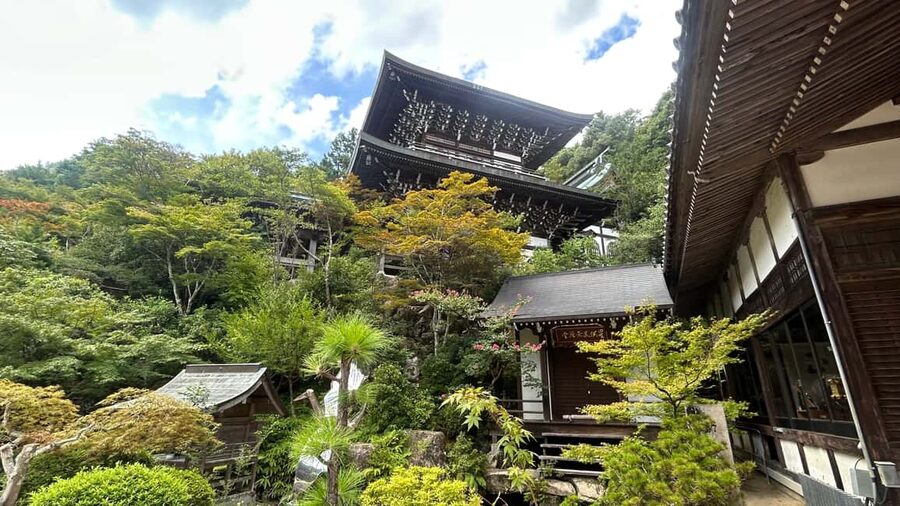
The guide adds value here by explaining the shrine and the spiritual character of the island. A short visit with context is more useful than racing through the buildings alone. The 80-minute stop gives you time to see the main area, but not to explore every corner of Miyajima.
Crowds are a real consideration. The shrine can have a long line, particularly on busy days. One guide, Shion, helped a group choose alternative sights when the wait became too long. That flexibility matters, though you should understand that the tour cannot guarantee a quiet visit or a short queue.
Omotesando Street, oysters, and momiji manju
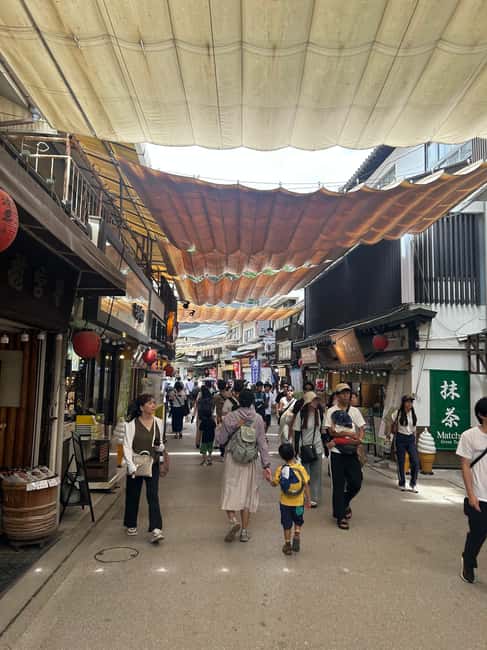
After the shrine, you spend about 45 minutes around Miyajima Omotesando Shopping Street. This is the island’s main food and shopping strip, with a lively feel and plenty to look at.
You can use this break for local specialties, including oysters and momiji manju. Momiji manju is a maple-leaf-shaped sweet associated with Miyajima. The stop is short, so I would not plan a full sit-down meal here. Think of it as time to sample something, browse, and get a feel for the island.
This part helps balance the shrine visit. You are not spending every minute listening to a formal explanation. You have a little freedom to look around and make your own choices, while the guide remains available for recommendations.
The tradeoff is that 45 minutes goes quickly. If you want a relaxed meal, extensive shopping, or more time on the island, this schedule may feel tight. Some people will prefer the efficient overview. Others may wish the tour gave Miyajima a full morning.
A few more Hiroshima tours and experiences worth a look

Returning to Hiroshima for the Atomic Bomb Dome
The return journey takes about 15 minutes by ferry and about 45 minutes by train. Once back in Hiroshima, you visit the Atomic Bomb Dome for roughly 30 minutes.
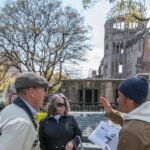
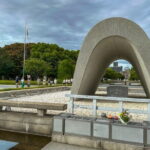
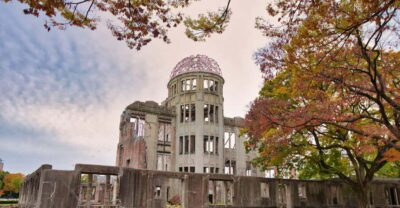
The dome is one of the city’s most recognizable sites and a UNESCO World Heritage Site. The damaged structure is not simply an old building to photograph. Its condition connects the physical city to the events of August 6, 1945, and to Hiroshima’s continuing message of peace.
Thirty minutes is enough for the guide to explain the site and point out useful views. You can take photographs, but the mood calls for care and restraint. This is not a stop to rush through while treating the dome as a backdrop.
The guide’s role is especially important here. A good explanation gives the building meaning without reducing the subject to dates and facts. Several guides, including Shion and Bo, have been praised for strong English and for making the history clear and engaging. Your exact guide will vary, but the experience is designed around live English guidance.
Peace Memorial Park and its many monuments
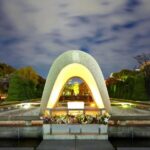
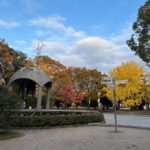
You then walk through Hiroshima Peace Memorial Park for about 40 minutes. The park brings together monuments dedicated to the victims, along with spaces for reflection.
I value a guided walk here because the monuments can blur together when you visit alone. The guide helps you understand what each place represents and how the park relates to the dome and museum. You still have room to pause, look around, and absorb the setting.
The park is also where the day’s emotional shift becomes strongest. Miyajima’s shops and shrine feel open and social. Here, the pace should slow. You may appreciate having a guide who can answer questions, but you should also expect that parts of the visit will be quiet rather than entertaining.
The 40-minute period gives you an organized introduction, not an exhaustive study of every monument. If you have particular memorials you want to see, ask your guide early in the day if the route allows time.
One hour inside the Peace Memorial Museum
The Peace Memorial Museum is scheduled for about one hour, with admission included. Its exhibits offer direct insight into Hiroshima’s past and the human cost of the atomic bombing.
For many people, this will be the most affecting part of the tour. The museum can be difficult, and it deserves your attention. I would avoid planning a demanding activity immediately afterward if you know that emotionally heavy sites stay with you.
One hour lets you see the main exhibits, but it is not generous. A busy museum can make the visit feel even shorter because you may need to wait to view displays. Two separate comments about the schedule point to the same practical issue: some people would prefer less time on Miyajima and more time at the Peace Memorial sites.
That is the central choice in this tour. If you want a first look at both destinations, the balance is sensible. If Hiroshima’s wartime history is your main reason for coming, a separate museum visit would give you more control and time.
The museum is closed from February 16 through 21. During those dates, the tour continues with the other stops, but the museum visit is skipped. Check your travel dates before booking if this part matters most to you.
What the guides add to the day
The guide quality is one of the strongest reasons to choose this experience rather than follow the same route alone. Names vary, but Shion, Bo, Rie, Hayato, Lena, Kana, Rei, Angel, and others have led groups.
Shion has been especially valued for his connection to Hiroshima and for sharing family experiences tied to the atomic bombing. That kind of local perspective can give the Peace sites a human voice, though the exact depth of personal insight depends on who leads your group.
Bo has been praised for fluent English and for speaking Chinese and Japanese as well. Rie has been described as warm, organized, and helpful to people arriving from Osaka. Rei even helped a participant find a pharmacy, a small practical service that can matter when you are far from home.
Guides also help with the mechanics of the day. One guide assisted a group in reaching a train back to Kyoto on time, while another adjusted the Miyajima visit when the shrine queue became too long. You should not expect every guide to make the same choices, but the small group makes questions and adjustments easier.
Walking, weather, and group comfort
This is an active 390-minute day. You walk through stations, along the island, around the shrine, through the park, and across museum areas. Comfortable walking shoes are important.
The tour operates rain or shine. Bring clothing suited to the forecast and rain gear when needed. Weather can change how enjoyable the ferry and island sections feel, but the schedule continues.
The tour is not suitable for children under 6, people with mobility impairments, or wheelchair users. Electric wheelchairs are also not allowed. If you need a slower pace or frequent seating, this itinerary may be difficult.
A group limit of 10 is a good middle ground. You do not get the total freedom of a private guide, but you receive more attention than on a large bus tour. That matters when you want to ask about the shrine, clarify a point at the museum, or get advice about food on Omotesando Street.
Who gets the best value from $96
I think this tour suits a first-time Hiroshima visitor who wants the city’s essential sights in one organized day. It is especially useful if you are unsure how to combine the train, ferry, shrine, park, and museum without wasting time.
The admission fees are included, and the guide provides the historical thread that links the stops. You are also spared the effort of figuring out the route by yourself. For many people, that makes $96 reasonable, even after adding transportation and food.
You pay for structure as much as for access. If you already know Hiroshima well, speak Japanese, and prefer to linger at the museum or spend half a day on Miyajima, you may find the fixed schedule restrictive. In that case, independent visits could give you more time at your priorities.
This is also a good fit if you are coming from another Japanese city and have limited time in Hiroshima. The meeting point is at Hiroshima Station, and the finish is at the Peace Memorial Museum, which can be convenient for continuing your day. Still, do not build an overly tight onward connection. The tour ends at the museum, and public transportation and group timing can vary.
Small details that make the day easier
A few simple choices will improve the experience:
- Wear shoes you can walk in for most of a day.
- Carry Japanese yen because fares, food, and purchases are not covered.
- Bring a small bag only. Large luggage and oversize bags are not permitted.
- Check the tide if the floating-torii view is important to you.
- Bring rain gear because the tour runs in wet weather.
- Arrive at the North Exit, not the South Exit.
- If the museum is your top priority, remember that one hour may feel brief.
- Cancel at least 24 hours before departure if your plans change and you want a full refund. You can also reserve now and pay later.
Should you book the Hiroshima and Miyajima tour?
Book it if you want a well-organized first visit that joins Miyajima’s shrine and food street with Hiroshima’s Atomic Bomb Dome, Peace Memorial Park, and museum. The small group, local English-speaking guides, and included admission make it a practical choice for a short stay.
Think twice if you want long, unhurried visits. Miyajima’s shrine can be crowded, and one hour at the museum is enough for an introduction but not for a slow reading of every exhibit.
My advice is to book this when your goal is coverage with meaning. You will see the two major sides of Hiroshima in one day, get help with the trains and ferry, and hear local explanations along the way. If the Peace Museum is your main purpose, book extra time in Hiroshima afterward or return independently for a longer visit.
FAQ
Where does the tour meet?
Meet at Hiroshima Station’s North Exit, also called the Shinkansen Exit, on the second floor. Wait on the benches between the Midori no Madoguchi JR Green Ticket Office and the Starbucks opposite it.
How can I identify the guide?
The guide will have a bright fluorescent green band attached to their bag.
What language is the tour offered in?
The live tour guide service is in English.
How large is the group?
The tour is limited to 10 participants.
Are transportation and meals included?
No. Train and ferry fares, meals, and personal purchases are not included. Bring Japanese yen in cash.
How long is the tour?
The tour lasts 390 minutes, or 6.5 hours.
Is the Peace Memorial Museum always included?
The museum is skipped from February 16 through 21 because it is closed during that period. The rest of the tour continues as planned.
Is the tour suitable for wheelchair users?
No. The experience is not suitable for wheelchair users, people with mobility impairments, children under 6, or electric wheelchair users.
More Guided Tours in Hiroshima


More Hiroshima City Tours in Hiroshima
More Miyajima Tours in Hiroshima
More tours in Hiroshima we've reviewed


Miyajima Tours, compared.
 ★ 5.0Peaceful Hiroshima & Miyajima UNESCO 1 Day Bus TourFrom $129
 ★ 4.9Hiroshima: Hiroshima and Miyajima UNESCO Sites 1-Day TourFrom $1228 hours
 ★ 5.0Hiroshima / Miyajima Full-day Private Tour with Government Licensed GuideFrom $202
 ★ 4.7Osaka/Kyoto: Hiroshima Miyajima Bus Tour & Shinkansen TicketFrom $27712 hours
 ★ 4.7From Hiroshima: Hiroshima & Miyajima 1 Day Tour with LunchFrom $1168 hours
 ★ 5.0Hiroshima and Miyajima Day Trip with Itsukushima Shrine & FerryFrom $45
