
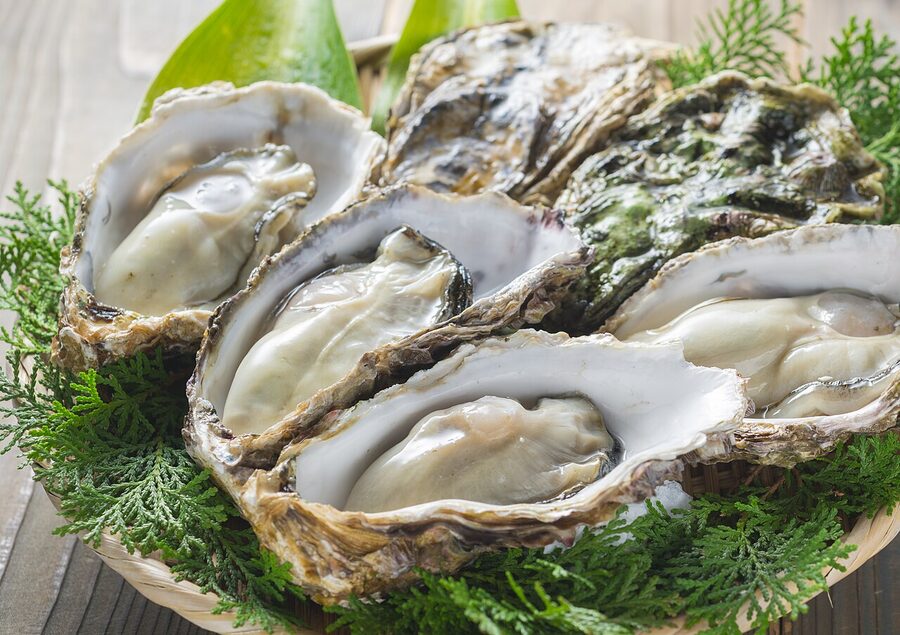
Hiroshima produces about 60% of all the oysters eaten in Japan. That’s roughly 20,000 tonnes a year, give or take, farmed almost entirely on bamboo rafts suspended in the shallow waters of the Seto Inland Sea. You can see the rafts from the ferry to Miyajima — long dark rectangles in the water, each one growing tens of thousands of oysters on cords hung beneath the surface. The industry is 400 years old, it’s been the backbone of coastal Hiroshima’s economy since the early Edo period, and it produces a specific kind of oyster that cannot be grown anywhere else.
This page is about that. Where the oysters come from, what makes them different from every other oyster in the world, the specific season to come eat them, and the six distinct ways locals prepare and serve them — from the street-stall grilled ones on Miyajima’s Omotesandō to the century-old floating kakibune oyster boats anchored in Hiroshima’s rivers.
Why Hiroshima oysters are specific
Three geographical facts about the Seto Inland Sea combine to make Hiroshima uniquely good at oyster farming, and they’re worth understanding if you want to know why the ones you eat here taste different from Galician or Colchester oysters.
Nutrient flow. Five major rivers empty into Hiroshima Bay — the Ōta, Enkō, Kyōbashi, Motoyasu, and Tenma — bringing mineral-rich freshwater runoff from the Chūgoku mountains. Oysters are filter feeders; they thrive where freshwater meets saltwater because the mix produces an enormous phytoplankton bloom. Hiroshima’s bay is one of the world’s most productive.
Low wave action. The Setouchi is an almost fully enclosed inland sea — Honshū, Shikoku, and Kyūshū block it on all sides from Pacific swells, and the islands inside it further break up whatever waves do form. The water barely moves. Bamboo-raft oyster cultivation, suspended three to five metres below the surface, is possible because the rafts don’t get smashed.
Water temperature. The Seto Inland Sea averages 9°C in February and 28°C in August — warm enough for fast oyster growth, cool enough for excellent flavour. The winter cold snap produces the dense, creamy meat that Hiroshima oysters are famous for; three weeks of water below 12°C is what transforms a regular spring oyster into the thick “R-month” style.
The species is Crassostrea gigas — the Pacific oyster — which is the same species farmed in France, Chesapeake Bay, and Tasmania. But Hiroshima oysters grow to 8–10 cm (larger than French, smaller than Gulf of Mexico), ripen faster, and have a specific mineral flavour that reflects the Chūgoku river water. They are, by most accounts, the sweetest Pacific oysters in the world.
The season
Hiroshima oysters are a winter food. Specifically, they are at their best from mid-November through late March, with peak eating months being January and February. The summer months (May through October) are legally closed fishing season — the oysters are spawning then and the meat goes milky and thin.
If you are in the region between October and March, oyster season is in play. Every restaurant in Hiroshima and the Seto coast will be running oyster specials, usually starting around ¥1,200 for a light set and going up to ¥4,500+ for full kaiseki oyster courses.
If you are here in May through September, you can still eat Hiroshima oysters — they’re frozen and they’re in stock — but they’re not what they should be. Unless you’re at a high-end restaurant sourcing from the Matoya or other farms with different seasonal cycles, it’s reasonable to wait for winter.
One exception. Iwagaki — Japanese rock oysters — are a different species (Crassostrea nippona) that runs on the opposite calendar, with peak eating months May through August. These are primarily a San’in-coast speciality rather than Hiroshima — see our Oki Islands guide for where to find them — but some Hiroshima restaurants carry them in summer.
The six ways to eat them
Hiroshima has more oyster preparation styles than any other region in Japan. Locals consider this a matter of municipal pride.
1. Yaki-gaki (grilled in the shell)
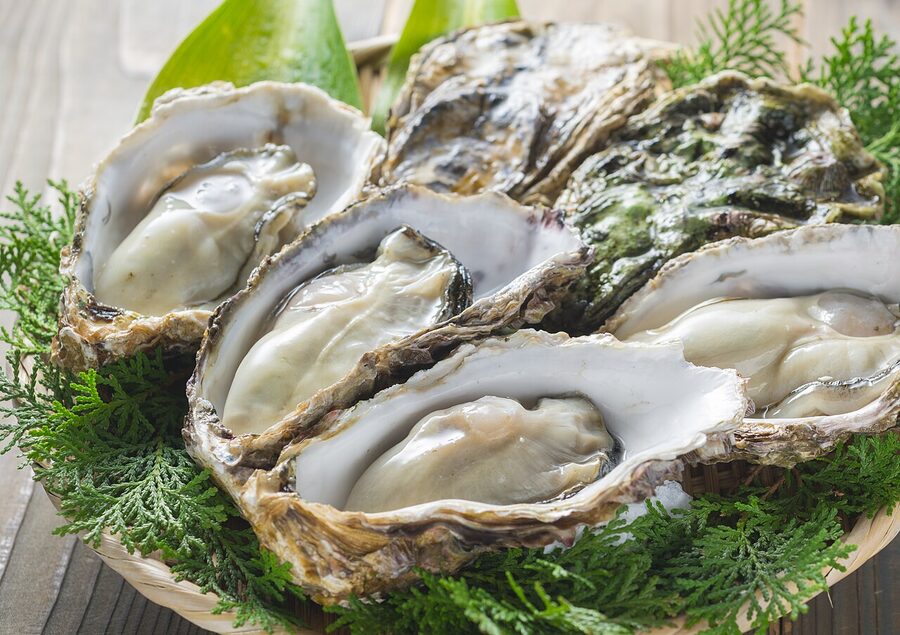
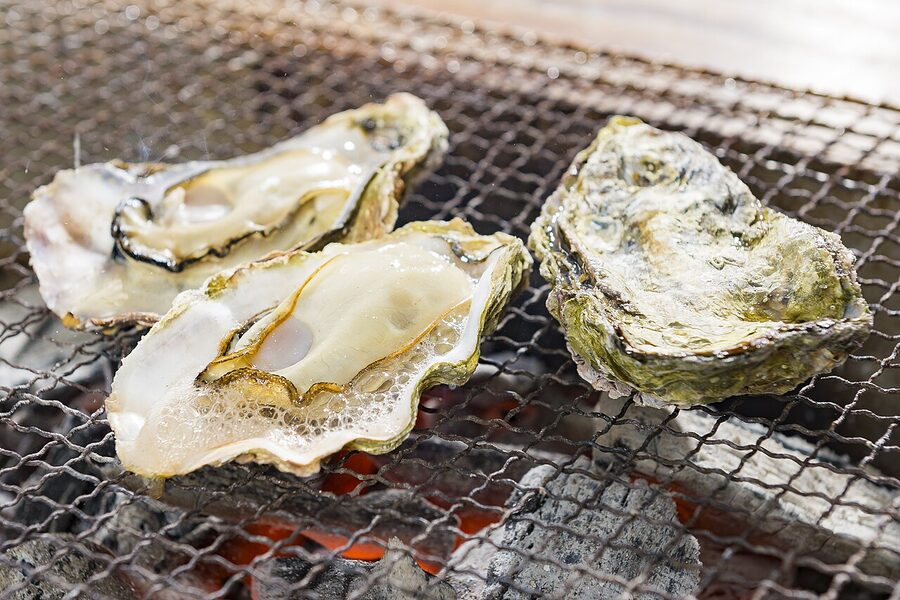
The most universal. Oysters are laid directly on a hot charcoal grill in their cupped shells; the heat pops them open, the juices stay inside. Eaten with a squeeze of lemon or a splash of ponzu. Stand-up grills along Miyajima’s Omotesandō, on the Hondōri arcade in Hiroshima city, and throughout the Setouchi coastal towns. ¥400–¥600 apiece.
2. Kaki-fry (breaded and deep-fried)
Battered in flour, egg, and panko, fried at high heat for 40 seconds per side, served with tonkatsu sauce and shredded cabbage. The Japanese winter home-cooking staple. Every izakaya in Hiroshima has this on the winter menu; a set of six with rice and soup runs ¥1,100–¥1,600. Good kaki-fry has molten oyster inside a crisp shell — bad kaki-fry is rubbery because the oyster was overcooked before frying. Order from places that look busy.
3. Kaki-nabe (oyster hotpot)
A simmering pot of Kombu-dashi broth on the table, with oysters, Chinese cabbage, tofu, carrot, mushrooms, and spring onion added progressively. Winter dish, eaten by multiple people sharing one pot. The most common variant is miso-based (kaki no dotenabe), where the inside rim of the pot is coated in a thick wall of miso paste that slowly melts into the broth as you eat. Proper kaki-nabe is a ¥2,500–¥3,800 per person set menu and takes about 90 minutes to eat properly.
4. Kaki-don (rice bowl)
Fried oysters on rice with a sweet-soy drizzle. A workday lunch variant, ¥1,000–¥1,400. Look for this on lunch boards outside small diners around the Hiroshima station area.
5. Kaki no tsukudani (simmered in soy)
Smaller oysters simmered down for two hours in soy sauce, sake, and sugar until they’re dense and savoury, served cold with rice. A traditional preservation technique now sold as a glass-jar souvenir product; every Hiroshima gift shop has it. Keeps for six months unopened.
6. Raw (nama-gaki)
Just-shucked, on crushed ice, with ponzu and grated daikon. Less common than the cooked preparations because freshness matters more and the Japanese raw-oyster style is slightly different from Western — the meat is typically rinsed in cold water just before serving. The good raw oyster restaurants are clustered in central Hiroshima city: Oyster Conclave Yatai and Kaki Donya both do counter-service raw oysters with the names of the farm on a ticket stuck in each shell. ¥600–¥1,200 per oyster.
Where to eat them, by setting
Miyajima Island — the tourist classic. The grilled oysters on Miyajima’s Omotesandō are the easiest way to eat Hiroshima oysters on a short trip. Most visitors do it. It’s fine. It’s not the best version — there’s something slightly performative about the open-stall grilling — but it pairs well with a torii-gate visit. ¥400–¥600 per oyster.
Hiroshima city centre — the stand-up bars. Oyster Conclave Yatai under the railway arches and Ekohiiki in the Hondōri area do specialist standing-bar oyster counters: raw, grilled, kaki-fry, kaki-nabe small plates, and a rotating “fisherman’s oyster of the week” from a specific farm. ¥3,000–¥4,500 for a full session with beer.
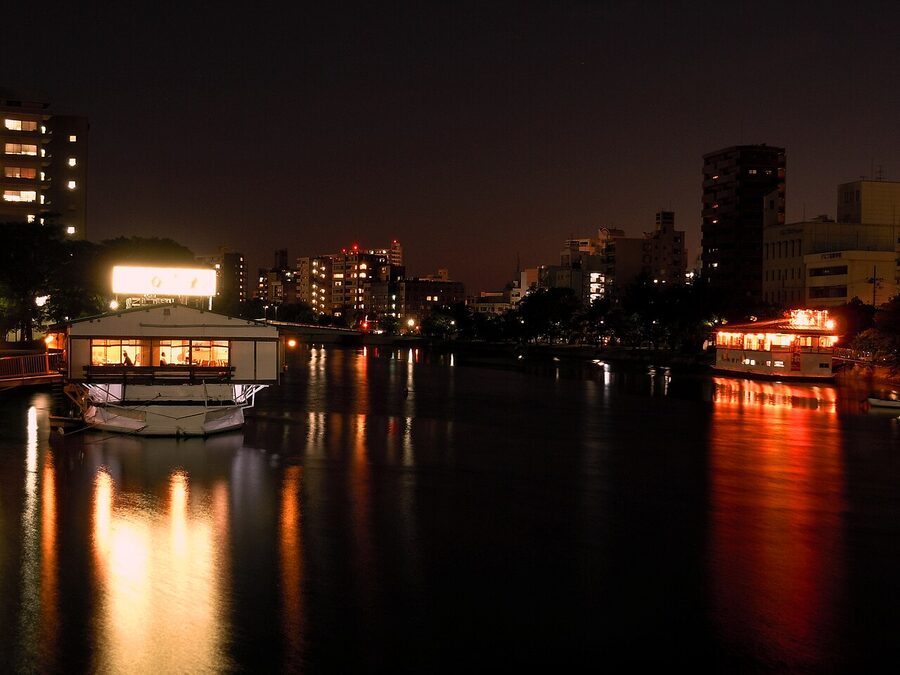
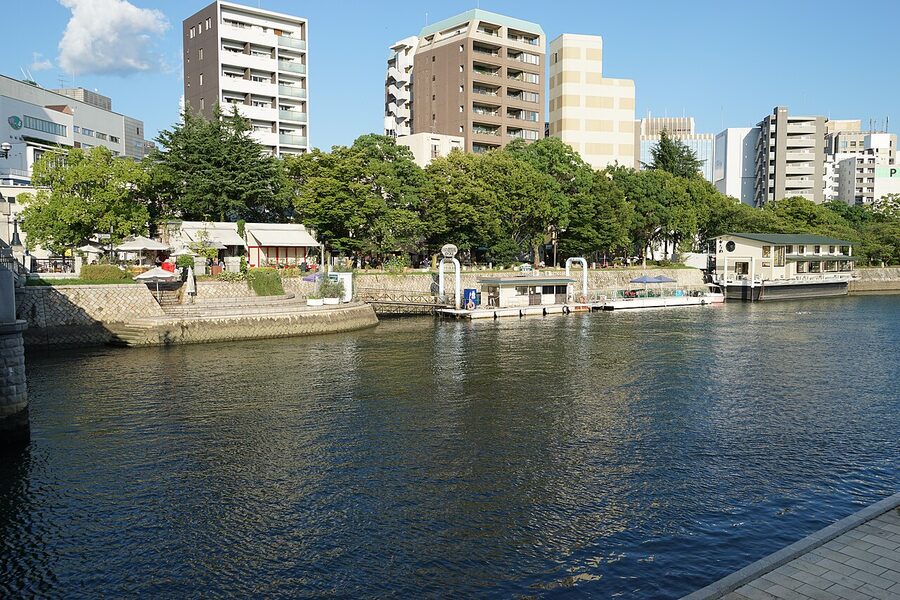
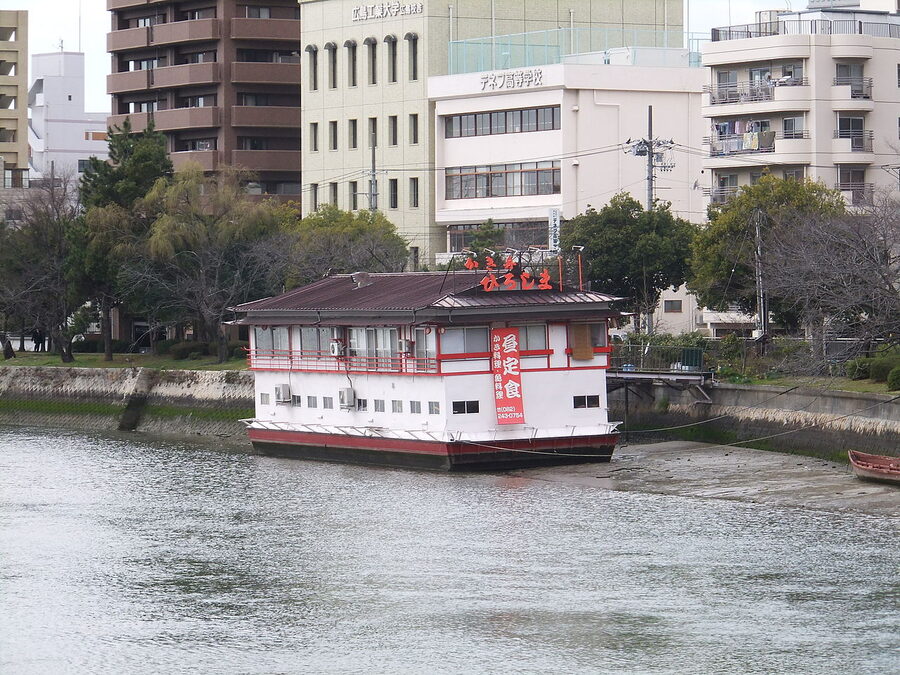
The kakibune boats. The three floating-restaurant boats anchored in the Motoyasu River next to the Atomic Dome are the specific Hiroshima oyster experience. They are called Kanawa, Hiroshima Kakibune, and Kaki no Ya. Each is an actual boat — the dining room is below deck, you eat on tatami, you watch the river traffic through small round windows. A full oyster kaiseki course is ¥6,000–¥15,000. Book at least two days ahead in oyster season.
Kaki-goya — the oyster huts. Along the coast to the east of Hiroshima city (Kaita, Etajima Island, and particularly Mihara‘s neighbour, Takehara), you’ll find kaki-goya — simple corrugated-iron sheds set up by oyster farmers specifically for all-you-can-eat grilling. You pay ¥2,000 per person, you get two buckets of oysters in their shells, tongs, a small grill, and a wedge of lemon. The rest is up to you. Weekends November through March. The best oyster-eating experience in the region for the budget.
The farms themselves. Several of the larger Hiroshima farms run direct-to-consumer tasting sessions during the season. Marutomi Suisan in Etajima offers a 2-hour tour that includes a raft visit, a shucking demonstration, and a 30-oyster tasting for ¥3,500 per person. Book through the Hiroshima Tourist Information Center at Hiroshima Station.
Where else in Japan to compare
Hiroshima is the largest producer but not the only serious one. If you’re travelling around Japan, there are three other regions with significant oyster traditions: Matoya Bay in Mie prefecture (Ise area), smaller and more saline, slower-growing; Sanriku Coast in Miyagi, devastated by the 2011 tsunami but now fully recovered, known for its creamy Kesennuma-style; and Saroma Lagoon in Hokkaidō, small and intensely cold-water-flavoured. Each has its partisans. Hiroshima’s still the benchmark.
And one curious footnote: France gets its oysters from Japan. In 1971, a disease called marteilia refringens killed most of the native Portuguese-spawn oyster population in the French oyster-farming regions. French farmers replenished the industry by importing juvenile Pacific oysters from Miyagi prefecture. Today the vast majority of French oysters are genetic descendants of Japanese stock. Hiroshima has since started importing back from France as a curiosity product, which is why you’ll occasionally see “Fine de Claire-style Hiroshima” on high-end menus. Circular seafood history.
How Hiroshima farms them: a short visual
The Hiroshima farming method is specific and centuries-old. Here’s how it actually works, step by step.
Step 1: Seeding (late July). The Pacific oyster spawns in summer. Farmers string empty scallop shells onto long vertical ropes, then lower the ropes into the shallow tidal flats of Matsunaga Bay (between Onomichi and Fukuyama) — the primary “seeding ground” for the whole industry. Oyster larvae in the water column attach to the empty shells at roughly 50-100 larvae per shell. The ropes are left in place for about six weeks while the larvae grow into tiny 1-cm spat.
Step 2: Transport (late September). The spat-covered ropes are transferred by boat to the deep-water growing grounds — mostly the Setouchi coast between Hiroshima city and Etajima, with outliers at Kure, Takehara, Mihara, and Onomichi. At the deep grounds, the ropes are hung from floating wooden rafts about 3 × 4 metres in size. Each raft carries 30-50 ropes.
Step 3: Growing (October – October). This is the slow part. The oysters feed by filtering plankton and algae from the water column, growing at different rates depending on the site’s salinity, temperature, and nutrient levels. Faster-growing sites produce “half-year” oysters harvested the following spring. Standard Hiroshima oysters are “one-year” oysters harvested at 12 months. Premium farms (notably Akitsu and Kaita) grow theirs for two years, producing larger and sweeter oysters at about double the market price.
Step 4: Harvest (October – March). Boats pull the ropes up from the rafts and strip the oysters off onto the deck. The good Hiroshima oyster boats use small hydraulic lifts now; the smaller family operations still do it entirely by hand. Shelled oysters are trucked to processing plants within a few hours, where they’re cleaned in UV-treated seawater tanks for 24 hours before shucking.
Step 5: Shucking (dawn). The shuck workers at the Hiroshima processing plants are almost all women, average age 65, working in unheated tiled rooms at 4°C to keep the oysters fresh. A skilled shucker opens 2,000 oysters in an 8-hour shift. The industry is slowly shifting to machine shucking, but hand-shucked is still considered superior because the oyster meat is less bruised.
Seasons by month
September – October. Season not yet started. Any “Hiroshima oyster” on a menu this month is either frozen stock from the previous year or a young “half-year” oyster, which is thin-bodied and not worth paying premium prices for.
November. Official season opens around 1 November. The first two weeks are peak-premium pricing; the oysters are still growing slightly, so they’re smaller than they’ll be in January but already have deep flavour. Best served raw or grilled simply with lemon.
December. Arguably the best month. Temperatures are cold enough to slow oyster metabolism, concentrating the glycogen in the meat and making them sweeter. Supply is high. Prices moderate. Almost every Hiroshima restaurant has an oyster menu in December.
January. Peak of the peak. The “warm-current” sites (Etajima, Kaita) produce milky, rich oysters with a specific almost-salt-caramel sweetness that’s unique to this month. The oyster-kaiseki at the kakibune boats is at its strongest this month.
February. Female oysters start developing roe. Some diners prefer this phase — the slight bitterness of the roe balances the sweetness of the meat — and some prefer pre-roe oysters. Either way the meat is firmer than in December.
Mid-March. Season formally closes. Shuck plants go dark. The kaki-goya huts take down their signs. If you’re visiting in late March or April, ask for Matoya (Mie) or Iwate oysters instead — they’re in season a month later.
Oyster festivals
Three Hiroshima festivals build around the oyster season if you can time your visit around one of them.
Miyajima Oyster Festival (宮島かき祭り) — first or second weekend of February. Held on the Miyajima ferry terminal concourse; 8-10 stalls grilling oysters from the bay visible from the festival grounds. Free entry; oysters ¥300 each. Hot sake, miso soup, and oyster rice balls available. Easy day trip from Hiroshima.
Hiroshima Oyster Road — January through February, street-food operation in the central Hiroshima Parco area. Five participating oyster farms take turns running the stall; each week’s oysters are specifically from one named farmer. ¥400 per grilled oyster. Weekdays only; weekends they’re closed to avoid the tourist pressure.
Kaita Oyster Festival — third Saturday of February. The smallest and most local of the three, held at Kaita fishing port about 30 minutes east of Hiroshima Station. This is the festival local oyster farmers actually attend. 2,000 yen gets you unlimited-grill entry plus a free miso soup. Worth the trip.
Practicals
When to come. November to March is peak season. January and February are the absolute best. Book a hotel at least six weeks in advance if you’re aiming at the Hiroshima Kaki Matsuri oyster festival, held the last weekend of February — this is the year’s single-largest oyster-eating event, 90 stalls, grilling, and draft beer.
Where to base. Hiroshima city works for all the main oyster experiences plus Miyajima day trips. If you want a more focused oyster-only itinerary, base in Mihara or Takehara on the eastern Setouchi coast — the kaki-goya scene is denser there and the prices are roughly half of Hiroshima city.
Allergies. Shellfish allergies are well-understood in Japan. Every Hiroshima restaurant takes this seriously; you can tell the waiter “kaki no arerugī ga arimasu” and the menu will be adjusted. Don’t assume English menus flag shellfish — the default Japanese restaurant assumption is that you’ll just not order those dishes.
Norovirus season. There’s a very small but real risk of norovirus from raw Japanese oysters in January through early February (peak infectious season for wild oyster stocks). All the commercial producers test for it, and official outbreak numbers are tiny, but if you’re cautious, order cooked preparations only during this window. Kaki-fry, yaki-gaki, and kaki-nabe all kill the virus.
One thing to do before you leave Hiroshima
Take the ferry out to Etajima Island, 25 minutes from Hiroshima Port, at around 15:00 in late January. Walk along the coastal path west from the ferry terminal for fifteen minutes. You will pass a small kaki-goya with three tables out in front; you pay ¥2,200, you get a bucket of 30 oysters, a pair of gloves, and you cook them yourself over a small charcoal grill for the next hour. There’s local draft beer. The sun goes down over the bay while you’re eating. An elderly fisherman will probably walk over from one of the nearby boats and say something in Hiroshima-ben dialect that you don’t understand, and then he’ll smile and walk off.
That’s the Hiroshima oyster experience. Everything else is a version of it. Come in the right season, eat them hot off a grill you’re tending yourself, and you will understand what 60% of Japan understands.



