
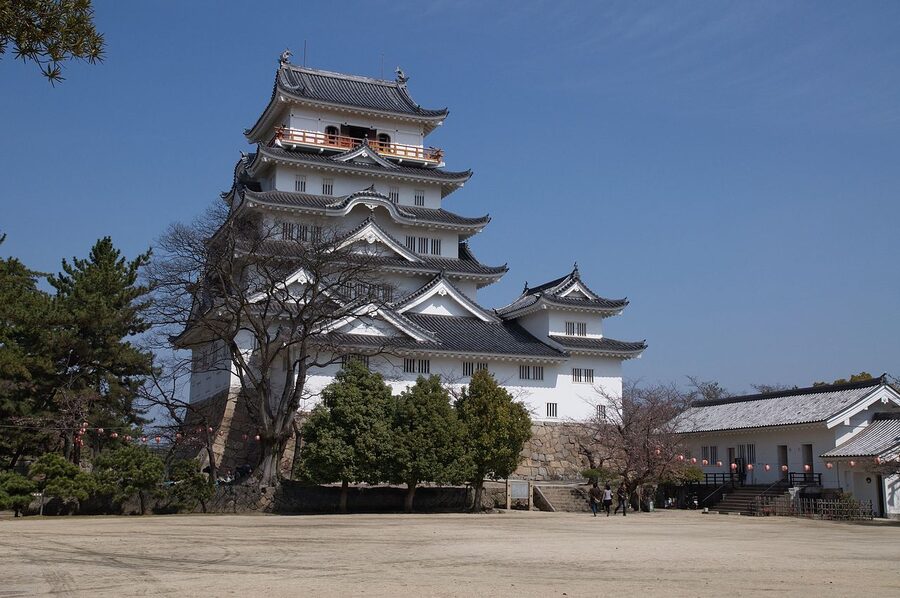
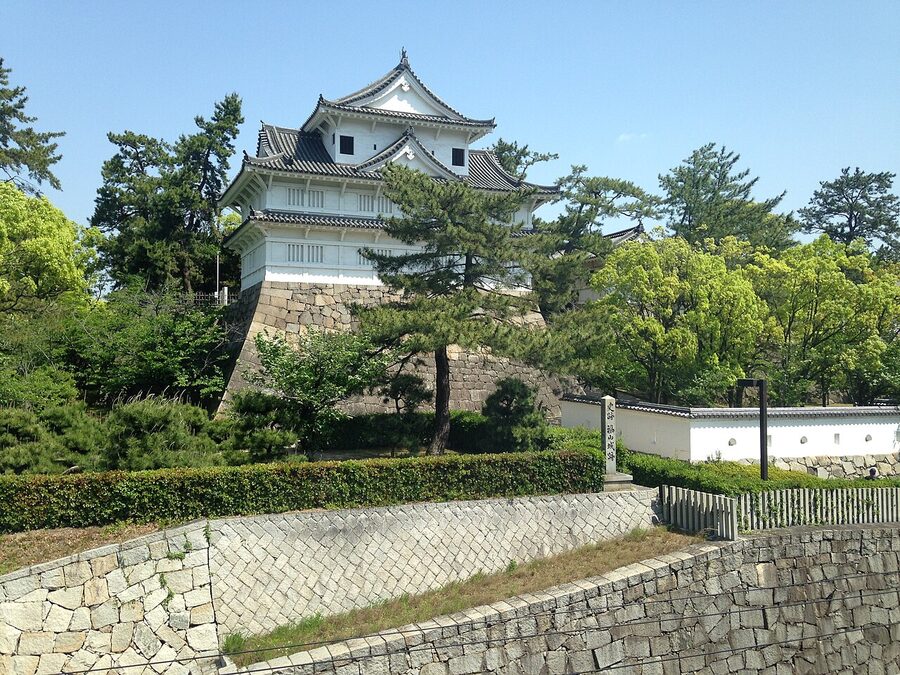
Most travellers who change trains at Fukuyama Station never look up. They should. Directly above the northbound Shinkansen platform, about 50 metres from where they’re standing, is an original Edo-period watchtower from a 1622 castle — the Fushimi Yagura — and above that, a reconstructed five-storey keep. It’s the only Shinkansen station in Japan where a castle keep is visible from the platform. You can see it in fifteen seconds of a train change. Almost nobody does.
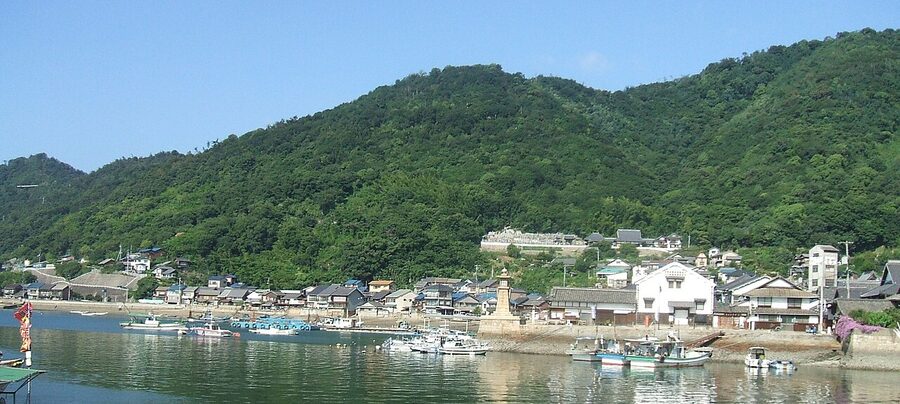
Fukuyama (福山) is an industrial city of about 470,000 on the eastern edge of Hiroshima prefecture, at the far end of the Seto Inland Sea before you reach Okayama. It’s a city most Japan guidebooks skip, and — for the central business district — they’re not wrong. But 30 minutes south by bus is Tomonoura, one of the best-preserved Edo-era port towns in Japan, and the reason the city is worth the stop.
This page covers both halves of the visit: the castle at the station for anyone doing a 90-minute Shinkansen transfer, and the full Tomonoura day trip for anyone with longer.
Fukuyama Castle
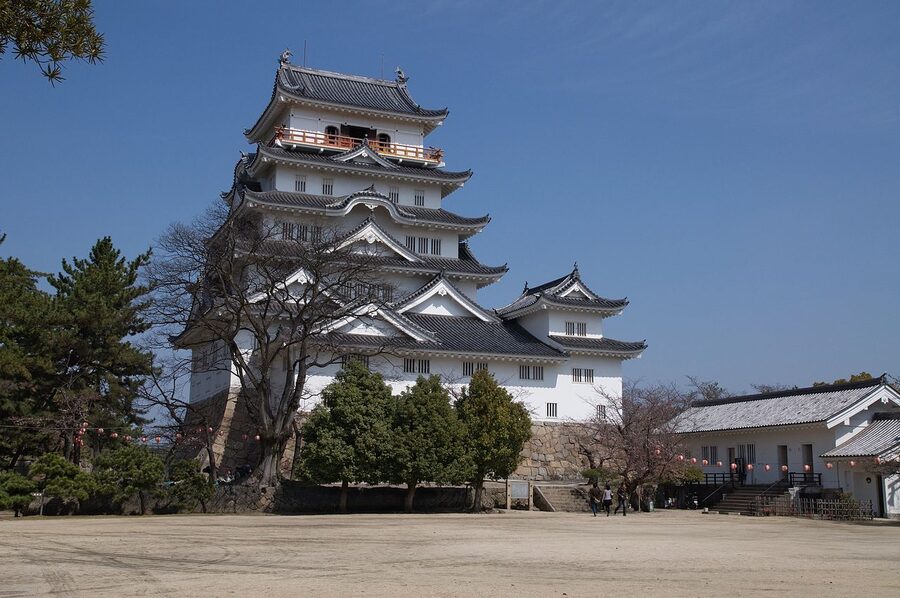
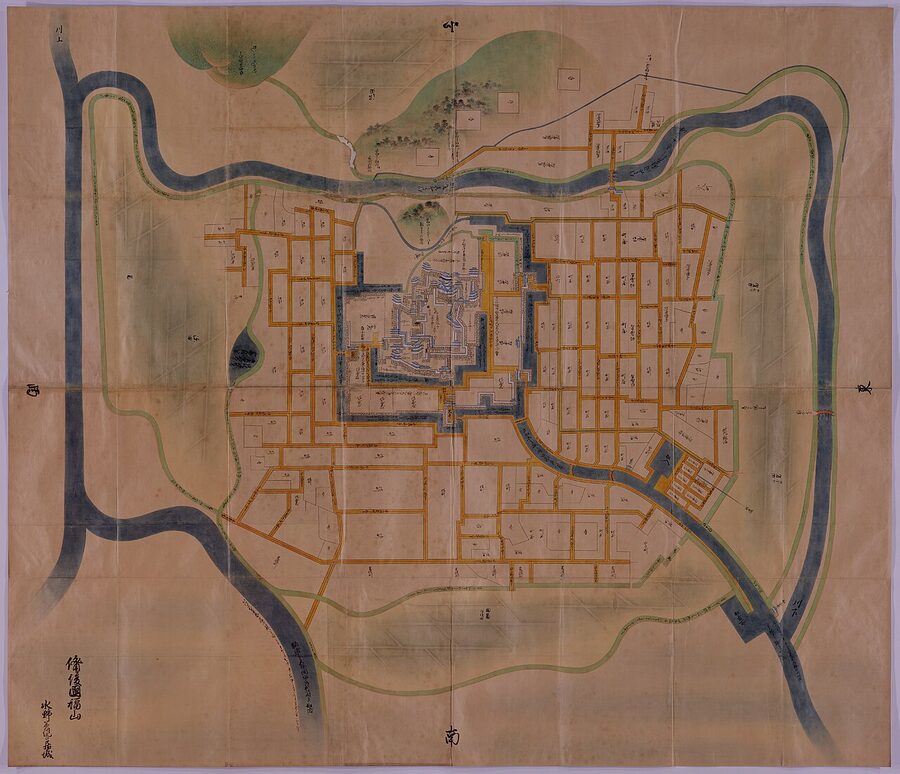
Fukuyama Castle was built in 1622 by Mizuno Katsunari, a cousin of Tokugawa Ieyasu, as part of the network of Tokugawa loyalist castles containing the western daimyo after Sekigahara. It was one of the last full-scale castles built in Japan — the shogunate’s Ikkoku-ichijō law capping castles-per-domain came into force in 1615, and Fukuyama was an exception negotiated specifically for Mizuno.
The original keep stood until 1945, when US incendiary bombing destroyed most of the city and the keep with it. The current keep is a 1966 concrete rebuild using the 1622 drawings; inside, it’s a museum of city and castle history. Interestingly, two genuine Edo-period structures on the castle grounds did survive the bombing: the Fushimi Yagura watchtower (the one visible from the Shinkansen platform, above) and the Sujigane Gomon main gate. Both were originally at Fushimi Castle in Kyoto and were moved here brick by brick in 1622 when Fushimi was demolished by the shogunate. They are the oldest structures on site by nearly 350 years.
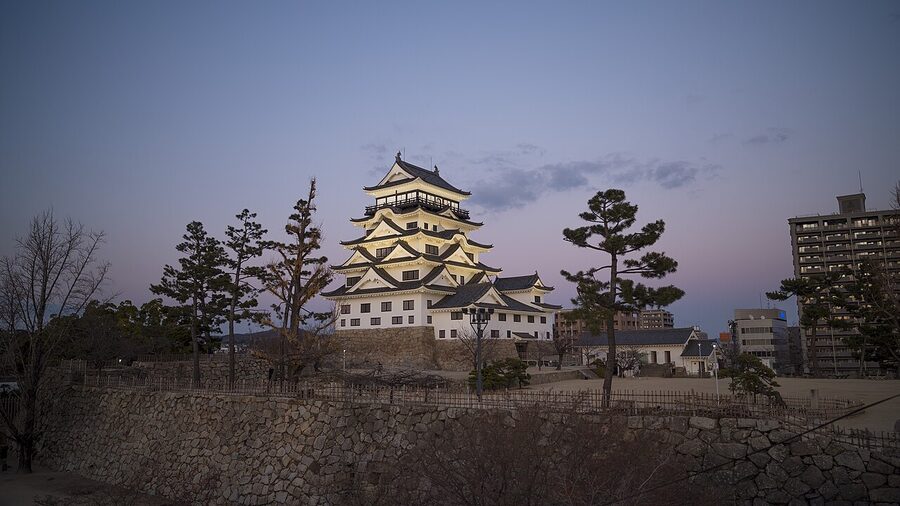
Castle park and outer grounds are free. Keep museum is ¥500. Open 09:00–17:00, closed Mondays. If you have 90 minutes between Shinkansen trains, this is an easy fill — 30-minute castle climb, quick look at the Fushimi Yagura from below, back to the platform.
Tomonoura: the port that shouldn’t have survived
Thirty minutes south of Fukuyama Station by bus — or the same by car — is Tomonoura (鞆の浦), a small, perfect, absurdly photogenic port town on the coast of the Seto Inland Sea. It sits at a specific point in the strait where the Setouchi’s tidal currents reverse direction four times a day, so historically every ship travelling between Kyūshū and Honshū had to stop here to wait for the tide. That created the port; the town grew around the wait.
The town has five specific Edo-period features that survive essentially unchanged, and the combination is what makes it special:
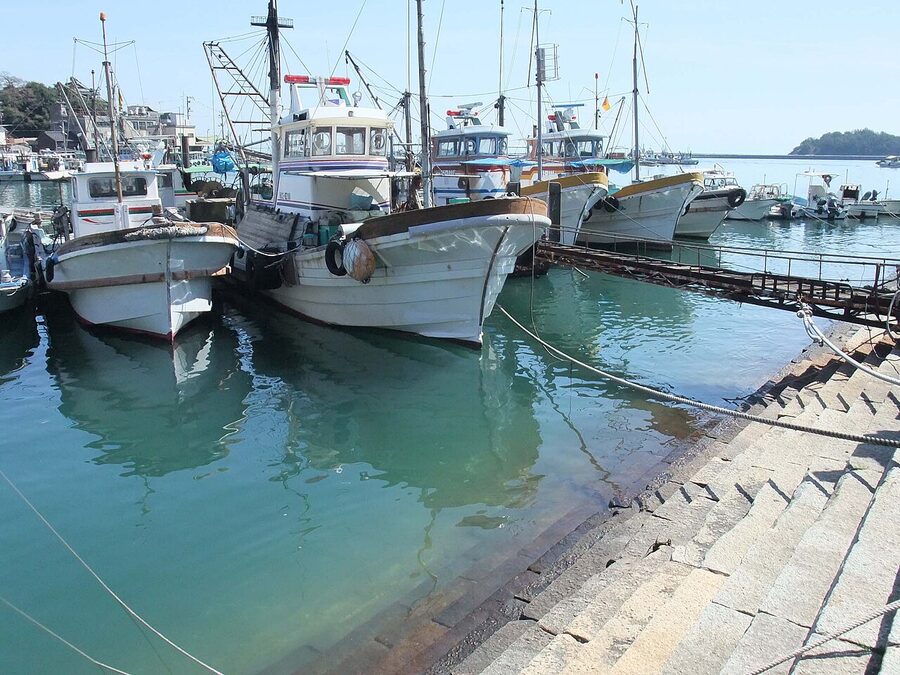
- The Gangi — a stepped stone wharf that was the original Edo-period landing pier.
- Joya-to — a 1859 stone lighthouse at the mouth of the harbour, still in service.
- Fune-ban-sho — the 1663 harbour-inspection station building.
- Tadeba — an enclosed stone dry-dock for repairing small boats.
- Hatoba — a curved stone breakwater with stairs.
All five are visible within a single 15-minute walk around the harbour. No other port in Japan has kept the full set in one place.
Why five ports? Tomonoura and the tide
Most Japanese ports are on rivers or at the end of bays — deep, sheltered, one-way in and out. Tomonoura is different. It sits on the narrowest part of the Seto Inland Sea, where tides from the Pacific meet tides from the Kanmon Strait, and the currents reverse direction twice a day. In the Edo period, before sail technology could reliably beat the tide, ships would make port at Tomonoura to wait for the tide to turn — sometimes for three or four days at a time.
This is what built the town. A port that’s always full of becalmed trade ships is a port with a captive economy: 15 inns, 40 restaurants, a red-light quarter, three Buddhist temples, a sake brewery, and a market that ran continuously from 1620 to 1868. Foreign envoys on their way to Edo stopped here too — the Korean embassies of 1711 and 1719 were recorded as staying in Tomonoura for the best part of a week on each visit, and the town has a small Korean Embassy Museum (¥200) documenting the diplomatic exchanges.
When steamships arrived in the 1880s, they didn’t need to wait for tides. Trade moved to deep-water ports elsewhere. Tomonoura shrank from a town of 25,000 to its current 3,000 in about a generation. The buildings stayed because nobody had money to replace them. That’s the story behind what you see today.
The Miyazaki connection
Studio Ghibli director Hayao Miyazaki spent two months in Tomonoura in 2005 researching what became Ponyo (2008), and the town appears in the film in essentially undisguised form. The fishing village where the main characters live, the port, the red building on the waterfront, the hilltop houses — all Tomonoura. Miyazaki rented a house on the hill for the duration of his research. The house is still there; you can walk past it but it’s not open to visitors.
This is where the town’s modern fame comes from. Anyone who has seen Ponyo recognises Tomonoura on arrival, which gives the place a specific kind of visitor — often quiet, often elderly, often European. The town doesn’t market the connection heavily, which is part of why the atmosphere works.
Temples, shrines, and the walk
The best way to see Tomonoura is on foot. A slow walking loop takes about 3 hours and covers the following:
Ioji Temple (medicine temple) — built 826 by Kūkai, the mountaineer-monk who founded Shingon Buddhism. Wooden structures, the main hall is a designated cultural property.
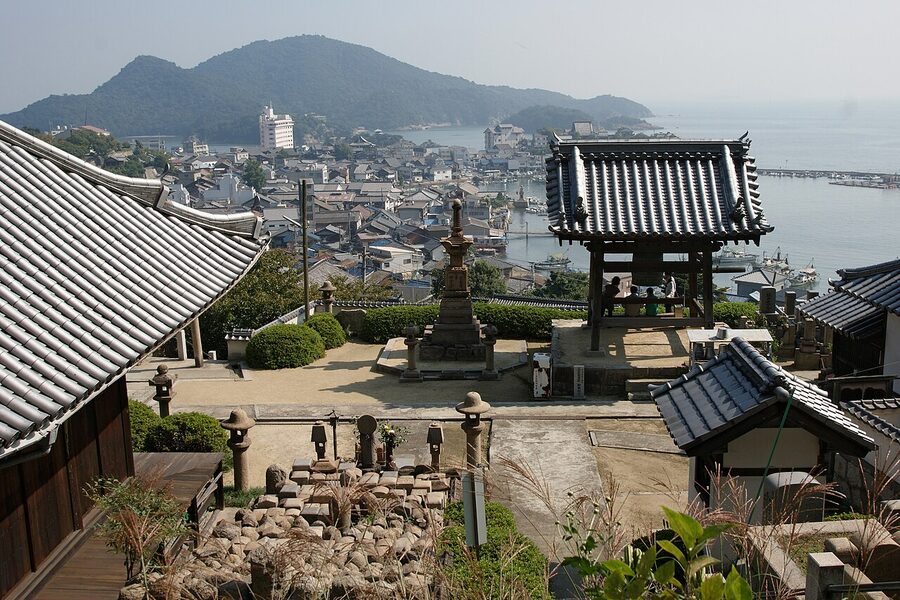
Fukuzenji Temple — 950 AD. The Taichō-rō hall has an interior view of the Setouchi that’s appeared in historical records since the 17th century; Korean envoys passing through Tomonoura in 1711 called it “the most beautiful scenic view in Japan east of the sea.” You can still sit in exactly the same spot they did.
Tomonoura preserved street grid — a 2-block section east of the harbour has been preserved with Edo-period merchant architecture intact. Soy-sauce breweries still operate here; two of them have sampling rooms.
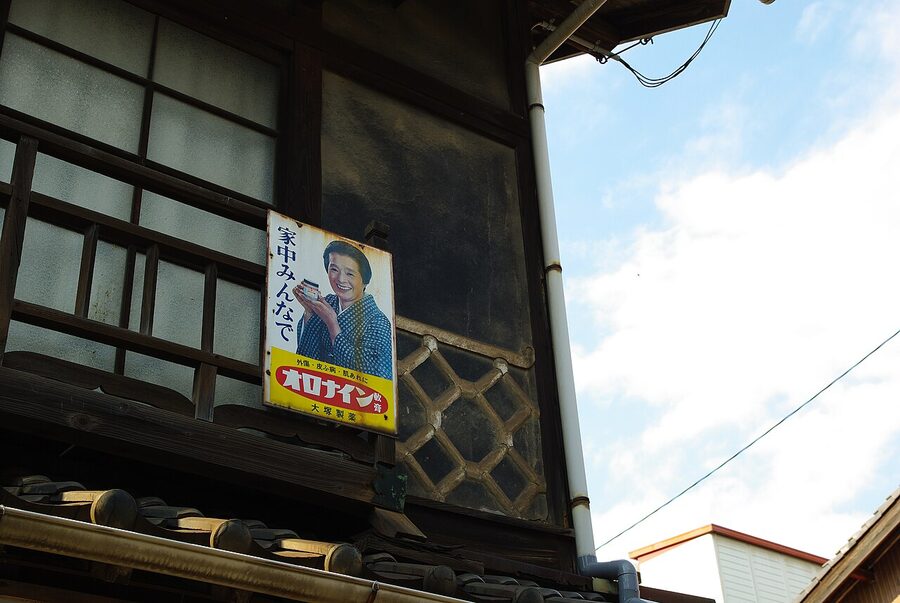
Ōta Family Residence — the former residence of the town’s biggest shipping merchant. Open as a museum, ¥400.
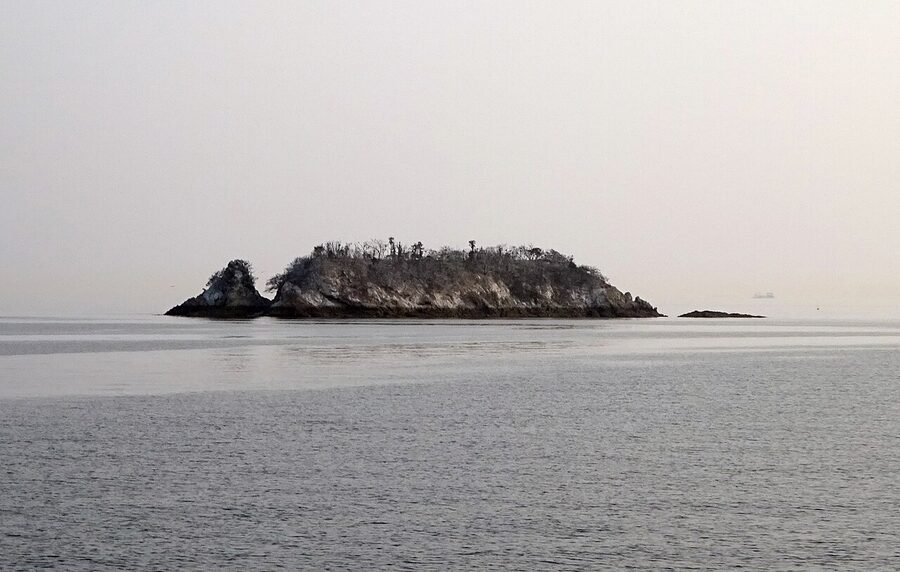
Sensuijima Island — a small offshore island connected to Tomonoura by a 5-minute municipal ferry (¥240 round trip). Walking trails, an onsen ryokan, a small beach. Most visitors skip the island, which is a reason to visit.
What to eat in Fukuyama and Tomonoura
Sea bream (tai). The Seto Inland Sea tide reversal at Tomonoura concentrates fish in the channel; sea bream is the specialty. A tai-meshi (whole sea bream cooked on rice) set at Ochikochi-tei in the Tomonoura preserved district is ¥2,800.
Homei-shu. The herb-infused sake from the 1659 brewery mentioned above. Sweet, warming, served hot in winter. A small bottle is ¥1,500 from the brewery shop.
Oni-kinumaki. Tomonoura’s traditional sweet — a sponge-cake roll filled with red-bean paste, eaten at the old teahouses along Tomonoura’s main street. ¥500 for a slice with tea.
Hiroshima oyster dishes. Winter only — see the full Hiroshima oysters guide. Tomonoura has a handful of oyster bars along the waterfront.
Fukuyama’s roses (and the industrial side of the city)
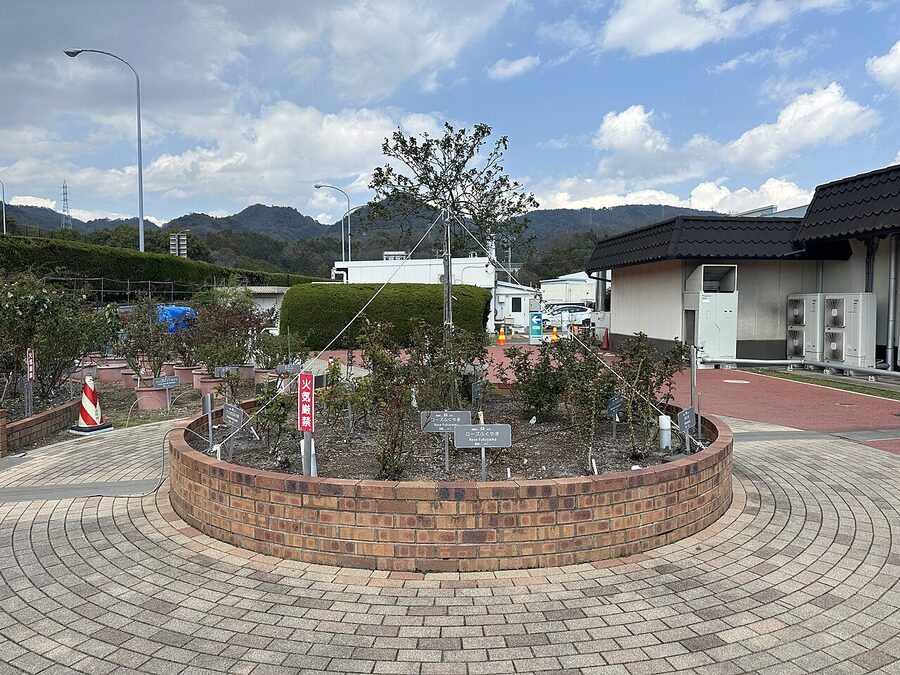
Fukuyama city itself has a specific modern identity as Japan’s “city of roses.” This came from the post-war reconstruction — after the 1945 firebombing destroyed 80% of the city, the Japanese rose society distributed 1,000 rose bushes among residents as a gesture of rebuilding, and the city has kept the tradition. There are now 5,500 rose plants across the central city, and the annual Fukuyama Rose Festival in mid-May brings 80,000 visitors.
The Fukuyama Rose Garden in the central Fukuyama SA (Service Area) is the best-curated display — 280 varieties, all labelled. Open year-round, free. Best bloom is the second half of May.
Fukuyama is also the headquarters of Fukuyama Transporting, one of Japan’s largest logistics companies, and has a significant steel industry (the JFE Steel West Japan Works is on the city’s coast — which is why you’ll see industrial scenery from the Shinkansen on the eastern approach).
Getting there
By Shinkansen. Fukuyama is on the Sanyō Shinkansen; Nozomi, Sakura, Hikari and Kodama all stop here. From Tokyo 4 hours, from Osaka 1 hour, from Hiroshima 25 minutes, all direct.
To Tomonoura. Tomonoura Bus #5 from Fukuyama Station bus stand, 30 minutes, ¥540 one-way. Runs roughly every 30 minutes. The bus drops you at Tomo-port in the centre of the old town.
From airports. Hiroshima Airport (HIJ) is 90 minutes west by highway bus. Okayama Airport (OKJ) is 70 minutes east. Shin-Kurashiki Station is 20 minutes east on the Shinkansen.
Where to stay
Tomonoura Keishokan — the traditional option, a 100-year-old ryokan on Sensuijima island with onsen baths, ¥25,000+ per person with kaiseki dinner. The experience.
Fukuyama Oriental Hotel — reliable mid-range near the station, ¥10,000–¥14,000, standard business-hotel setup.
Tomonoura Kappo Ryokan Ofutei — smaller guesthouse-style inn in the Tomonoura preserved district, ¥16,000 with two meals. Walking distance to everything.
Planning your visit
Shinkansen transfer (90 minutes). Fukuyama Castle only. Quick station-adjacent castle walk and back. A worthwhile use of a long train-change layover.
Half-day. Fukuyama Castle + bus to Tomonoura for the harbour walk and a tai-meshi lunch. Back on evening Shinkansen.
Full day. Morning castle, bus to Tomonoura, full 3-hour walking loop including Fukuzenji Temple and Sensuijima Island, dinner at Tomonoura, back to Fukuyama Station.
Two days. Day one as above with overnight at Tomonoura Keishokan. Day two: ferry to the nearby Shimanami islands, or east to Kurashiki’s Bikan quarter.
A Fukuyama + Tomonoura + Kurashiki loop is the best way to see eastern Setouchi without rushing. Fukuyama to Kurashiki is 15 minutes by Shinkansen; both cities make good single-night bases.
The moment that defines Tomonoura
Walk to the Joya-to lighthouse at sunset. It’s on the west breakwater of the inner harbour. Sit on the stone wall. Watch the Setouchi tide reversal actually happen — the water’s direction slows, stalls, reverses, and for about 15 minutes the whole channel is completely still. This is the thing that made the port possible in the first place. Every ship crew that stopped here for 1,000 years watched this same event. You sit with them for 15 minutes and then the world starts moving again.
That’s Tomonoura. That’s what makes it worth the day.



