
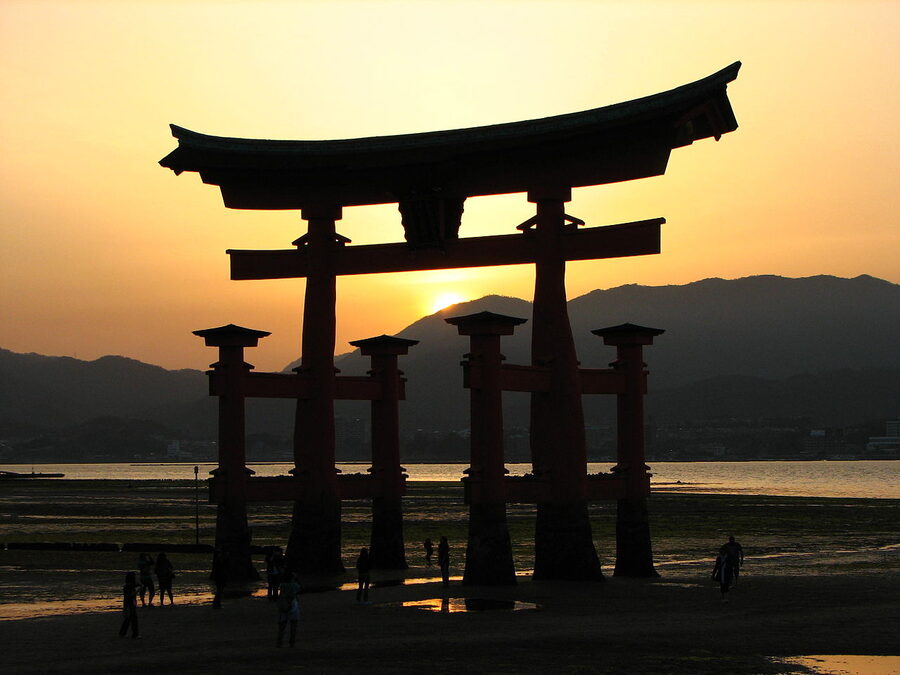
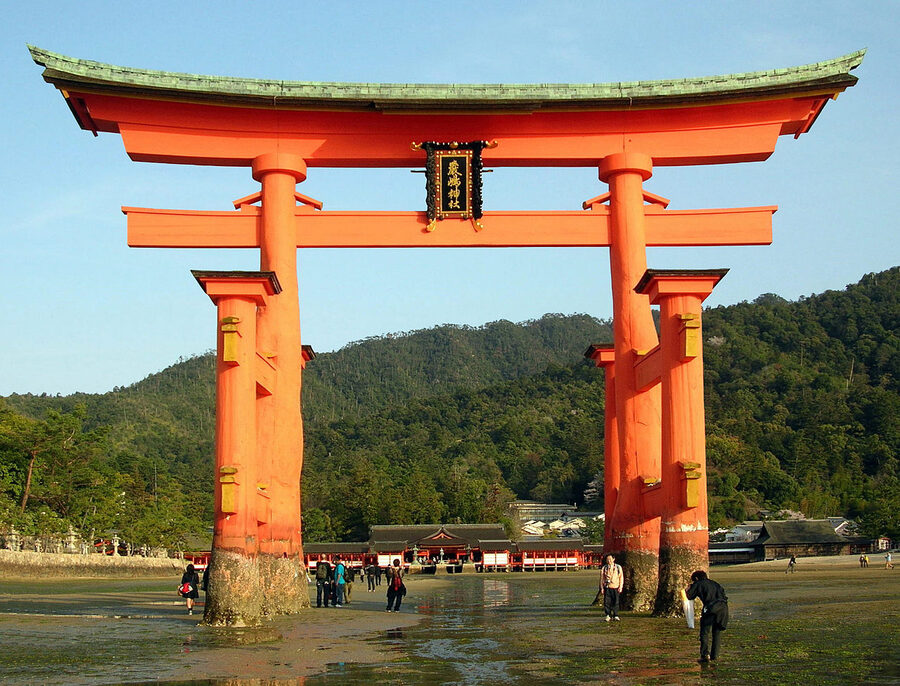
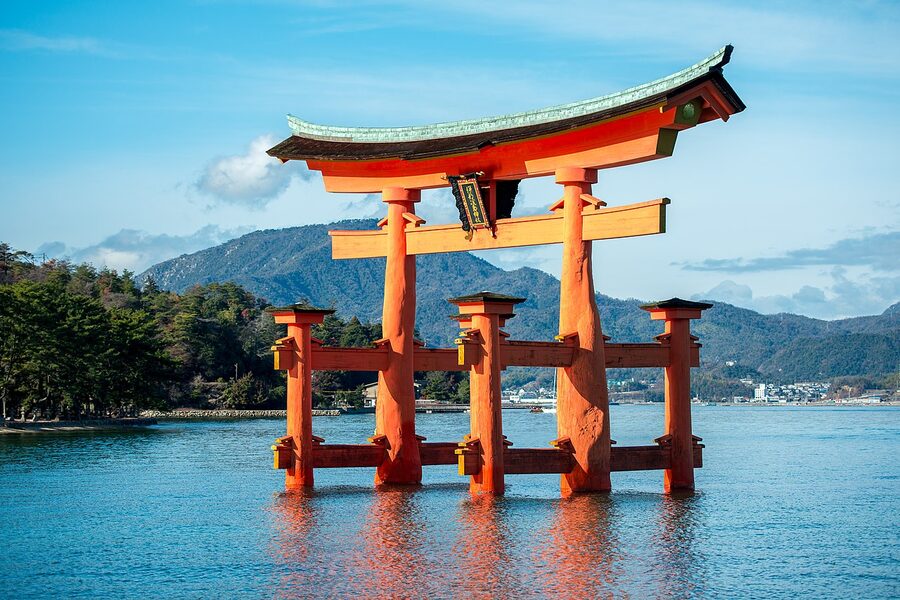
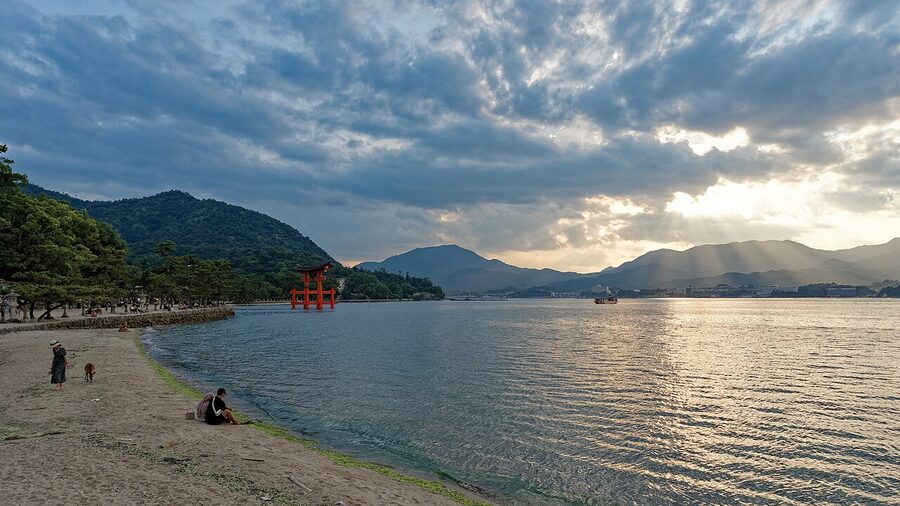
The famous shot of Miyajima’s floating torii — the bright vermilion gate standing out in the water at high tide with the whole 16-metre span reflected back — has been printed on every Japan travel brochure since roughly 1920. Most people assume it’s set up for tourists. It isn’t. It’s been there, in some form, since 593 AD. The current version was rebuilt in 1875 using huge unmortared cross-timbers of camphor wood; it weighs 60 tonnes; it sits on the tidal flat because the island as a whole is considered sacred, so the gate was placed out in the bay to let pilgrims approach the shrine by boat without first setting foot on holy ground.
Miyajima — officially Itsukushima (厳島) — is a 30 km² island in the Seto Inland Sea, about 40 minutes southwest of Hiroshima. Its vermilion shrine is a UNESCO World Heritage site. Its mountain, Mt Misen, is one of the oldest continuously venerated peaks in Japan. Its deer outnumber its permanent residents. Its name translates as “shrine island,” which is accurate, and Japanese aesthetic tradition ranks the view of the torii from the sea as one of the country’s three classical sankei — “three views” — alongside Amanohashidate and Matsushima.
This page is what to actually do when you’re there, and how to do it without fighting the coach-tour crowds.
The tide table is everything
The single most important thing to know about Miyajima is that the whole Itsukushima experience depends on the tide, and the tide on this coast swings by up to 4 metres. High tide and low tide look completely different; the shrine buildings that appear to be floating at 11:00 can be standing in sand at 17:00 on the same day.
Here’s the breakdown:
High tide (manchō). Water reaches the shrine’s wooden corridors, the torii appears to stand in the sea, the classical postcard-composition reflections happen. This is what you want for photography.
Low tide (kanchō). Water recedes and you can walk right out to the base of the torii across the wet tidal flat — you can touch the barnacles, put coins in the base of the pillars (a luck tradition), walk directly under the crossbeam. This is what you want for the physical experience.
Both are worth seeing in a single visit. If you arrive on a high-tide morning, the timing naturally works: photograph the floating version from the ferry, tour the shrine, have lunch, walk out under the torii at low tide in the afternoon, hike Mt Misen, come back for sunset. That’s the ideal day.
Check the daily tide times at the Miyajima Tourist Association website before you travel. The site publishes the exact high/low minutes for any given date, a month in advance.
Getting there
Miyajima is easier to reach than almost anywhere in Japan. You take the JR Sanyō local line from Hiroshima Station to Miyajimaguchi Station (25 minutes, ¥420, covered by the JR Pass and the Hiroshima day pass). From Miyajimaguchi, walk the two minutes to the ferry terminal; the JR-West ferry to the island takes 10 minutes, ¥180 each way, runs every 15 minutes 06:25–22:14.
The Matsudai ferry company runs an alternative service on the same route for a slightly cheaper fare, but the JR ferry does a specific 10:10–15:10 “torii-loop” route that takes you close alongside the gate in the middle of the crossing. If the tide is high, this is the signature photograph opportunity. The boat rotates so everyone gets the view.
You can also reach Miyajima directly from the Hiroshima Peace Park via the World Heritage Sea Route boat — 45 minutes, ¥2,200 one-way. Expensive, but you skip the train transfer and the boat passes directly under the Peace Memorial’s atomic dome.
Itsukushima Shrine
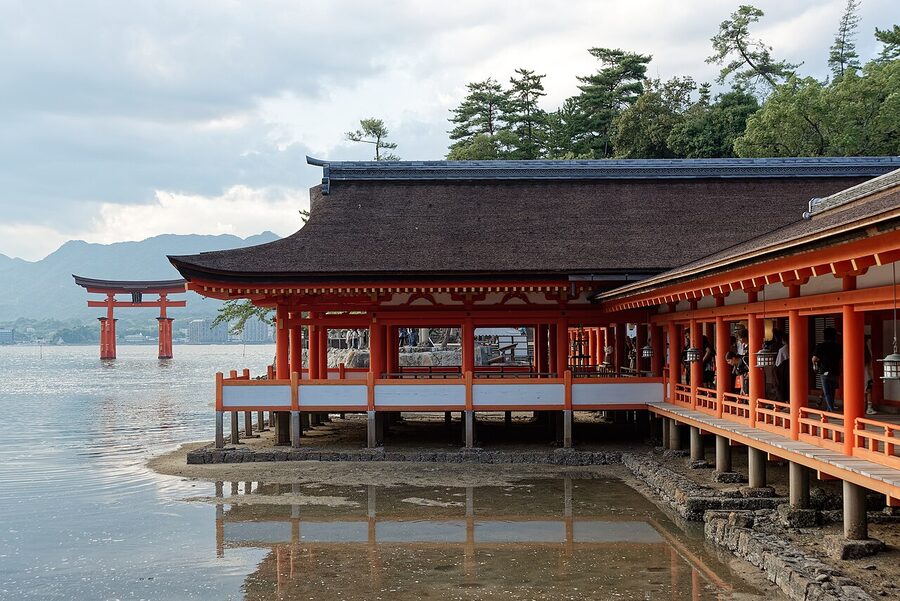
The shrine itself dates in its first form to 593 AD, but the current compound is mostly 1168 — a comprehensive rebuild commissioned by Taira no Kiyomori, the 12th-century warrior-politician who briefly ruled Japan from Kyoto. Kiyomori was an Itsukushima devotee; his fortune came from the Seto Inland Sea trade routes he controlled, and the shrine was, functionally, the religious headquarters of his maritime empire. The architecture reflects it. The 280-metre wooden corridor runs on pillars above the sea, the main hall and the pure-dance stage project out over the water, and the whole complex is designed to look like a floating palace at high tide.
Entry is ¥300 for the shrine alone, ¥500 for the combination ticket with the Treasure Hall (which contains an extraordinary collection of 12th-century lacquerware and court paintings). Open 06:30–18:00 most of the year; slightly shorter hours in winter.
The shrine is genuinely crowded between 10:30 and 14:30. Arrive on the first ferry (06:25 from Miyajimaguchi, which puts you on the island at 06:40) and you’ll have the shrine essentially to yourself for the first hour. The light is better too. I cannot overstate how much difference this makes — the 09:00 arrival experience and the 06:45 arrival experience are two entirely different visits.
The deer
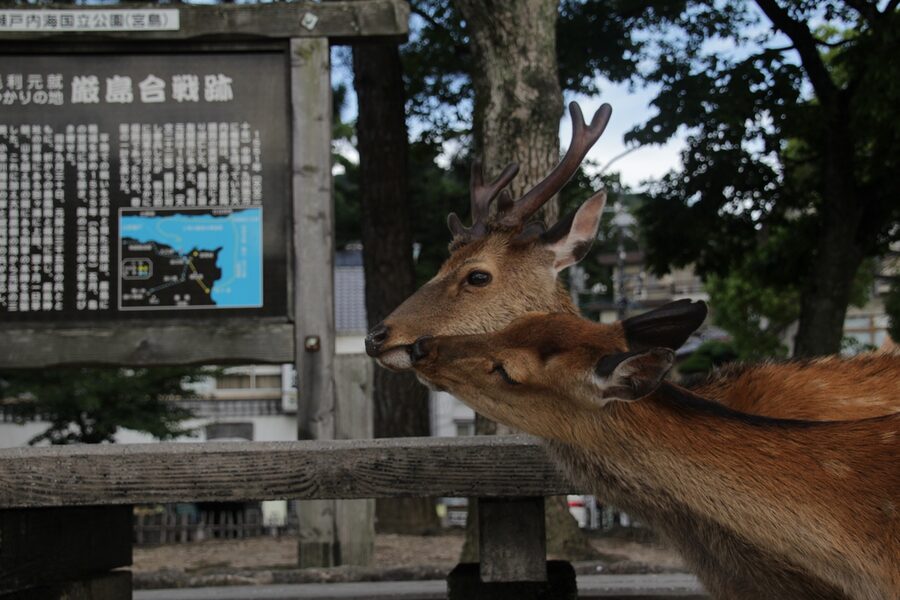
Roughly 600 sika deer live free-range on Miyajima, and they’ve been there about as long as the shrine has. In Shinto tradition the deer are messengers of the kami, so they’ve been legally protected for over a thousand years, and the population has adapted accordingly: the Miyajima deer are fearless, clever, and have a professional-level understanding of how to extract food from tourists.
A few specific practical notes. Do not feed them. The tourist office sells this advice half-heartedly, but every Miyajima regular will tell you the same: the deer have grown increasingly unhealthy from plastic-wrapped snacks fed by visitors, and the town has been trying to wind the behaviour down. Don’t hand-feed. Don’t leave crisps open in your bag — they will get taken, bag and all. Don’t sit down on the grass with a paper bag of momiji manjū next to you. The deer will eat your paper bag.
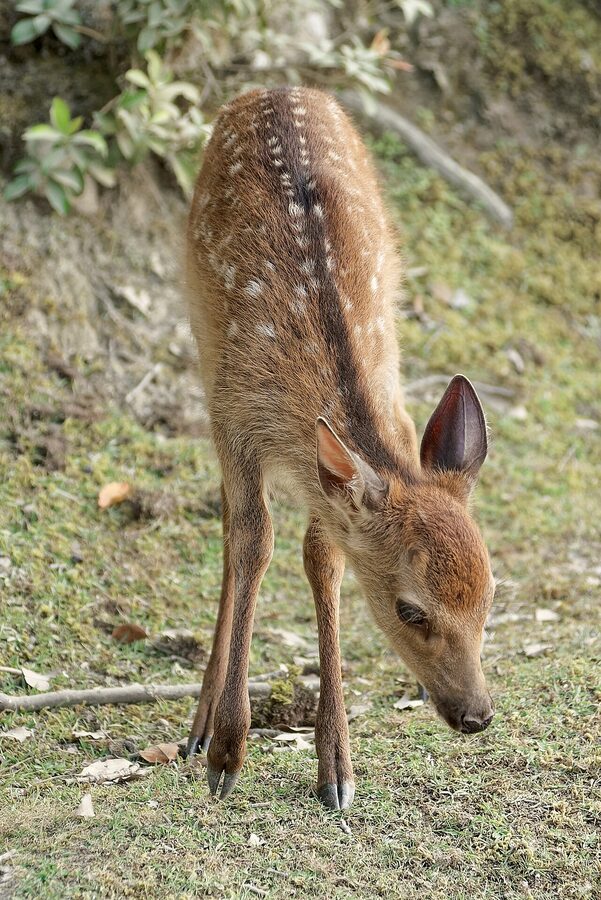
All that said — they’re gentle, they’re famously photogenic, and seeing a stag sleeping on a shrine step at 07:00 with the mist still on the water is one of the better Japanese travel memories you can have.
Mt Misen
The peak that rises behind the shrine — Mt Misen (弥山, 535 m) — is itself a sacred mountain, and the single best thing to do on Miyajima after the shrine. It’s been a site of Shingon Buddhist practice since 806 AD, when the monk Kūkai established a training monastery near the summit. There are three walking routes up (the Momijidani, Daishō-in, and Omoto routes, each about 90–120 minutes uphill) and a ropeway that does 90% of the climbing for you (¥2,000 round trip).
The combined ropeway + short summit hike is what most visitors do, and it’s genuinely worth the 90 minutes. From the upper ropeway station, a 30-minute trail leads through a primeval forest (no logging, ever, because the mountain is sacred) past the 1,200-year-old Reikadō eternal flame — which Kūkai lit in 806 and which has reportedly never gone out — to the summit observation deck. The fire was the source of the flame used for the peace lantern at Hiroshima’s Peace Memorial in 1964.
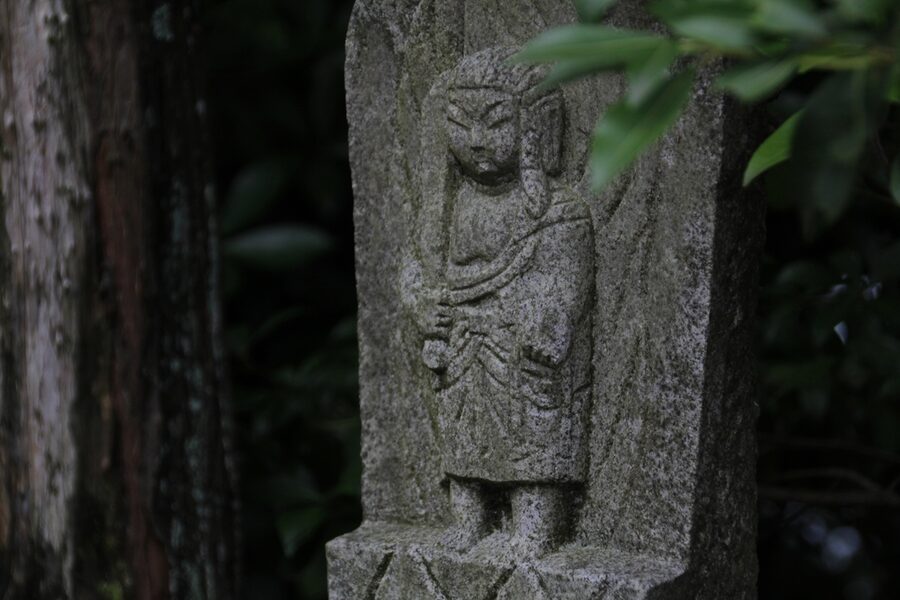
If you walk down rather than taking the ropeway back, the Daishō-in route is the most rewarding descent: 90 minutes, via a cedar forest, past seven small stone shrines, ending at the Daishō-in temple complex (see below). A good set of shoes and about half a litre of water is all you need.
Daishō-in Temple
Daishō-in (大聖院) is the oldest temple on Miyajima — founded in 806 by Kūkai himself, the same monk who established the Mt Misen practice. It sits at the base of the mountain, a 10-minute walk south-east of the shrine along a stream-side path. Most visitors miss it. They shouldn’t.
The temple’s compound is a compressed tour of esoteric Buddhist iconography: the 500 Rakan statues along the entrance stairs, a mandala hall, the Kannon-dō with a 4-metre wooden goddess, an Inari shrine with red gates tucked into the slope, and — most unexpectedly — a small cave called the Henjōkutsu (遍照窟) that houses 88 small Buddha icons representing the Shikoku 88-temple pilgrimage route. Walking the length of the cave once is considered a “virtual” Shikoku pilgrimage. It takes about 90 seconds.
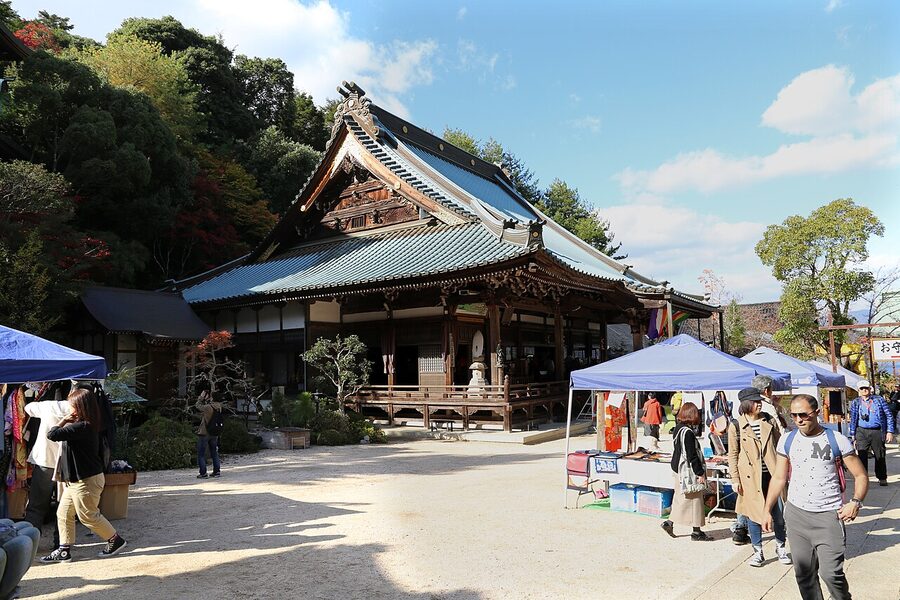
Daishō-in is free. Open 08:00–17:00. Plan 40–60 minutes.
Food on Miyajima: the specific things you should eat
The island has exactly two streets of restaurants — Omotesandō Shōtengai, the main approach from the ferry terminal, and the smaller Machiya-dōri a block back — and the food here is specific. Three things to order.
Grilled oysters (yaki-gaki). Hiroshima prefecture is one of Japan’s largest oyster producers and the rafts you can see offshore from Miyajima are part of the industry. Several stalls on Omotesandō grill oysters in their shells in front of you — ¥400–¥600 per oyster, with a squeeze of lemon or a dab of ponzu. Get two. They are larger and sweeter than the pre-shucked versions you’ll find anywhere else in Japan. See our full Hiroshima oysters guide for where the best ones come from and the season.
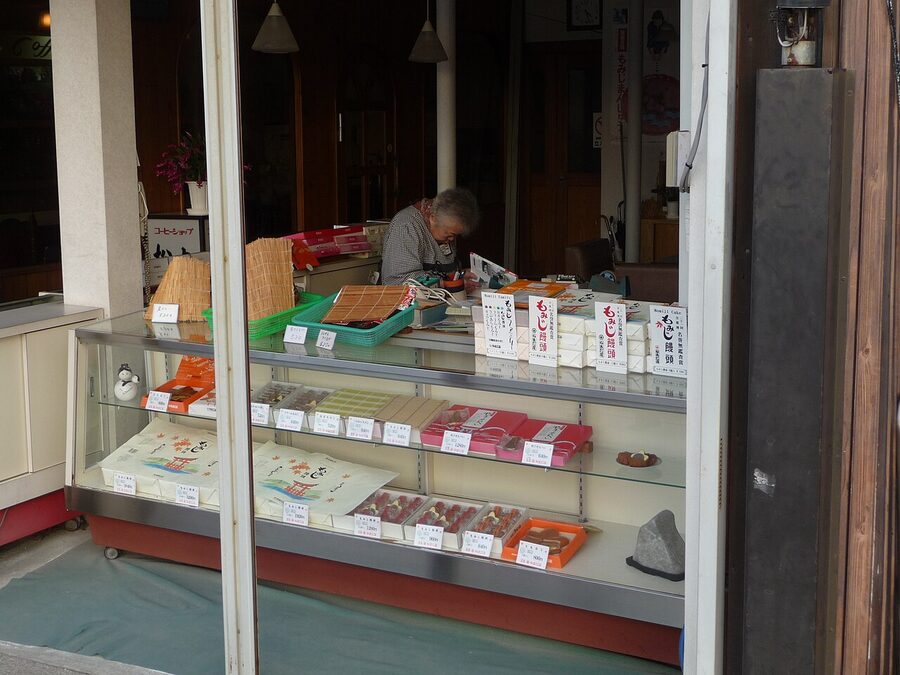
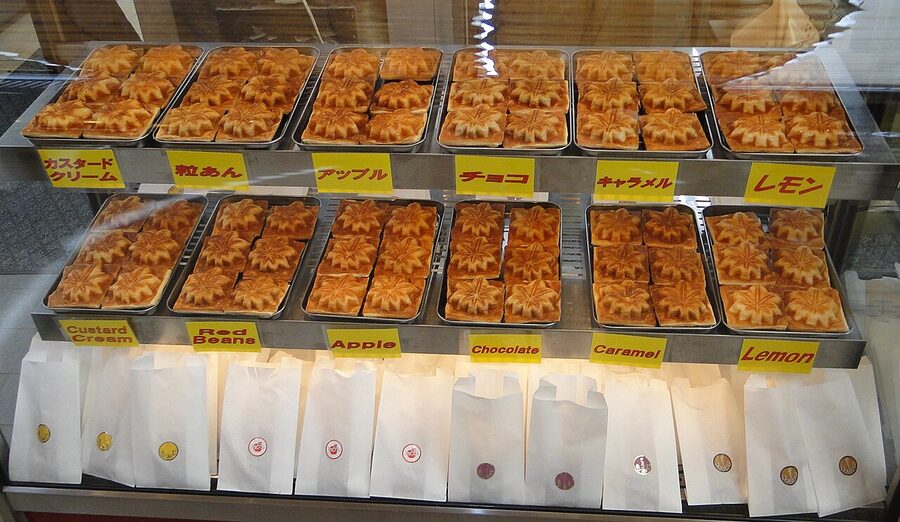
Momiji manjū. The signature souvenir sweet of Miyajima — small maple-leaf-shaped cakes with a red-bean-paste filling, invented here in 1906 by a local pastry chef working for the imperial envoy. You can watch them being made in real-time at Fujiiya or Kitagawa Shōten on Omotesandō; a box of 10 is about ¥1,000. The age-momiji (deep-fried on a skewer) variant is a newer invention — about 2004 — and is surprisingly good. Only one shop, Momiji-dō, sells them.
Anago-meshi. Grilled conger eel on rice — a local take on unagi-donburi using the slightly smaller and more delicate salt-water conger instead of freshwater eel. Ueno near the ferry terminal, open since 1901, is the canonical place; ¥2,800 for a full set, and there will be a queue unless you arrive before 11:00.
Staying overnight
Most visitors do Miyajima as a day trip from Hiroshima. This is a mistake if you can avoid it.
Here’s why: the last ferry back to the mainland runs around 22:14, and essentially every day-tripper leaves between 17:00 and 19:30 — which means from about 19:30 until the first ferry at 06:25, there are perhaps 200 people on an island with 600 deer and one of the most important shrines in Japan. The lantern-illuminated torii at 20:30 is a completely different experience from the daytime one. Sunrise from a shrine-facing ryokan room is another level again.
Iwaso. The island’s grand traditional ryokan — 170 years old, in the Momijidani valley behind the shrine, river-facing rooms, absurdly good kaiseki dinners. ¥40,000+ per person per night. Book two months ahead.
Miyajima Grand Hotel Arimoto. Modern comfortable ryokan-hotel on the waterfront 10 minutes from the shrine, partial sea views, reliable onsen. ¥18,000–¥25,000.
Ryokan Sakuraya. Mid-range, 150-year-old family-run ryokan just off Omotesandō. ¥15,000 including breakfast and an onsen bath.
Guest House Mikuniya. Budget option, dorm from ¥4,500, private rooms ¥9,500. Gets you on the island without breaking the budget — and at this price the 06:45 sunrise experience is still yours.
Practical notes
The island charges a visitor tax of ¥100 per adult per visit, collected automatically when you buy your ferry ticket. Introduced in 2023 to fund infrastructure and conservation. Not optional.
There is no beach swimming on Miyajima — the water around the shrine is part of the sacred precincts, and swimming is forbidden. The island has one small public beach on the south coast (Tsutsumigaura) where swimming is allowed in summer.
The ropeway closes for maintenance two weeks every February; check before you book if you’re planning a Mt Misen day in that month.
There are no chain convenience stores on the island — no 7-Eleven, no Lawson, no Family Mart. The only food options are the Omotesandō restaurants and a small supermarket. Bring cash.
Planning your visit
Half-day. First ferry out, shrine before the coaches, quick Daishō-in visit, lunch of oysters and anago-meshi, back on the 14:00 ferry. You’ll miss Mt Misen. Works if you have only one spare morning in Hiroshima.
Full day. First ferry out. Shrine at high tide. Walk out to the torii at low tide. Mt Misen via ropeway with descent on the Daishō-in route. Dinner and last sunset on the coast. Catch the last ferry back.
Overnight. The correct way. Day one as above, but stay on the island. Morning of day two: sunrise from the torii (about 05:30 in summer, 06:30 in winter), quiet shrine visit before the first ferry arrives, breakfast at the ryokan, return to Hiroshima by mid-morning.
If you’re doing a wider Setouchi trip, Miyajima pairs naturally with a Hiroshima city day (Peace Memorial + okonomiyaki), and with the Shimanami Kaidō cycling route onward to the east. Mihara on the same coast is worth a stop. Kurashiki makes a strong three-night-loop combination.
A quick history: Kiyomori, Kūkai, and the Heike
Miyajima’s continuous religious history is longer than almost anywhere else in Japan that isn’t Kyoto or Nara. The island was considered sacred from the pre-historic Yayoi period — so sacred that commoners were forbidden from living there, and even in the Edo era, births and deaths had to happen on the mainland (the island still has no cemetery). The Itsukushima Shrine’s founding is dated in local tradition to 593 AD, but the version you walk through today is essentially a 12th-century rebuild.
The man responsible is Taira no Kiyomori (1118–1181), a warrior-aristocrat who briefly ran Japan as regent from Kyoto in the 1170s. Kiyomori was Itsukushima’s chief patron — he believed the shrine’s sea-goddesses had brought him his fortune, and his trade empire rested on the Seto Inland Sea routes this shrine commanded. In 1168 he commissioned a radical reconstruction, replacing the modest earlier buildings with the sprawling sea-above pavilion complex that still stands. He donated the Heike Nōkyō, a set of 33 illuminated Lotus Sutra scrolls, one for each of his family members, now a National Treasure and kept in the Treasure Hall.
The shrine became, briefly, the spiritual heart of the Taira clan. In 1185 the Taira were wiped out by the rival Minamoto at the battle of Dan-no-Ura, 80 km west along the same coast — the clan’s young emperor drowned, the clan was annihilated, and the shrine lost its patron. It survived because the Minamoto treated it with respect, and because every subsequent regime — the Ashikaga, the Toyotomi, the Tokugawa — renewed the patronage for their own reasons. The torii has been rebuilt about a dozen times in those 850 years; the shrine buildings slightly less often. The current torii is the 1875 version; it underwent its most recent major renovation in 2019–2022, during which visitors briefly got the rare experience of seeing the gate inside scaffolding.
Separately: Kūkai (774–835), the monk who founded Shingon Buddhism, established a training monastery on Mount Misen in 806 AD, making the mountain one of Japan’s earliest Buddhist pilgrimage sites. The Reikadō (“Eternal Flame Hall”) near the summit still burns the fire Kūkai reportedly lit. That same flame was used in 1964 to light the Flame of Peace at Hiroshima’s Peace Memorial Park; the flame there will be extinguished only when the last nuclear weapon on Earth has been dismantled. It’s an unusually direct line from a 9th-century Buddhist monk to a 21st-century memorial.
When to go: season by season
Miyajima shifts mood dramatically across the year. Any month is worth visiting; each for different reasons.
Cherry blossom (late March–early April). The Momijidani valley behind the shrine has about 200 sakura trees; the climb to Daishō-in is lined with them. Quieter than Kyoto equivalents. Bloom window is usually 28 March to 8 April.
Kangen-sai (mid-June, lunar calendar 17 June). The oldest continuous boat festival in Japan. Three elaborately decorated “dragon boats” carry portable shrines around the island at night, with traditional gagaku court music played live on deck. The torchlit procession to the torii around 22:00 is extraordinary and almost completely unknown to foreign visitors. Check the exact date annually — it shifts by about 10 days year to year.
Summer (July–August). Hottest and most crowded, especially during Obon week in mid-August. The water around the torii is warm enough to wade at low tide. Tsutsumigaura beach on the south coast is open for swimming.
Autumn leaves (mid-November). This is the single best time to visit. The Momijidani — literally “Maple Valley” — is one of the top maple-viewing spots in western Japan, and the red leaves against the vermilion shrine buildings is a combination that makes it onto every Japan autumn-travel poster. Peak usually 15–25 November. Arrive on the first ferry.
Winter (December–February). Dramatically quieter. Snow is rare but occasional — roughly once every three winters you can get the torii dusted in white, which is a photograph worth keeping. The ropeway closes for maintenance two weeks in February. Worth it for the empty shrine at sunrise.
Two festival weeks to actively avoid if you can’t book a ryokan months ahead: Golden Week (late April to early May) and the 15–20 August Obon period. Both put 3–4× the normal volume of day-trippers on the ferry.
The night Miyajima
After 18:30 the day-trippers are gone and the island becomes something else entirely. A few specific things worth doing in the evening.
Illuminated torii. The shrine and the torii are lit from sundown until 23:00, year-round. The sea mist often softens the light into something almost theatrical. Walk the 400-metre shore path from the ferry terminal to the shrine; the best angle is from the small beach directly west of the shrine grounds.
Evening shrine visit. The Itsukushima Shrine compound itself closes at 18:00, but the exterior walkways and the view from the shore stay open all night. Approach from the east along the Arima-no-ura beach — there’s almost never anyone there after 19:00.
Bar Mister Kamata. A small Showa-era backstreet bar about three minutes from the ferry, run by a man in his late seventies who keeps a collection of Seto Inland Sea whiskies. Local regulars, no English menu, opens 20:00. The barrier to finding it is part of the experience — ask at your ryokan for directions.
Miyajima Aquarium after-hours tour. Select Saturdays in summer only; 19:00–21:00; ¥1,400. Small Seto Inland Sea–focused aquarium with a nocturnal sea-creature viewing after hours. Probably not worth planning a trip around but genuinely fun if you happen to be there.
Some photography notes
If you’re here for the photograph, the specific advice your guidebook won’t have.
The classic shot — torii reflected in still water at high tide — needs three things: high tide (check the tide table), no wind (ripples kill the reflection), and golden hour (45 minutes before sunset). These align about two days a month. Multi-day stays on the island are worth it partly for this reason alone.
Alternative angles. The Omoto-Kōen side of the shrine gets the afternoon light on the torii from the west; the view from behind the Kaimon-jinja side-shrine at sunset is less photographed and often better. The ferry approach angle is dramatic at high tide but almost impossible to shoot without strangers’ heads in frame.
Drone. Banned. Don’t even bring one out of your bag. Both the shrine precincts and Mt Misen are no-fly zones enforced seriously; the local police will confiscate the drone.
Tripod. Allowed outside the shrine compound but not inside. There’s a raised stone seawall opposite the torii where serious photographers cluster around sunset; arrive by 16:30 in autumn if you want a spot.
One thing to do before you leave
Walk to the torii at the exact moment the sun sets. It’s not a secret — hundreds of people know — but most of them leave before it actually happens, because the last ferry is tightening their schedule.
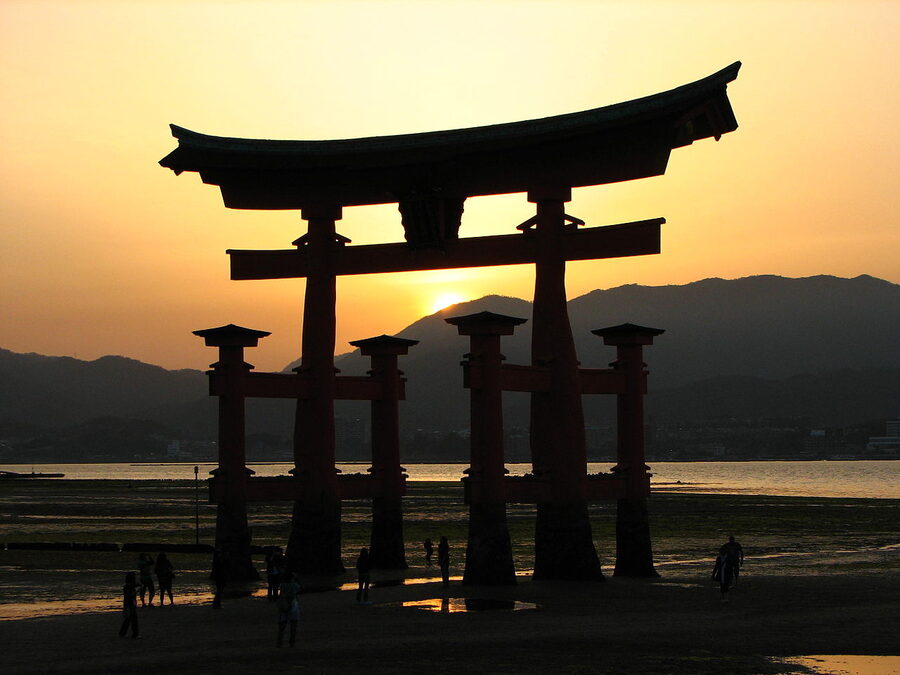
Stay. The sun drops behind the island’s western ridge about 40 minutes before it “officially” sets on the Hiroshima weather forecast, and for the fifteen minutes after that, the sky turns from blue to pink to bronze, and the torii silhouette becomes the single most iconic image in Japanese Buddhism. Take the photograph. Put the phone away. Then walk back to your ryokan.
That’s the version of Miyajima worth telling people about.



