
Most travellers arrive in Okayama and immediately leave. The Shinkansen splits here — north-west to Hiroshima, west over the Seto bridge to Shikoku, east back to Osaka — and for a certain kind of Japan itinerary this city is a transit node, nothing more. A fifteen-minute coffee at the station, a platform change, and you’re gone before the ticker finishes scrolling.
That is, frankly, a mistake. Okayama (岡山) is a compact prefectural capital of about 700,000 people sitting in the widest plain of the Setouchi coast, with one of Japan’s three most famous gardens, a black-walled castle called the “crow”, an 8th-century shrine with a 360-metre wooden corridor, a 400-year-old mercantile culture that invented most of Japan’s favourite sweets, and — if the folklore is to be believed — the birthplace of Momotarō, the peach-boy hero every Japanese child knows. The city deserves a full day. Two, if you include Kurashiki as a day trip.
Kōrakuen: one of Japan’s Three Great Gardens
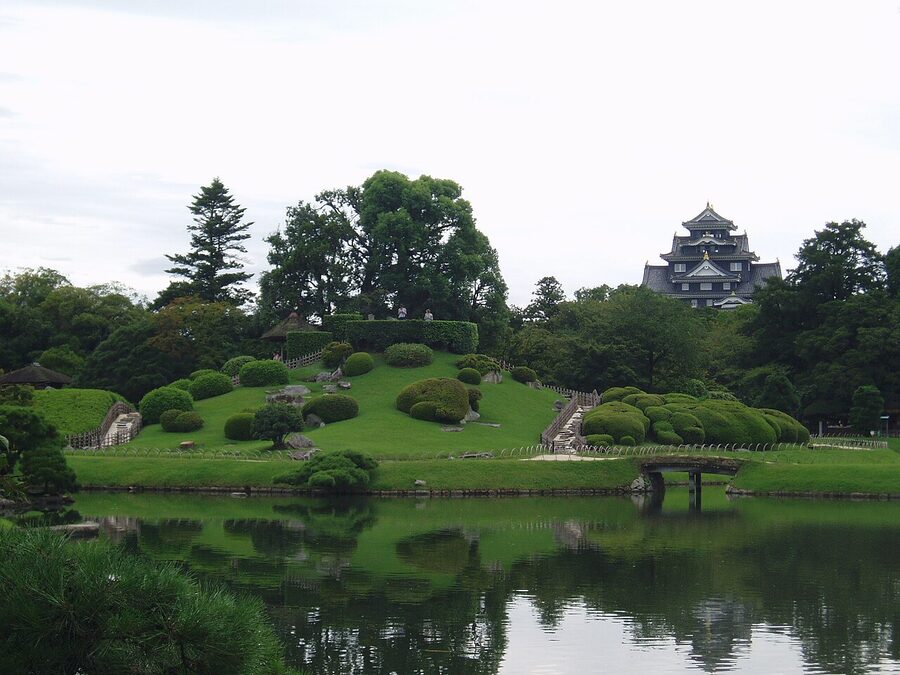
Japan has a loose traditional ranking of its three greatest gardens: Kenroku-en in Kanazawa, Kairaku-en in Mito, and Kōraku-en here in Okayama. The three-way classification is about 150 years old, semi-official, and more or less correct.
Kōrakuen (後楽園) was laid out between 1687 and 1700 by Ikeda Tsunamasa, the second Ikeda lord of Okayama, as a private retreat for the domain’s ruling family. The name comes from a Chinese aphorism: sen-yū-kō-raku — “suffer first, enjoy later” — which was the Ikeda family motto for governance. The garden was opened to the public in 1884 and it’s now a 13.3-hectare site run by the prefectural government.
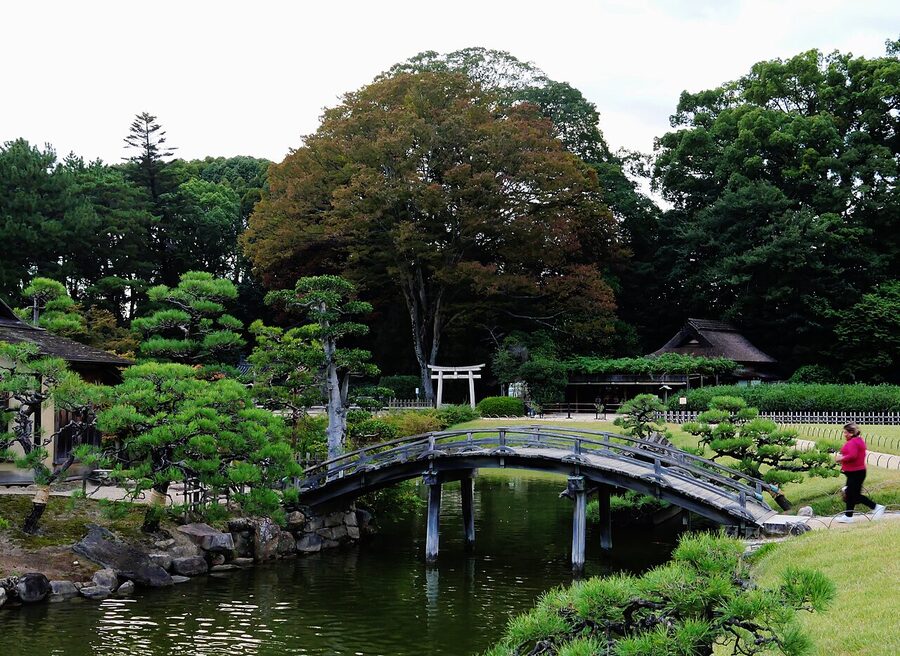
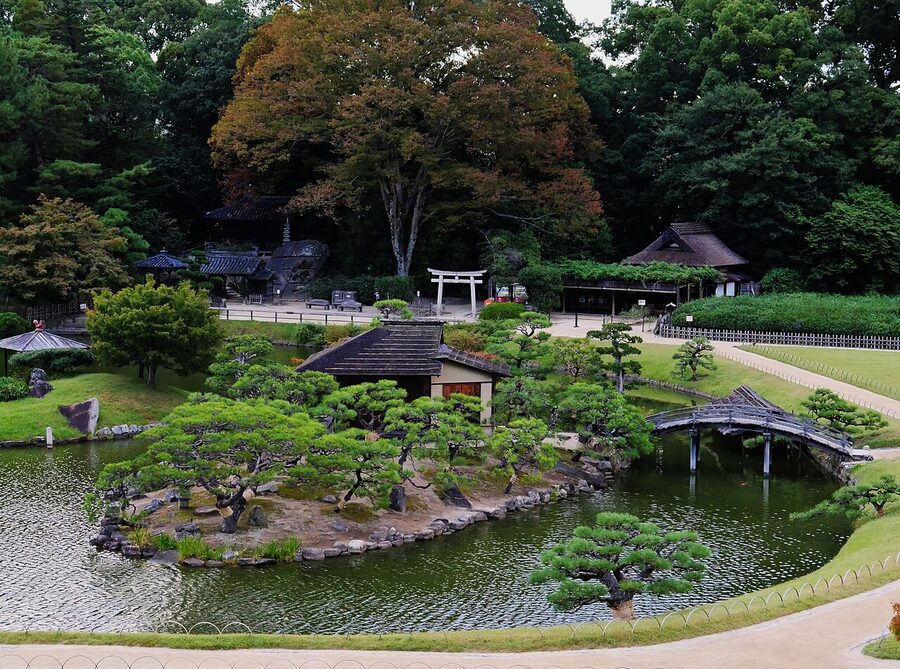
The layout is a kaiyū-shiki — a stroll-style garden — with a main pond (Sawa-no-ike), three islands, half a dozen tea pavilions, and specific seasonal zones: 400 cherry trees in a dedicated grove at the north end, an iris marsh in the middle that blooms in June, a maple grove at the east that peaks in late November, and a rice paddy and tea field on the upper slope that you can harvest in the autumn (staff do the cutting; visitors watch).
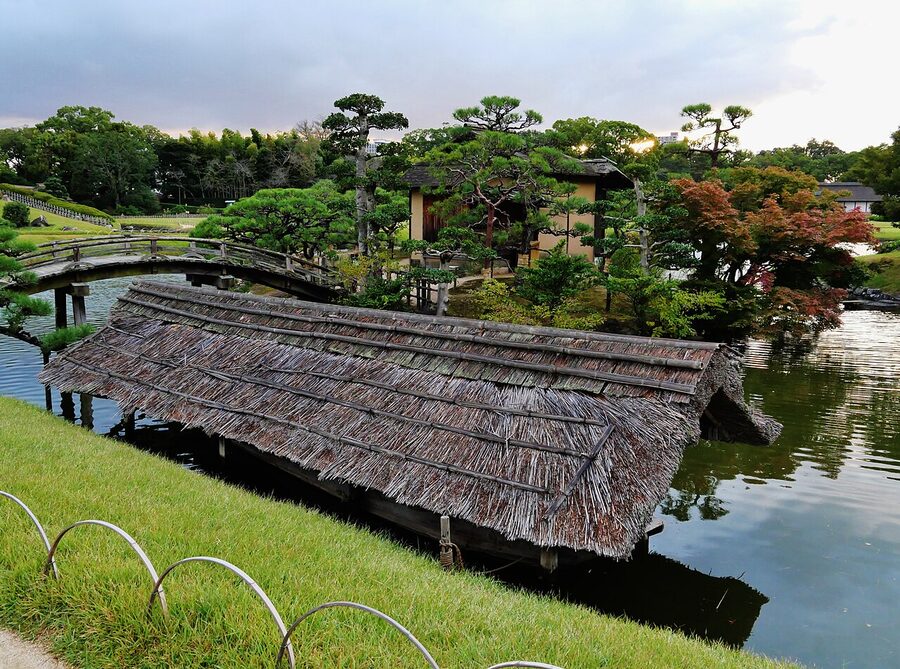
Entry: ¥410 for the garden alone, ¥720 for a combined ticket with Okayama Castle (which is the one to buy). Open 07:30–18:00 from March 20 to September, 08:00–17:00 the rest of the year. Closed December 29–31.
Specific seasonal peaks worth planning around: cherry blossoms late March / early April, irises and early-summer roses in June, komoro lotus flowers in late July, maple kōyō from the second week of November for about 12 days, night illuminations in early August and the third weekend of November. If you have one afternoon in Okayama, this is where it goes.
Okayama Castle: the one they call the crow
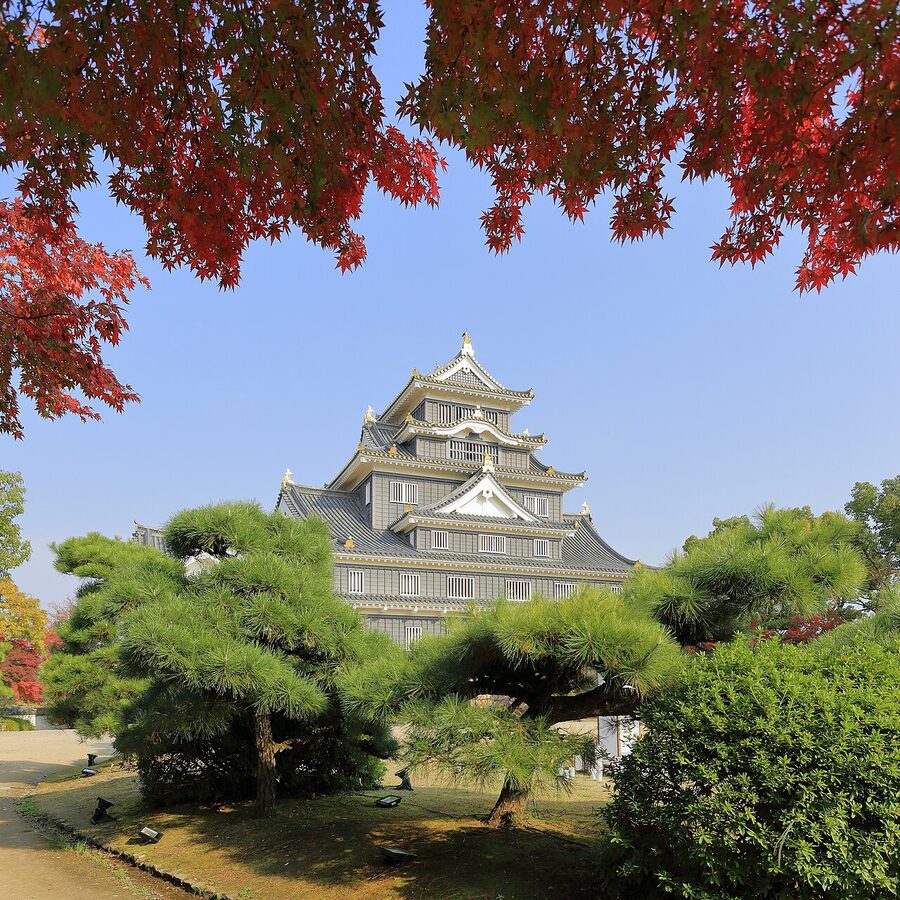
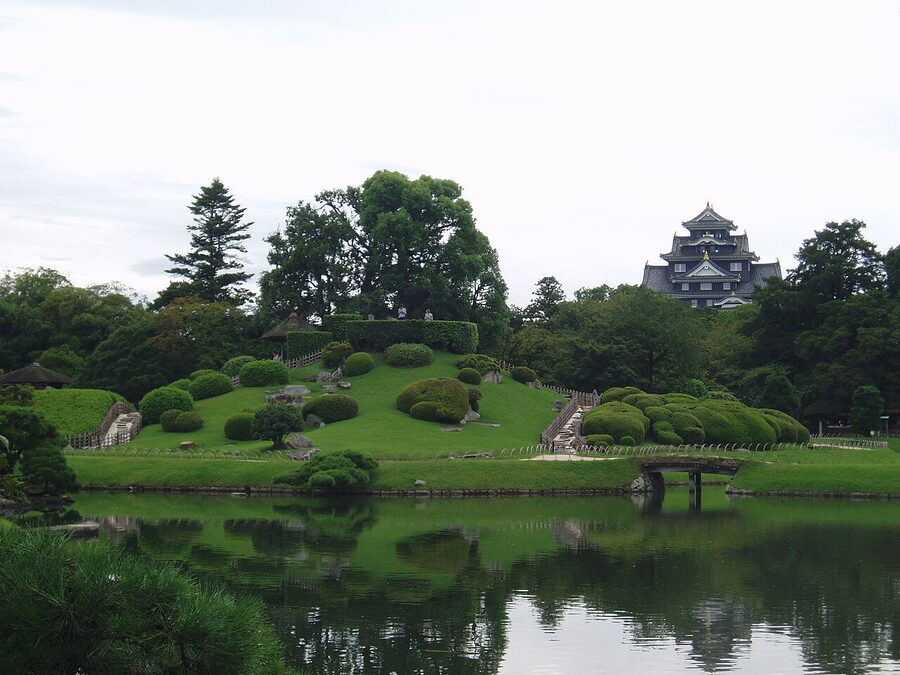
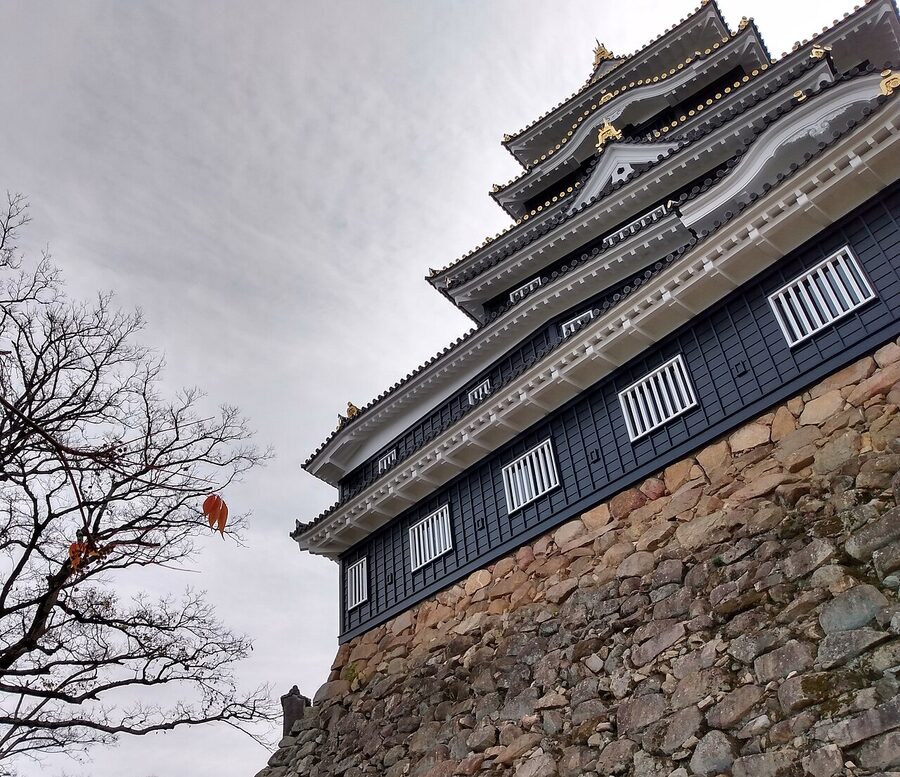
Across the Asahi River from Kōrakuen — 5-minute walk over the Tsukimi Bridge — is Okayama Castle. Its local nickname is U-jō, “the Crow Castle”, because of the black-lacquered wooden panels covering the exterior walls. Most Japanese castles are white. Okayama is black. Its sister castle in colour is Matsumoto in the Japan Alps; the two are often photographed together in guidebooks as the two “black” Japanese castles.
The history is straightforward. The castle was founded in 1573 by Ukita Naoie and completed in its current form by his son Hideie in 1597. The Ukita family picked the wrong side at Sekigahara, the Tokugawa gave the castle to the Kobayakawa and then the Ikeda clan, and the Ikeda ran Okayama Castle and the surrounding domain for the next 270 years.
The original keep was one of the few truly intact five-storey Edo castles to survive until the 20th century, but it was destroyed in the June 1945 US firebombing of the city, which burned most of Okayama to the ground in a single night. The 1966 reconstruction is concrete — not an authentic timber rebuild — so the interior is a modern museum with an elevator rather than original floorboards. The exterior, however, was meticulously researched. Close-up, you can’t tell.
Inside, six floors of museum cover the Ikeda-clan era, samurai armour, the 1945 bombing, and the 2022 renovation (which added a café-restaurant on the ground floor where you can taste a recreated Ikeda-family tea). The top-floor observation deck gives you the canonical composition across the river back at Kōrakuen — this is where you take the postcard.
Entry: ¥400 castle only, or included in the ¥720 combo with Kōrakuen. Open 09:00–17:30. Allow 60–90 minutes.
Kibitsu Shrine and the Momotarō origin story
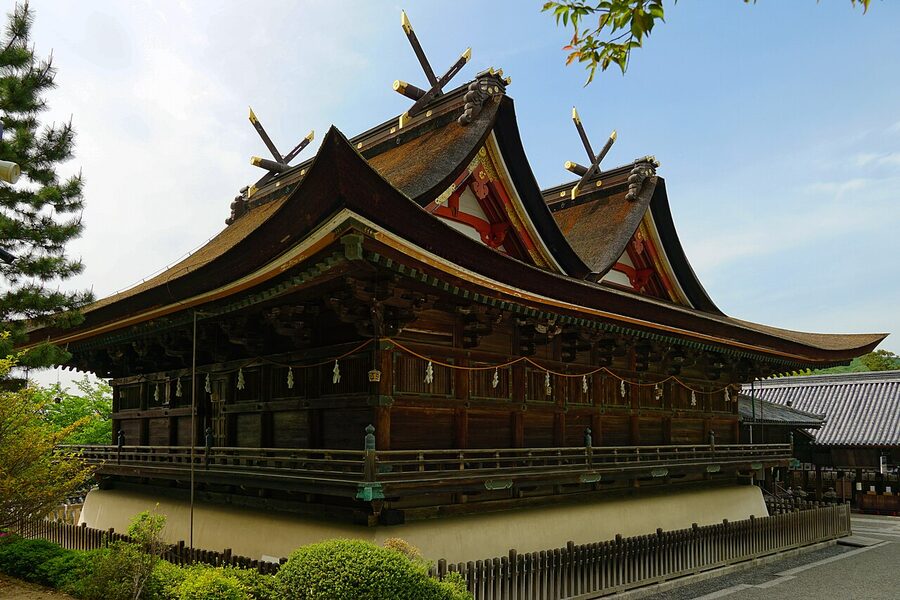
Fifteen minutes west of Okayama city on the JR Kibi Line is Kibitsu Jinja (吉備津神社) — arguably Okayama prefecture’s most historically important Shinto site. It’s been here since at least the 8th century. The main hall, rebuilt in 1425, is a National Treasure, and the shrine’s unique “Kibitsu-zukuri” roof-style survives nowhere else in the country.
The shrine enshrines Kibitsuhiko-no-Mikoto, a 4th-century prince who, according to the Kojiki, was sent by the imperial court to subdue a demon called Ura who was terrorising the Kibi plains (the old name for Okayama). The fight takes place, Kibitsuhiko wins, the demon’s head is buried under the shrine grounds. For the next sixteen centuries the shrine held a ceremony where the demon’s head supposedly groans if there’s an impending disaster (spoiler: Kibitsu is still there, and people still listen). It’s called the Naru-kama shinji ceremony. You can attend — ¥3,000, by prior booking — and it is genuinely odd.
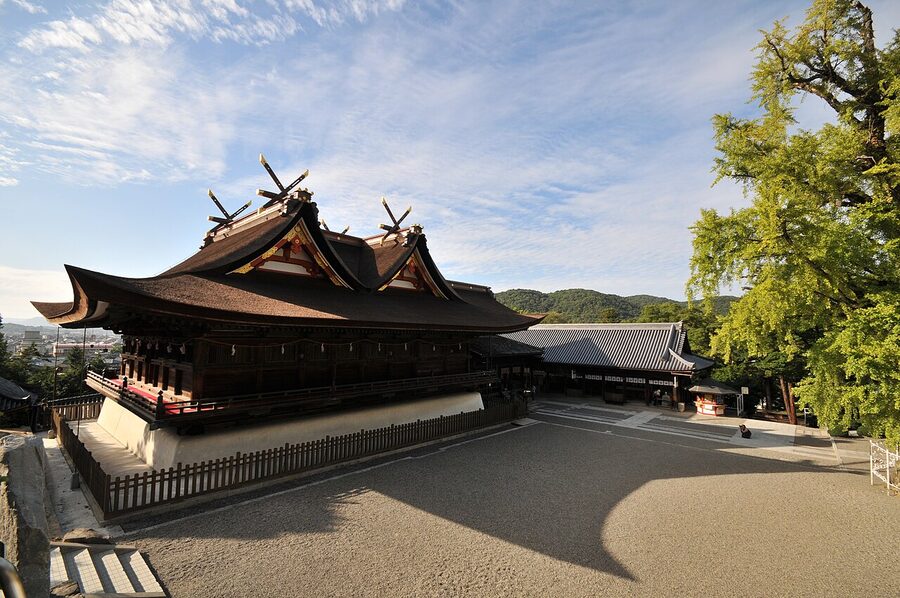
Here’s where it gets folklorically interesting. Over the centuries the Kibitsuhiko-vs-Ura myth drifted into folk tale. The prince became a peach-farmer’s adopted son born from a peach. The demon got relocated to an offshore island. The retainers became a dog, a monkey, and a pheasant. This is Momotarō, the most popular folk tale in Japan, and the kids’ version elides most of the brutality in the Kibitsu original. If you know the story, you’ve essentially heard the Kibitsu myth.
Okayama has leaned into this heavily. The main shopping street outside Okayama Station is called Momotarō-ōdōri (Peach Boy Avenue). The station itself has a bronze statue of Momotarō at the east exit. Kibi-dango — millet dumplings — are the city’s signature souvenir because the folktale says the Peach Boy fed them to his demon-fighting animal friends. The baseball team is the Omuninori. Everything leans into the peach.
Kōrakuen by season
The garden itself warrants a full paragraph on timing because it changes so dramatically across the year. Kōrakuen (後楽園) is one of Japan’s Three Great Gardens (alongside Kenrokuen in Kanazawa and Kairakuen in Mito), and unlike those it’s designed as a “stroll garden” — the visitor walks a continuous route past engineered views, rather than sitting and contemplating from one fixed point.
Spring (late March-early April). Plum blossoms first in late February, then ~100 cherry trees peak around 1-8 April. The garden runs evening illumination (“Fantasy Garden”) for 10 days during the cherry bloom, 18:00-21:30, ¥800.
Early summer (May-June). Iris Garden peaks around 25 May-5 June — several hundred iris plants lining a specific pond; genuinely one of the best iris displays in western Japan. Peonies bloom mid-April and azaleas carry through May.
High summer (July-August). Lotus in the Zawanoyo pond peaks late July. The garden opens at 07:30 in summer (the Hayaasa-no-Kōrakuen pre-breakfast viewing), which is how to see the lotus petals still closed before the sun fully hits them.
Autumn (mid-November). The Mochigatsu momiji peak around 15-25 November. Evening illumination runs again for 10 days during peak; this is the most-photographed Kōrakuen configuration. Crowds are heavy but the garden is large enough to absorb them.
Winter (December-February). The white rice-field “tanbō” in the garden’s northern section is at its prettiest in snow, when it happens — maybe 3-5 days a year in Okayama. The rest of the garden goes quiet; camellias, early plum. Crowds are at their thinnest, which is a pleasure in itself.
The Kibi plain cycling route
The flat 17-km Kibiji cycling course runs from Bizen-Ichinomiya Station (one stop west of Kibitsu) along a dedicated cycling path through the old Kibi plain, hitting four of the region’s most important cultural sites in a straight east-west line: Kibitsuhiko Jinja, the 5th-century Tsukuriyama Kofun (the fourth-largest ancient tumulus in Japan), Bitchū Kokubun-ji Temple with its five-storey pagoda, and Ki no Jō Castle ruins. It’s one of the best self-guided day trips in the Chūgoku region.
Bike rental at Bizen-Ichinomiya Station: ¥1,200 for a half-day, ¥1,500 full day, electric-assist bikes ¥1,800. You return the bike at Sōja Station at the western end. The ride takes about 3½ hours with stops. Almost entirely flat, almost entirely on dedicated bike paths, very well signed.
The Okayama food scene
Okayama has a better food reputation than its size would suggest, partly because the Ikeda domain was historically fruit-obsessed and partly because the Seto Inland Sea in front of it produces some of Japan’s best seafood.
White peach (hakuto). Okayama’s signature fruit. In season mid-July through mid-August. Grown exclusively in the Kibi hills west of the city. These are the delicate, white-fleshed, floral peaches — not the stony ones from the supermarket. A single perfect one at Chayamachi Farm Parlor or Fruit Parlor Chiba costs ¥1,500–¥2,000. Peach parfaits, about ¥2,500. The peach tart at Chiba is the order.
Muscat of Alexandria grapes. Same farmers, same hills, different crop, roughly the same absurd price. In season September–October.
Demi-katsu-don. A peculiarly local Okayama comfort food: a pork katsu on rice, smothered in a thick French-style demi-glace sauce rather than the Osaka/Tokyo egg-and-onion. The inventor was a 1930s Okayama restaurant called Nomuraya, which is still open, four generations in. ¥900.
Bara-zushi. The local take on chirashi sushi: scattered over rice with mamakari (pickled herring), conger eel, and a specific five-vegetable mix. Eaten at Aburiya in the Omotechō arcade, ¥1,400.
Mamakari. The same pickled Setouchi herring you’ll find in Kurashiki. Eat with beer.
Kibi-dango. The millet dumplings. Almost more of a souvenir than an actual meal. Koeidō‘s original shop on Omotechō is the place.
The night izakaya scene is concentrated in the Omotechō and Nishigawa Ryokuchi areas, both walkable from the station. The best single walk for dinner is from the castle, along the Nishigawa canal park, to Omotechō arcade.
Other places worth a short visit
Hayashibara Museum of Art — just north of the castle. A compact single-building collection of Ikeda-family artefacts and medieval Chinese/Japanese paintings. Pricey at ¥600 for a small museum but genuinely good. Allow 45 minutes.
Okayama Orient Museum — the best collection of Middle Eastern and Persian antiquities in western Japan, donated by the Hayashibara pharmaceutical family after they happened to pick up a Mesopotamian cuneiform tablet at a London auction in the 1960s and kept collecting. ¥500. An hour.
Nishigawa Canal Park — the 2.5-km north–south linear park that follows the old samurai-district drainage canal. Cherry-tree lined, fountains, cafés, one of the best urban-park strolls in Japan that nobody outside Okayama talks about.
Omotechō arcade — covered shopping arcade from station to castle area. 1.1 km long. A functioning local street rather than a tourist show; this is where you buy school uniforms, umbrella, and kimchi.
And, of course, Kurashiki. The Bikan canal quarter is 17 minutes west of Okayama Station on the JR Sanyō Main Line. Most people do it as a day trip from Okayama. If you’re in the city for two days and one night, this is how the second day goes — see our full Kurashiki guide for the walking route.
Getting there
By Shinkansen. Okayama Station is a Nozomi stop — the fastest service. From Tokyo 3 hours 15 minutes (¥17,500), Osaka 45 minutes (¥5,500), Hiroshima 35 minutes (¥6,000), Fukuoka 1h 40 (¥13,500). Okayama is the most connected mid-sized city in western Japan; if you’re going anywhere in the Chūgoku region by rail, you change here.
By plane. Okayama Momotarō Airport (OKJ) — 30 minutes by bus from the station (¥780). Daily flights from Tokyo Haneda (70 min), Sapporo, Okinawa, and selected international routes (Seoul, Shanghai, Hong Kong, Taipei).
From Shikoku. The Seto-Ōhashi Line Marine Liner express from Takamatsu crosses the Seto-Ōhashi Bridge in 55 minutes. ¥1,550. One of Japan’s most scenic regular-service trains.
Getting around. The city is walkable — station to castle is about 25 minutes. Trams (Okaden) run from the station to the castle district for ¥100–¥140 flat. Rental bikes at the tourist office outside the east exit of the station, ¥1,000/day. JR Kibi Line trains to Kibitsu / Kibitsuhiko / Bizen-Ichinomiya depart roughly every 30 minutes from platform 9.
Where to stay
Okayama Koraku Hotel — the high-end traditional option. Right beside the garden’s main gate, with in-room Kōrakuen views for the top suites. ¥25,000+ including breakfast.
Hotel Granvia Okayama — the flagship JR-group business hotel, directly attached to Okayama Station. ¥14,000–¥22,000. Excellent access, weak atmosphere.
Dormy Inn Premium Okayama — the reliable mid-range chain option. ¥9,500–¥14,000. Rooftop onsen, free ramen at 22:00, comfortable rooms.
Koraku Guesthouse — a renovated machiya in the Nishigawa area. ¥5,500 dorm, ¥9,800 private room. Young staff, some English, decent atmosphere.
If you have the option, the Ryokan Kurashiki in the Kurashiki Bikan district (35 minutes away) is the standout regional ryokan and significantly more atmospheric than any Okayama-city option. Many travellers base there and day-trip into Okayama, rather than the other way round.
Planning your visit
Half-day (3–4 hours). Kōrakuen + Okayama Castle combo ticket, one lunch at Nomuraya or a peach parfait, back on the Shinkansen. Works if you’re transiting.
Full day. Morning at Kōrakuen, lunch in Omotechō, afternoon at the castle + Hayashibara Museum, Nishigawa canal walk, dinner and tram back to the station.
Two days. Day one: Okayama city as above. Day two: morning Kibi Plain cycling route (Kibitsu Shrine, Tsukuriyama Kofun, Bitchū Kokubun-ji pagoda), afternoon Kurashiki Bikan Quarter, dinner and back.
Three days. Add a day for Tsuyama (1 hour north — castle ruins and merchant streets) or a Seto Inland Sea island day (Naoshima is 1 hour by train+ferry from Okayama — art installation island).
The small thing almost nobody mentions
At 07:30 on any weekday morning, Kōrakuen’s East Gate is opened by an elderly gardener who rakes the central gravel before the first visitors arrive. The gravel is raked in a specific pattern — a series of wave lines that runs east-west around the main pond. If you get to the garden right at 07:30, you’ll catch the last of the raking being finished and you’ll get to walk paths that have not yet been stepped on by anyone else that day. The morning light on the pond is flat and cool and better than the afternoon photograph everyone else takes.
Go early. The whole of Kōrakuen takes about 90 minutes to walk properly. If you do it first, with the gate literally just opened, you’ll have the garden almost entirely to yourself for the first 45 of those minutes. By 09:15 the coach tours arrive and the composition of the photograph changes entirely.
Then walk across Tsukimi Bridge, eat a peach, look at the crow castle, and catch the 11:30 Shinkansen west. You will remember the morning for years.



