
Western Japan — the Chūgoku region — is the quiet end of the country. If you’ve done Tokyo, Kyoto, and Osaka, and you’re wondering where else in Japan actually rewards a second trip, this is it. Five prefectures along two parallel coasts, a large enclosed sea (the Setouchi) in between, a handful of remote islands beyond, and a specific unhurried rhythm that the major cities lost decades ago.
This page is the big-picture orientation. What the region is, why it’s different, and how its pieces fit together.
The five prefectures
Chūgoku — literally “Middle Country” — is the western third of the main island of Honshū. It sits between Kansai (Kyoto-Osaka) to the east and Kyūshū to the west. Five prefectures, each with a distinct coastal orientation.
Hiroshima, on the Setouchi side, is the best-known for visitors because of the Peace Memorial and Miyajima. It’s also the oyster-farming capital of Japan. Its other destinations — Mihara, Miyajima, the Setouchi oyster coast — are what this site focuses on.
Okayama is the next prefecture east, on the same coast. Drier (statistically Japan’s sunniest prefecture), more agricultural, home of Kurashiki’s canal quarter, Okayama city, and the inland castle town of Tsuyama. Also the country’s main producer of denim and white peaches.
Shimane, on the opposite side of the range, is the San’in coast — the “shadow side” facing the Japan Sea. Older, wetter, quieter. Home to Izumo Taisha, Matsue, the Oki Islands, and parts of Japan’s most remote-feeling coastline.
Tottori is Japan’s smallest prefecture by population. Wedged between Shimane and the Hyogo border, it’s defined by the sand dunes on its north coast, Mount Daisen on its west, and an oddly productive folk-craft scene around Yonago and Sakaiminato.
Yamaguchi is the western tip of Honshū, with coasts on both sides. The Shinkansen ends at Shimonoseki before passing under the Kanmon Strait to Kyūshū. Key destinations: Hagi, Yamaguchi city, Iwakuni, and Yanai on the Setouchi side.
Two coasts, one sea
The geography that defines the region is the double-coast layout. The San’yō coast (southern side) faces the Seto Inland Sea — sheltered water, warm climate, dense population, the Shinkansen. The San’in coast (northern side) faces the Japan Sea — rough winter storms, cooler, quieter, older, and the only major train line is the slower JR San’in Main Line. Between the two runs a chain of mountains called the Chūgoku Range, roughly 1,000-1,700 metres tall.
This physical divide is the whole reason western Japan has two distinct cultural registers. The San’yō side is the “modern” side — bullet trains, industrial cities, coastal shipping. The San’in side is the “traditional” side — folk tales, ancient shrines, smaller towns. Both are worth travelling; the contrast between them is part of what makes the region interesting.
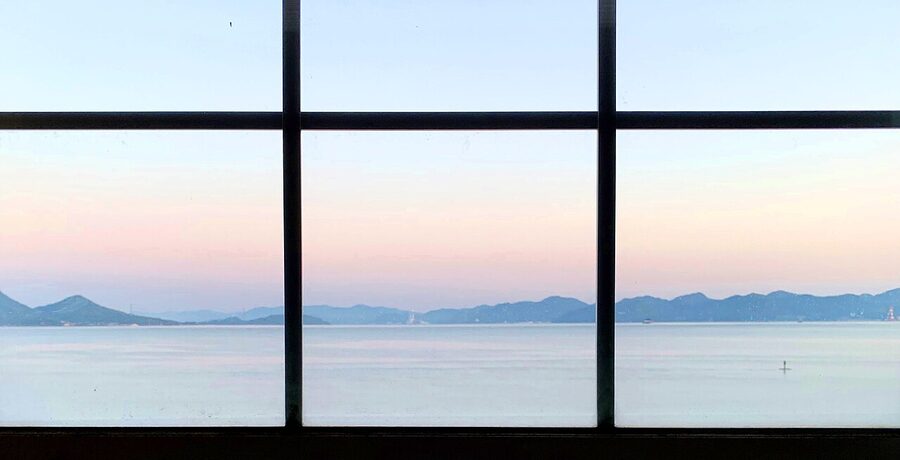
The Setouchi itself — the enclosed inland sea — is where most of the islands are. The Shimanami Kaidō cycling route crosses it between Onomichi and Imabari. Ferries link Hiroshima, Matsuyama (on Shikoku), and smaller island ports. The sheltered water allowed 2,000 years of coastal trade and is why towns like Mihara and Onomichi developed as ports.
When to visit
Western Japan’s climate is milder than either Tokyo’s or Hokkaido’s but not tropical. Four proper seasons.
Spring (late March – mid May) is cherry blossom season, which peaks in the last week of March on the San’yō side and the first week of April on the San’in side. Tsuyama Castle, Hiroshima’s Peace Park, and Kurashiki’s canal are all on the Japanese top-100 sakura list. Late April brings the peony season at Yūshien Garden near Matsue.
Summer (June – August) is hot, humid, and festival-heavy. June is the rainy season (the tsuyu). July-August sees the Mihara Yassa Matsuri, the Kangen-sai boat festival on Miyajima, and the Yanai Goldfish Lantern Festival. Good for island-hopping and coastal activities.
Autumn (mid October – late November) is the single best time to visit Western Japan for foliage. Mount Daisen’s beech forests, Miyajima’s Momijidani valley, Kurashiki’s Ivy Square ginkgo, and the Buttsuji temple grounds in Mihara are all top-tier autumn destinations. Peak bloom runs 5-25 November across the region.
Winter (December – February) is the quieter season. The San’in side gets occasional snow; Mt Daisen runs as a ski resort. November-March is oyster season on the Hiroshima coast and snow-crab season on the San’in side. Hot springs feel particularly earned in January.
Getting around
The Shinkansen (San’yō line) runs the length of the southern coast — Osaka to Hakata — with stops at Himeji, Okayama, Hiroshima, Iwakuni, Yamaguchi (Shin-Yamaguchi), and Shimonoseki (Shin-Shimonoseki). Fast. Modern. Mostly what foreign visitors already know.
The San’in Main Line is the slower local rail line on the northern coast — no Shinkansen, occasional limited-express services, and a lot of single-carriage trains through rice fields. Slower travel; better scenery. The trip from Kyoto to Shimonoseki via the San’in coast takes a long 15 hours and is one of Japan’s great under-rated train journeys.
Connecting the two are several north-south train lines through the Chūgoku range — the Yakumo limited express from Okayama to Izumo-Yonago, the San’in Main Line’s Masuda branch, the Geibi line inland from Hiroshima. Most of them are gorgeous, all of them slow.
If you’re planning a trip: the JR West All Area Pass covers everything in the region for 5 or 7 days. The cheaper San’in-Okayama Area Pass (¥5,000 for 4 days) is a better deal if you’re only doing the Chūgoku loop. Both require foreign passport registration.
A suggested seven-day trip
The standard Chūgoku loop from most travellers’ starting point (Kansai airport or Tokyo):
Day 1-2. Train to Hiroshima. Peace Memorial and Miyajima (see Miyajima guide). Night one in Hiroshima city, night two overnighting on Miyajima itself.
Day 3. Train east to Mihara or Kurashiki. Canal quarter, Ohara Museum, Ivy Square. Night in Kurashiki.
Day 4. The Yakumo limited express north across the mountains to Izumo or Matsue. Izumo Taisha, Inasa Beach. Night in Matsue.
Day 5. Matsue castle, Adachi Museum, Horikawa boat tour. Day trip or overnight in Yonago for the Mizuki Shigeru Road.
Day 6. East along the San’in coast to Tottori. Sand dunes. Night in Kaike Onsen or the Uradome coast.
Day 7. Train back to Kansai via Himeji (castle + detour). Home.
Variations: add two days to do Hagi on the western coast, or swap Tottori for the Oki Islands if you’re fine with a 2-hour ferry. Both are worth it.
