
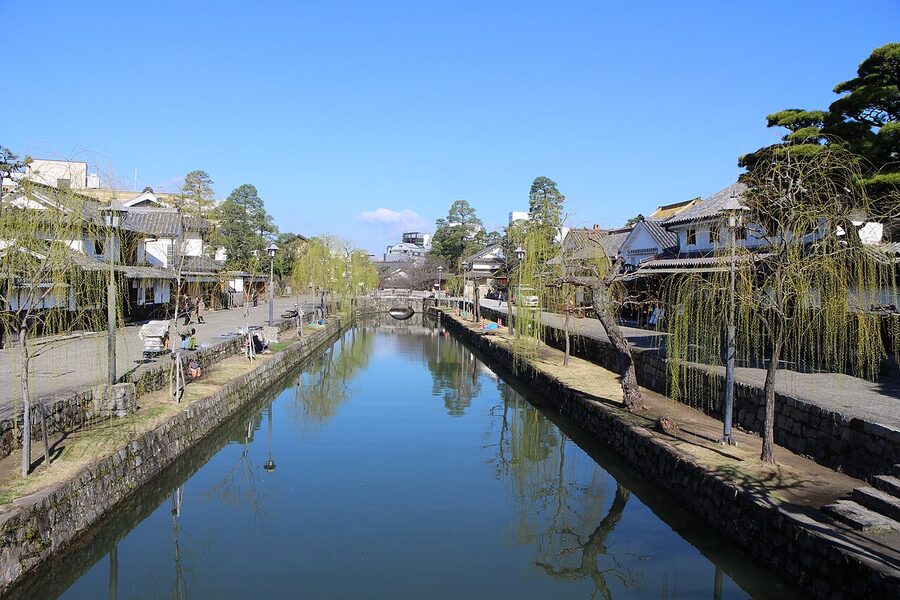
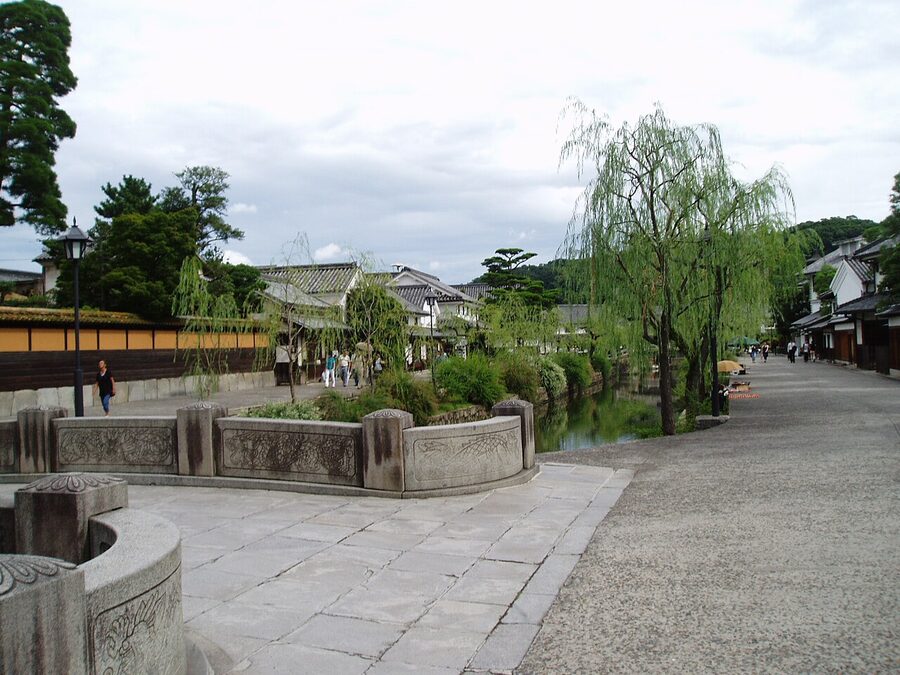
Most Japanese towns that look like film sets don’t feel like them. Kurashiki does both. You step off the shinkansen transfer at Kurashiki Station, walk fifteen minutes south through a standard regional shopping arcade, turn left, and fall through a hole in the 21st century into what feels like Edo-period townscape set-dressing. Willow trees drag their branches in a grey-green canal. A flat-bottomed wooden boat ducks under an arched stone bridge. White-plastered walls with black-tiled inlays rise on either side. A pair of resident swans glides past. All of it is real.
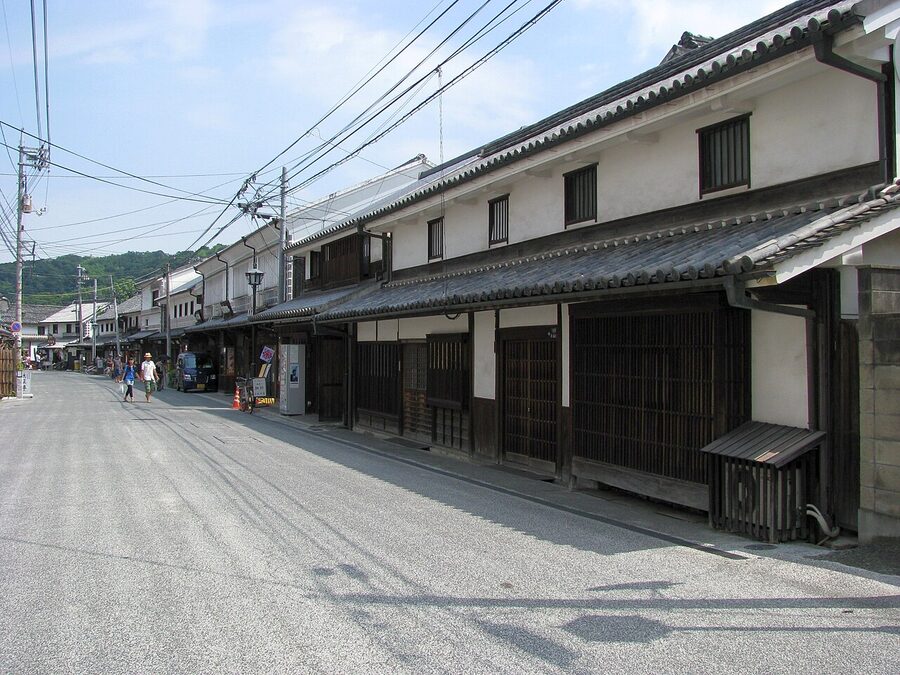
Kurashiki (倉敷) — the name literally means “warehouse district” — was a rice-trading hub in the 17th and 18th centuries. The shogunate’s rice tax for western Japan piled up here in a quarter of blindingly white-walled granaries built out of two materials: fireproof shikkui plaster and the diamond-patterned tile called namako-kabe, so named because it resembles the armour of a sea cucumber. When the rice economy collapsed in the Meiji era, the merchants who’d built the warehouses pivoted to cotton, textile mills, and — in one extraordinary case — to collecting French Impressionist paintings. The result is the Bikan Historical Quarter (美観地区, “Beautiful Sight District”), arguably the best-preserved Edo-period merchant townscape in Japan, sitting in a prefecture that most foreign visitors skip entirely.
What makes Kurashiki different
If you’ve been to Takayama, Kawagoe, or Kanazawa’s Higashi Chaya district, you already know the Japanese genre of “preserved historical quarter.” Kurashiki is that, but with two distinguishing features.
The first is the canal. The Kurashiki River was engineered in the Edo period specifically to move rice from inland Okayama down to the Seto Inland Sea, and the whole Bikan was laid out along its banks. This gives you something most other preserved quarters don’t: a central navigable waterway, stone bridges at regular intervals, willows, and a daily programme of traditional punt-boat rides (Kurashiki-kawabune) with boatmen in straw hats and faded indigo jackets. Twenty minutes, ¥500 per adult, tickets from the small booth beside the Nakabashi bridge. Yes, it’s a tourist ride. Yes, it’s worth doing.
The second is the Ohara effect — I’ll come back to this — which injected a dose of serious Western art, modernist architecture and cotton-mill industrial history into what would otherwise be a standard preserved townscape. It’s the reason the quarter reads as somewhere with a real, specific history rather than a themed backdrop.
The Ohara Museum of Art
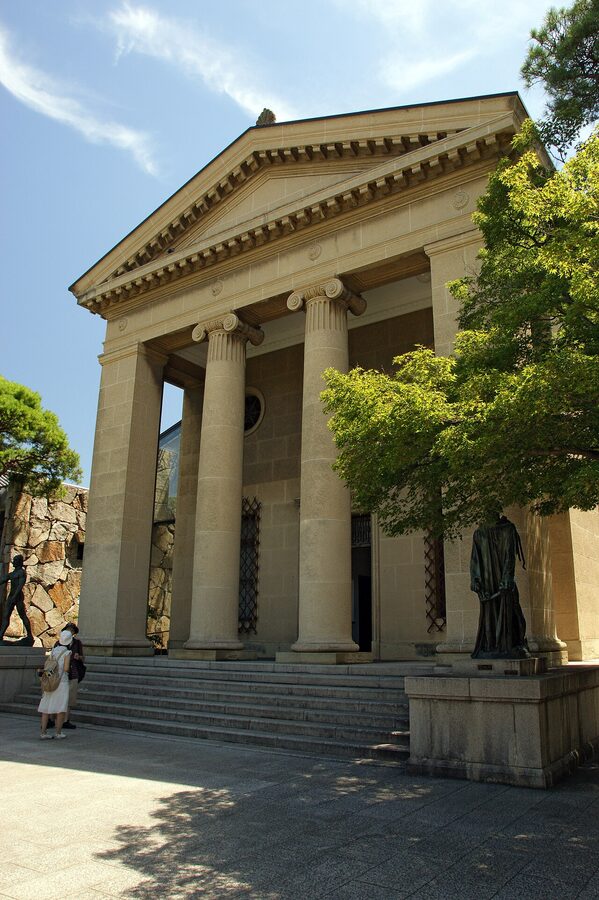
In the 1920s, a Kurashiki textile magnate called Ohara Magosaburō — who’d inherited and expanded his family’s cotton-mill fortune — was funding a young local painter named Kojima Torajirō. Kojima had studied at the Tokyo School of Fine Arts and wanted to learn directly from European painters. Ohara sent him to Europe three times. Kojima spent most of his time in France, sending home paintings he bought directly from the artists and from Parisian galleries: Monet, El Greco, Gauguin, Matisse, Renoir, Rodin, Cézanne. These were not prints or lithographs. These were canvases.
Kojima died suddenly in 1929. The following year Ohara built the museum as a tribute. When it opened, it was the first privately owned museum in Japan exclusively dedicated to Western art — not just in Kurashiki, in the entire country. Most Japanese people had never seen a Monet in person. You could, in Kurashiki.
The collection has expanded steadily since. It now runs to something like 3,000 works across four buildings (the main hall, the Craft Annex, the Asian Art Annex, and a separate museum shop with its own small exhibition space). Highlights include El Greco’s The Annunciation (acquired directly from a Paris dealer in 1922 — basically the first significant El Greco outside Europe), Monet’s Water Lilies (Kojima bought it personally from Monet at Giverny), and a major Gauguin oil from the Tahitian period. There’s also a very good collection of Japanese post-war ceramics in the Craft Annex, which most visitors skip and shouldn’t.
Entry is ¥2,000 for the full complex (separate sections have cheaper individual tickets if you only want one hall). Open 9:00 to 17:00, last entry 16:30. Closed Mondays and the New Year period. It’s small by international-museum standards — two hours is enough — and the ticket is expensive, but this is an essential stop in Kurashiki. If you skip the Ohara you’ve essentially skipped the reason the town looks the way it does today.
Walking the canal: a route that works
The Bikan is compact enough to wander without a plan, but the walk is better done in a specific order. Here’s the one I use every time I bring somebody.
Start at Kurashiki Station, head south down the Kurashiki Center Street covered arcade, and turn left onto Ebisu-dōri. This spits you out at the first arched bridge — Imabashi — which is where the canal view really starts. Don’t cross it yet. Walk along the north (left) bank first.
After about 200 metres you’ll reach Nakabashi bridge. The boat dock is on the opposite (south) side of the canal here. Book your boat slot now — they sell out by noon — and carry on. Another hundred metres puts you at the Ohara Museum. Do the museum second, after the initial canal walk, because you’ll want unhurried time inside.
Emerging from the museum, cross Takasagobashi (the southernmost arched bridge) to the Kurashiki Museum of Folkcraft — a 200-year-old rice granary that’s been converted into a three-building folk-art museum with 600 objects from Japan and beyond. It’s quiet, and beautifully lit, and cheap (¥1,200). The ¥1,200 is well spent.
From here, head south-east to Ivy Square — which warrants its own section.
Ivy Square: the other Kurashiki
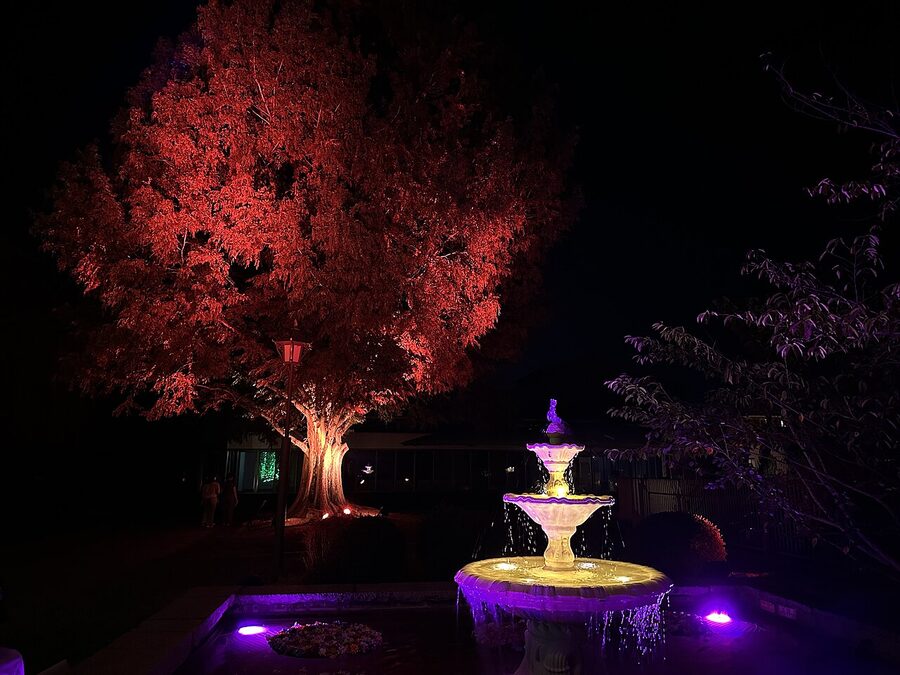
If the Bikan’s canal street is the Edo layer of Kurashiki, Ivy Square is the Meiji industrial one. These red-brick buildings were Japan’s second cotton-spinning mill, built by Ohara Magosaburō’s father Ohara Magosaburō Sr. in 1889 (Meiji 22). The ivy that covers most of them — hence the name — was planted as a cooling measure, to keep the summer temperature inside the mill tolerable for the workers. It worked well enough that the plants were never removed, and the whole compound became the pattern of “Japanese industrial red brick with ivy” that you now see replicated across Meiji-era sites nationwide.
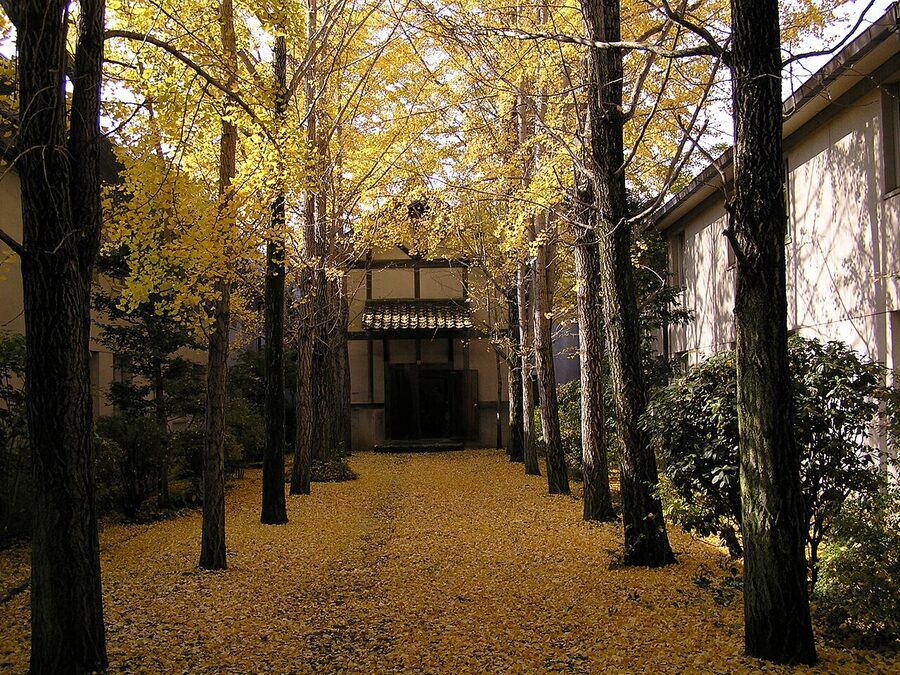
What’s there now: a mid-range hotel (Kurashiki Ivy Square Hotel, reasonable rates, atmospheric rooms), the Torajirō Kojima Memorial Hall (yes, that Kojima), a restored orientation museum about the mill’s history, two restaurants, and a large souvenir shop that does actually good embroidered magnets for ¥500 each. There’s also a hands-on pottery workshop in one corner for ¥3,000 per person if you want to spend ninety minutes making a tea cup. Don’t skip this — Ivy Square is free to wander.
Achi Shrine and the view from the hill
Most visitors don’t know this, but the Bikan has a view. The west side of the canal is backed by a small wooded hill — Tsurugata-yama — and the top of it is occupied by Achi Shrine (阿智神社), which has sat there since roughly the 4th century.
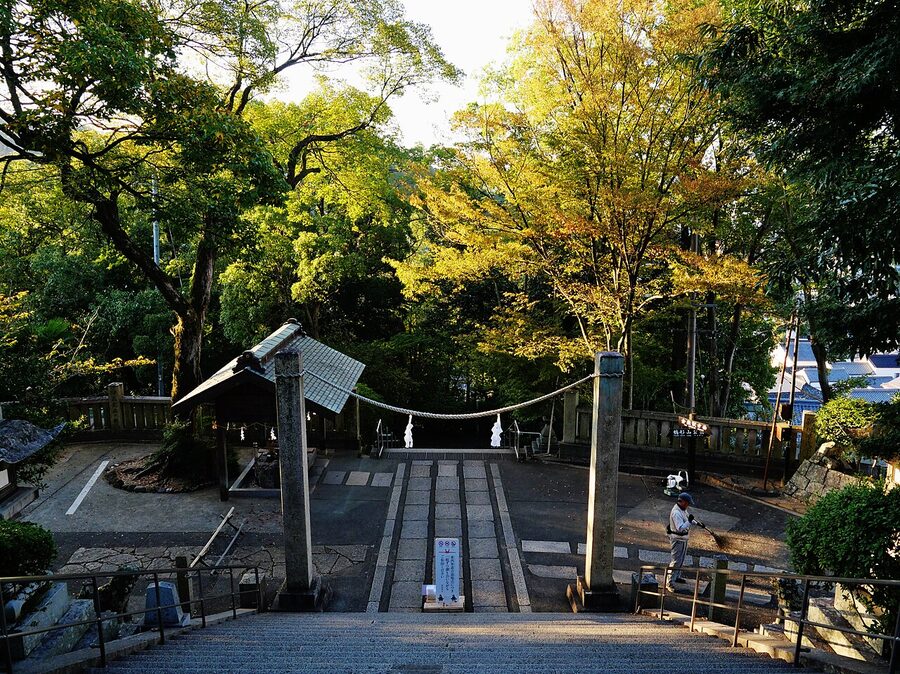
The stairs are worth it. At the top you get a wide platform, a small traditional stage used for kagura dance performances, two enormous ancient wisteria vines (the shrine claims one is 300 years old — the other is at least that), and an eastern-facing viewing platform that looks out across the whole Bikan, the Kurashiki River snaking south, and — on clear days — the Seto Inland Sea in the distance. Sunset on a clear summer evening is genuinely special here. There’s a small rest hut where you can sit on the tatami and wait it out.
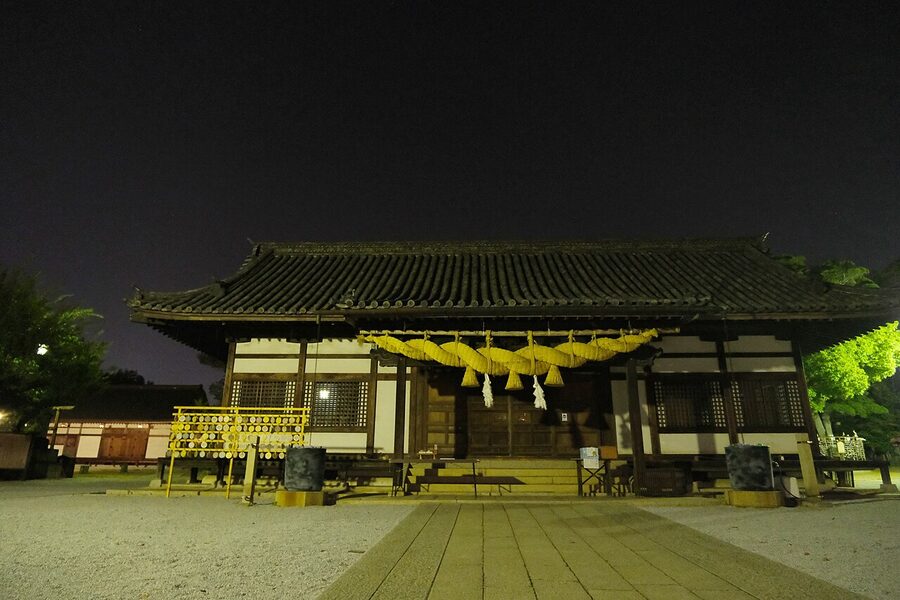
The descent route most people miss: if you walk down the east side instead of back the way you came, you come out behind the Kurashiki Museum of Folkcraft. Saves ten minutes and avoids the main tourist drag.
The small obsessions of Kurashiki
The Bikan has a few things that make no sense until you’ve spent an afternoon there.
The resident swans
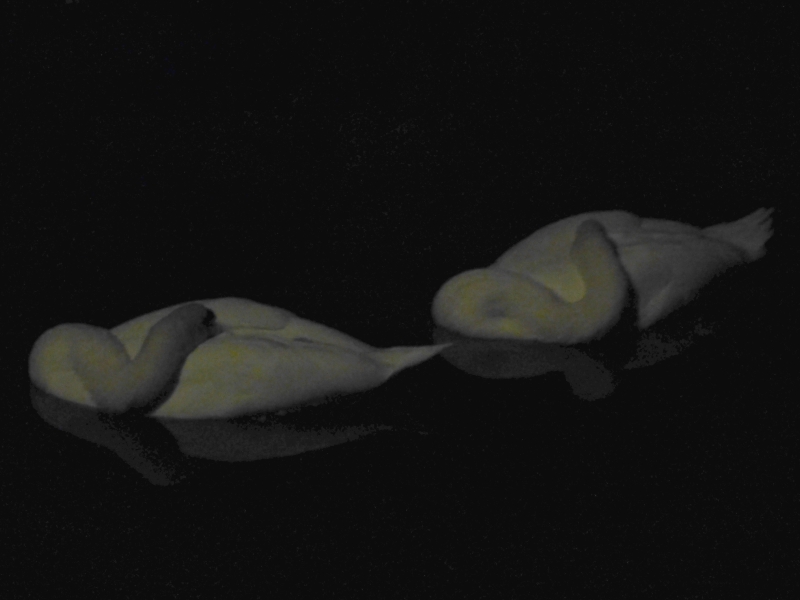
There are two of them — Sora (meaning “sky”) and Yume (“dream”). Mute swans, not the Japanese black-necks. They were introduced in the 1990s to replace a pair of mandarin ducks that had stopped breeding, and they’ve been there ever since. If you visit on a midweek morning in spring they’re usually asleep under the willows on the north bank near the Nakabashi dock. Try not to wake them.
The fire watchtower
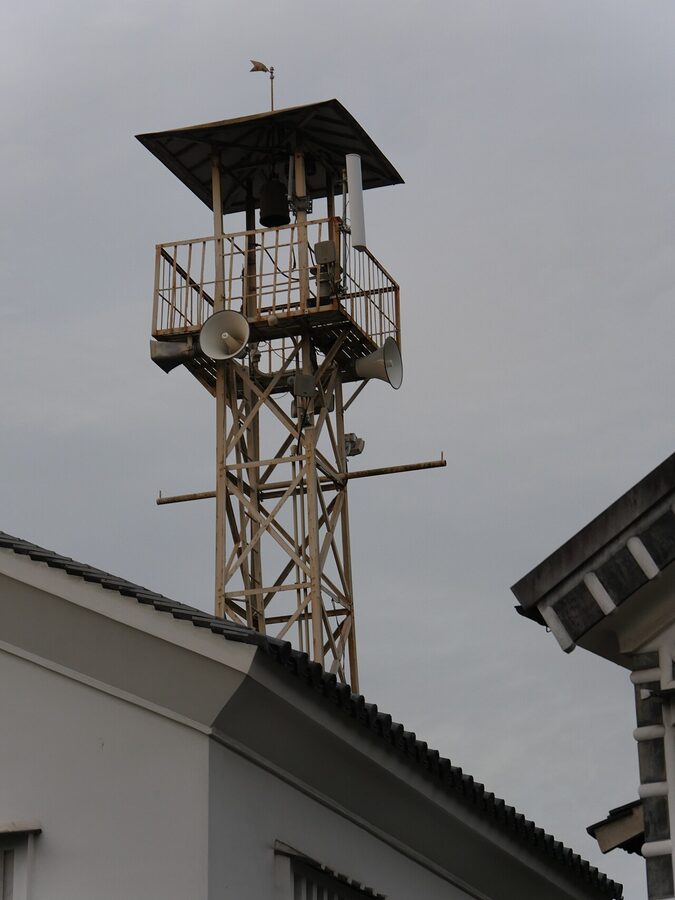
Small, easy to miss, but it’s the single most photographed non-canal object in the quarter. Head to the junction of Honmachi-dōri and Chūō-dōri — the tower is on the south-east corner.
Denim Street (a pocket version)
Okayama prefecture — specifically the Kojima district, which is administratively part of Kurashiki — is Japan’s denim capital. Roughly 70% of Japanese-made jeans come from here, including most of the premium labels now sold internationally (Momotaro, Japan Blue, Oni, Pure Blue). A full visit to Kojima is a separate half-day trip (covered below). But for a small-bite version inside the Bikan, Kurashiki Denim Street runs for about 100 metres east of Takasagobashi. Shops, accessories, a denim-flavoured soft-serve ice cream (ramune-blue, mildly soapy, weirdly good), a pair of skinny jeans that cost ¥38,000 because they’re genuinely hand-dyed with natural indigo over 14 weeks.
The toy museum
The Japanese Folk Toy Museum — a block south of the main canal — houses more than 10,000 Japanese folk toys dating back to the 1600s. Kites, daruma dolls, Hina-matsuri sets, hand-painted papier-mâché animals, a giant spinning top certified by the Guinness Book of World Records. If you have kids it’s the best ninety minutes in the Bikan. If you don’t have kids, it’s still the best ninety minutes in the Bikan. ¥600.
The Kojima detour: Japan’s denim capital
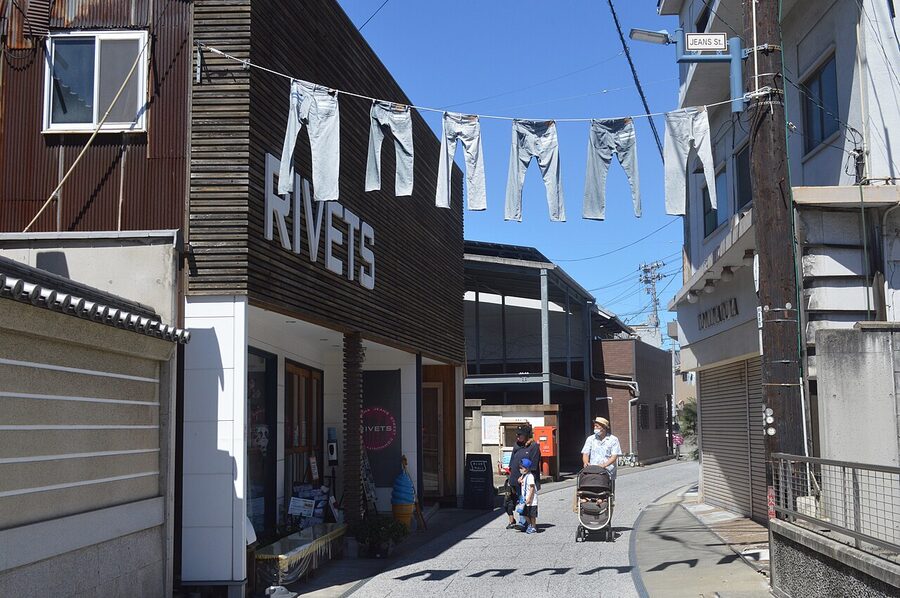
If you genuinely care about denim, skip the Bikan’s sample version and go straight to Kojima. Kurashiki → Kojima is 25 minutes by train on the Seto-Ōhashi Line from JR Kurashiki Station (¥330), then a ten-minute walk from Kojima Station to Kojima Jeans Street.
Dozens of ateliers and shops in a five-street grid: Momotaro Jeans flagship (free small museum in the back), Japan Blue Co., Betty Smith (the oldest — they did denim uniforms for the Japanese navy in the 1960s), Big John, several denim-dyeing workshops you can book an hour at for about ¥4,000. A pair of entry-level Kojima selvedge runs ¥20,000–¥35,000, which is cheap by Tokyo denim-shop standards.
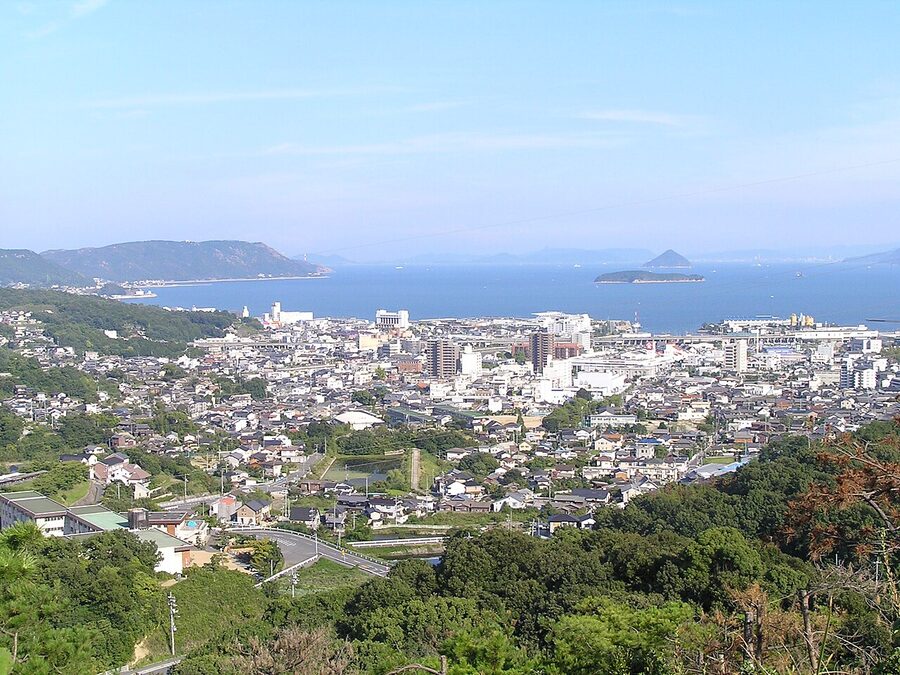
If you combine Kojima with Mount Washu (Washūzan) — the 133-metre headland that looks out over the Seto-Ōhashi Bridge — you’ve got a half-day that covers Japanese industrial heritage, seascape, and an iconic 20th-century piece of civil engineering all in one bus route. The bus from Kojima Station takes 20 minutes.
What to eat in Kurashiki
Mamakari. A small herring-like fish (scientific name Sardinella zunasi) that’s the defining local ingredient. Name translates roughly as “borrow-rice”, because you eat so much rice alongside the pickled version that you have to borrow more from your neighbour. Pickled mamakari over rice is the signature set meal at almost every traditional restaurant in the Bikan. Kamoi on the south bank does a solid ¥1,800 lunch set.
Kibi-dango. Millet dumplings, Okayama’s signature gift sweet — historically given to Momotarō by his grandmother for his demon-hunting expedition, mythologically speaking. Now packaged in every souvenir shop in the prefecture. The original is at Koeido Honten on Honmachi-dōri; about ¥700 for a box. Eat one, give the rest away.
Hakuto. Okayama white peaches. In season July-August only. Whitest, softest, most fragile peaches you’ll eat in your life. ¥1,500 for one at the good fruit parlours. Worth it once.
Kurashiki coffee. There’s a small but serious speciality coffee scene in the Bikan. El Greco opposite the Ohara Museum is the historic one — opened 1959, ivy-covered brick exterior, same ¥600 cup of hand-drip Colombian they’ve been serving for sixty-five years. Kurashiki Roastery is the modern counterpart a few doors down.
For a bigger food scene, Okayama city is only 15 minutes north on the Hakubi Line and has a proper izakaya quarter around the station. I’d normally do Bikan-by-day, Okayama-by-night if I had one full day.
Getting to Kurashiki
By Shinkansen. Shin-Kurashiki Station is on the San’yō Shinkansen main line, but — as with Mihara — only the Kodama stops here. From Tokyo, the fast route is Nozomi or Sakura to Okayama (3h 15), then the local Hakubi Line (15 min, ¥330) west to JR Kurashiki. Faster overall than routing through Shin-Kurashiki.
By local train. From Osaka, Shinkansen to Okayama (45 min, ¥5,500) then the local 15 minutes on. From Hiroshima, Shinkansen to Okayama (45 min) or the slower direct Sanyō local line (2h). From Hiroshima there’s also the option of the Seto-Ōhashi line via Kojima if you want a scenic route.
From Hiroshima Airport. Airport bus to Hiroshima Station (45 min) then Shinkansen. Budget 2 hours door-to-door.
From Takamatsu (Shikoku side). If you’re island-hopping, take the Marine Liner across the Seto-Ōhashi Bridge — Takamatsu to Okayama in 55 minutes, then the 15-minute local to Kurashiki. One of the most scenic regular train rides in Japan.
JR Kurashiki Station is a 15-minute walk from the Bikan. There are taxis (¥700 flat) and a community bus (¥100) but the walk down the Kurashiki Center Street arcade is part of the arrival — do it on foot.
Where to stay
Kurashiki has two broad hotel situations: traditional ryokan inside the Bikan (gorgeous, expensive, limited), and business hotels near the station (cheap, practical, uninspiring).
Ryokan Kurashiki (旅館くらしき) is the grand dame — a 250-year-old rice merchant’s townhouse on the main canal bank, converted into a fourteen-room ryokan. ¥45,000+ per person per night with dinner. Worth one night of your trip if the budget allows. Kurashiki Ivy Square Hotel inside the old mill is the mid-range option — atmospheric, ¥14,000–¥22,000. Dormy Inn Kurashiki by the station is the reliable budget call (¥9,000, rooftop onsen, breakfast buffet).
For wider-region context, a Kurashiki stay pairs well with Okayama city for the night-dining scene and Kōrakuen garden, or with Tsuyama further north for the inland castle route. Our western Japan landscapes overview maps out the full Chūgoku loop if you’re planning a longer trip.
Planning the visit
Half-day (3 hours). Walk the canal, the Ohara for 45 minutes of its best rooms, lunch of mamakari, climb Achi Shrine. Doable on a stopover from Okayama or Hiroshima.
Full day. Above + the Folkcraft Museum, Ivy Square, the Folk Toy Museum, and a slow dinner. Don’t try to do Kojima denim on the same day.
Two days. Day one Bikan. Day two either Kojima + Washuzan, or a side trip to Okayama for Kōrakuen garden. If you’re overnighting, stay in the Bikan itself — the quarter at 07:00 with no other tourists is the trip’s highlight.
Three or more. Full Chūgoku loop is possible from here: Kurashiki → Tsuyama (castle town) → Izumo (Izumo Taisha) → Hiroshima. Five days, all by train, zero rental car needed.
A few practical notes
The Bikan gets busy between 11:00 and 15:00, particularly on weekends. Japanese domestic weekend coach tours and Taiwanese and Korean day groups arrive in pulses. If you have flexibility, aim to be on the canal between 07:00 and 10:00 or 16:00 and sunset — the quarter is almost empty, the light is better, and the shop owners have time to talk to you.
A lot of the museums close at 17:00. The cafés close at 18:00. The restaurants stay open until 21:00 but most stop serving food at 20:30. If you’re on a day trip, plan dinner on either end of the Bikan visit, not in the middle.
Most shops in the Bikan accept credit cards, which is unusual for rural Japan — the area has been pushing cashless since the 2023 push. The ryokan and some of the older places are still cash-only, so carry ¥10,000 in notes.
English signage is better than at Izumo, worse than at Himeji or Kyoto. Every museum has at least a leaflet; most of the mid-range restaurants have a picture-menu or an English-translated version. The tourist office in the middle of the canal (the white single-storey building labelled Kurashikikan) has free English maps and helpful, patient staff.
And one last thought. The Ohara is the official reason the town is famous, and Ivy Square is where the money came from, and Achi Shrine is where you’re meant to watch sunset. But the thing that sticks, afterwards, is simpler: an early-morning walk down the north bank of the canal with nobody else around, the willows dragging in the water, and the two resident swans asleep under a bridge. That’s the real souvenir. Go before breakfast.



