
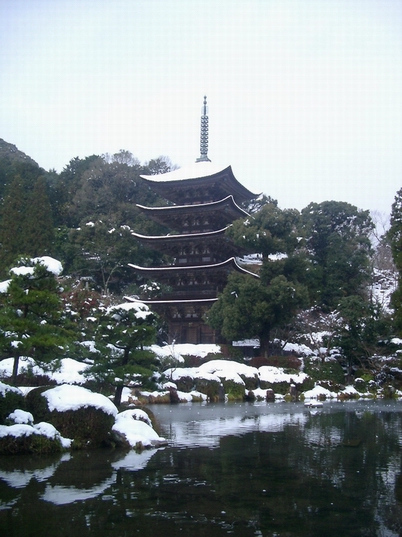
In 1360 the Ōuchi clan — a powerful western daimyo family — started rebuilding their capital city on the model of Kyoto. Over the next two centuries they laid out a grid of streets matching the old imperial capital, commissioned Kyoto-trained artists, imported Chinese paintings, funded Japanese Zen temples and a five-storey pagoda that’s now considered one of Japan’s three most beautiful, and — in 1551 — hosted the missionary Francis Xavier when he received official permission to preach Christianity in Japan. For about 150 years, Yamaguchi was the most culturally sophisticated city in western Japan. Contemporaries called it “Nishi no Kyō” — “the Kyoto of the West.”
The Ōuchi lost a war in 1557, the city was burnt, the golden era ended. But the pagoda is still there, the samurai street grid is still there, the city is still — in its quiet way — one of the most underrated cultural destinations in western Japan. Yamaguchi (山口) is also the prefectural capital, meaning it’s the transport hub for Yamaguchi prefecture’s other attractions: the Akiyoshidai karst plateau, the Motonosumi Inari shrine coast, Hagi on the Sea of Japan side, and Iwakuni in the east. If you’re doing the full western Yamaguchi prefecture circuit, the city is the obvious base.
Yamaguchi was added to the New York Times “52 Places to Go” list in 2024 — one of only two Japanese destinations on the list that year — and the recognition has been pulling more foreign visitors in. It’s still quiet compared to Kyoto, which is the point.
Rurikō-ji and the pagoda
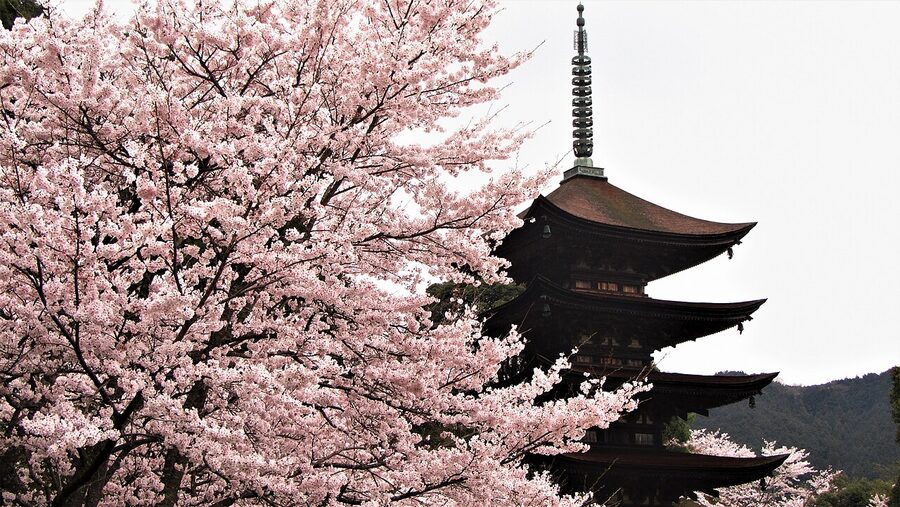
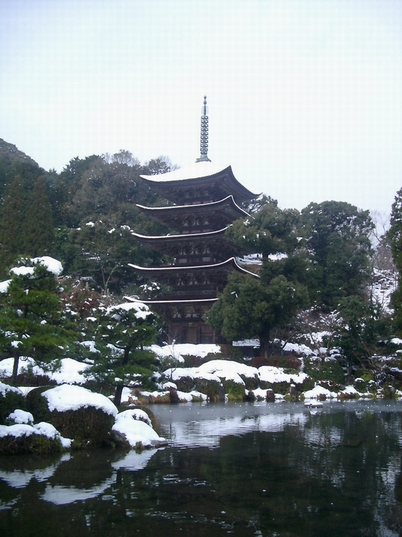
Rurikō-ji (瑠璃光寺) is a Zen temple about 2 km north of Yamaguchi Station. The pagoda was built in 1442 in memory of Ōuchi Yoshihiro, a regional daimyo killed in a family feud, by his younger brother. It’s 31.2 metres tall and made entirely of unpainted Japanese cypress — an unusual choice for a 15th-century structure, since most pagodas of the period were painted in red lacquer. The weathered, silvery wood is what the pagoda is known for.
The architecture is also specific to the era. The pagoda uses a combination of Chinese Tang-period and Japanese traditional techniques — the result of the Ōuchi clan’s active Chinese trade contacts during the Muromachi period. The second-storey balustrade is a distinctly Chinese detail, and the roof tile arrangement is unusually asymmetric, which is unique to this pagoda in Japan.
Entry to the park and pagoda is free; the small adjacent museum is ¥200. Open 24 hours (you walk through a public park). The pagoda is illuminated at night from sunset until 22:00.
The Xavier connection
In April 1551, the Spanish Jesuit missionary Francis Xavier arrived in Yamaguchi, met the Ōuchi lord Ōuchi Yoshitaka, and received formal permission to preach Christianity — the first such permission granted anywhere in Japan. Xavier stayed for six months and baptised about 500 Yamaguchi residents. He left for Kyoto in September 1551 and never returned; he died in China a year later.
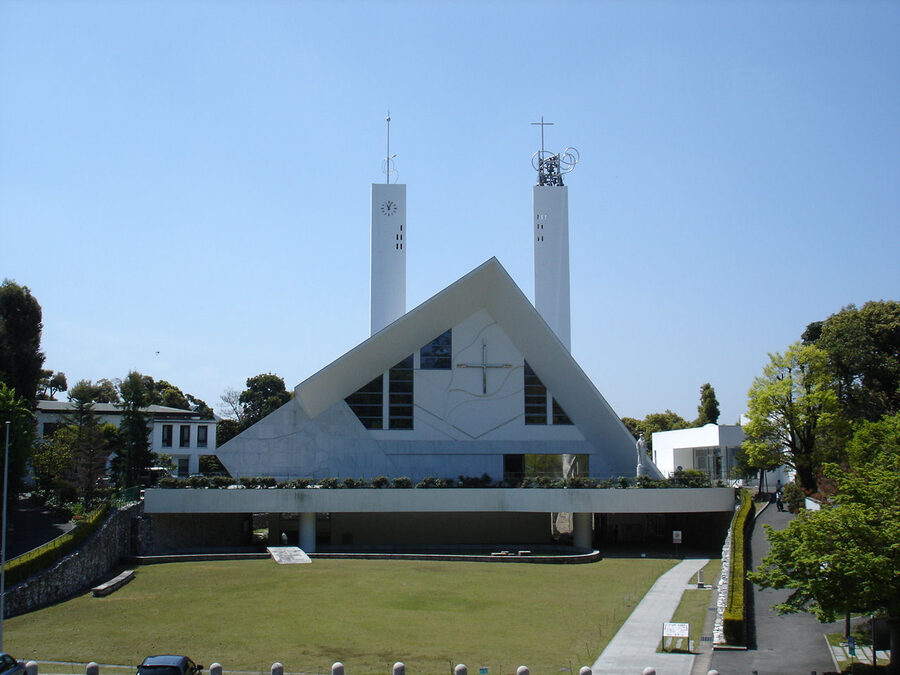
The Xavier Memorial Church (サビエル記念聖堂) was built in 1952 to commemorate the 400th anniversary of Xavier’s mission. It burned down in 1991 and was rebuilt in 1998 in a modernist conical design — the two angular white towers are now one of Yamaguchi’s most recognisable landmarks.
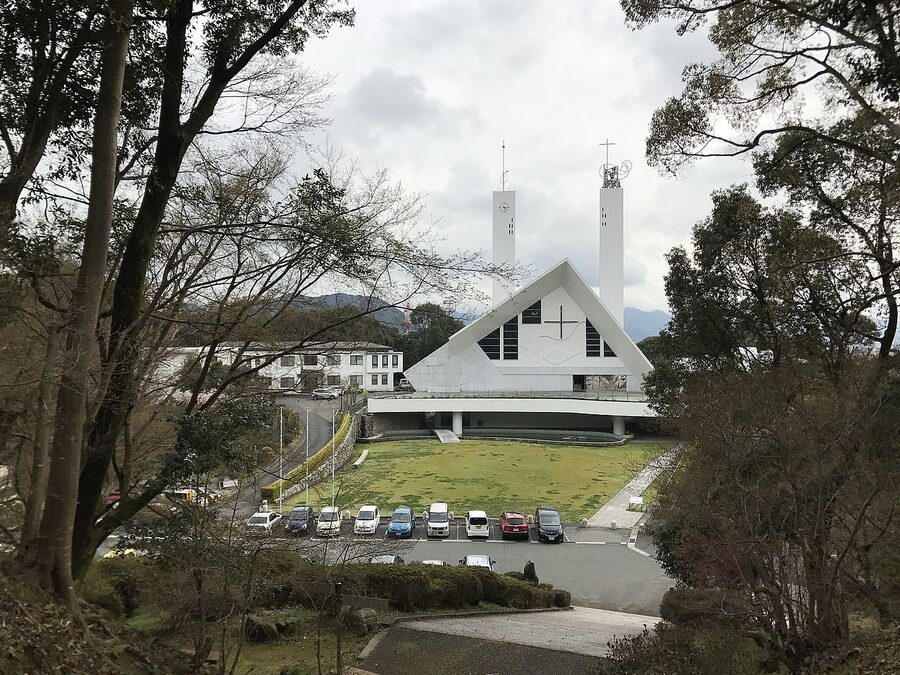
Entry to the church is free; the small museum is ¥300. Open 10:00–16:00 daily. Plan 30 minutes.
Kōzan Park and the Ōuchi streets
The broad hillside behind Rurikō-ji is Kōzan Park (香山公園), which has been designated as one of the top 100 historical sites in Japan. Inside the park, in addition to the pagoda, are the Mori family cemetery (the same Mori family from Hagi — they moved their funerary grounds here in the early Edo period), a small Shinto shrine, and a quiet walking trail that connects to the Ōuchi-era samurai district below.
The Ōuchi-Hishi samurai district runs for about 1 km south of the pagoda. The street layout here is specifically modelled on Kyoto’s Heian-kyō grid; walking it with a city map side-by-side with a Kyoto map shows the influence. A few original Ōuchi-period walls survive; most of the buildings are Edo-era or Meiji-era replacements built on the original foundations.
Akiyoshidai and Akiyoshidō cave
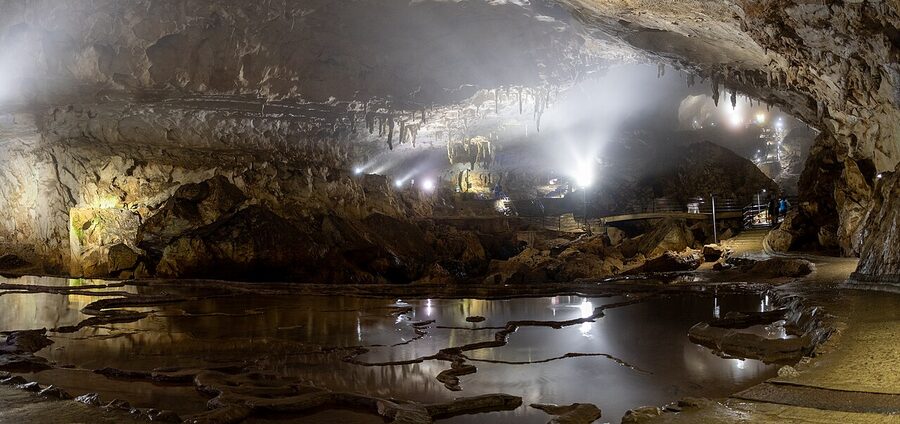
Ninety minutes inland from Yamaguchi city by bus is the Akiyoshidai karst plateau and its underground cave system, Akiyoshidō (秋芳洞). The plateau itself is covered in the landscape overview article — 130 km² of rolling limestone grassland, the only major karst landscape in Japan, grazed by local cattle in summer.
The cave below is more spectacular. You enter at a vast cave mouth along a small stream, follow a 1-km illuminated walking path past a series of limestone formations (particularly the “Hyakumai Zara” or “hundred saucer” terraced pools, and the huge “Kogane Bashira” golden column), and exit via an elevator to the plateau surface above. About 90 minutes round trip. ¥1,300 entry.
The cave is one of the best cave-tour experiences in Japan — better-lit than most Western show caves, genuinely large, and with a natural-history museum at the entrance that’s worth the 30 minutes.
Motonosumi Inari Shrine
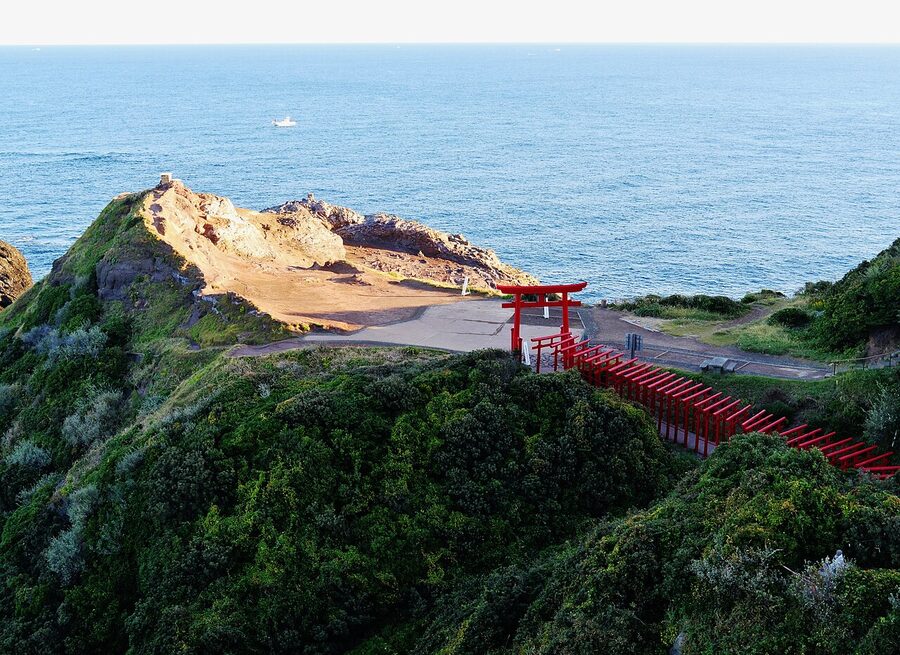
Two hours north-west of Yamaguchi, in Nagato city, is Motonosumi Inari Shrine (元乃隅稲成神社) — a small coastal shrine with 123 vermilion torii gates running for 100 metres down a clifftop to the Sea of Japan. CNN listed it as one of “Japan’s 31 most beautiful places” in 2015 and the shrine was essentially unknown before that; now it’s on every Yamaguchi prefecture itinerary.
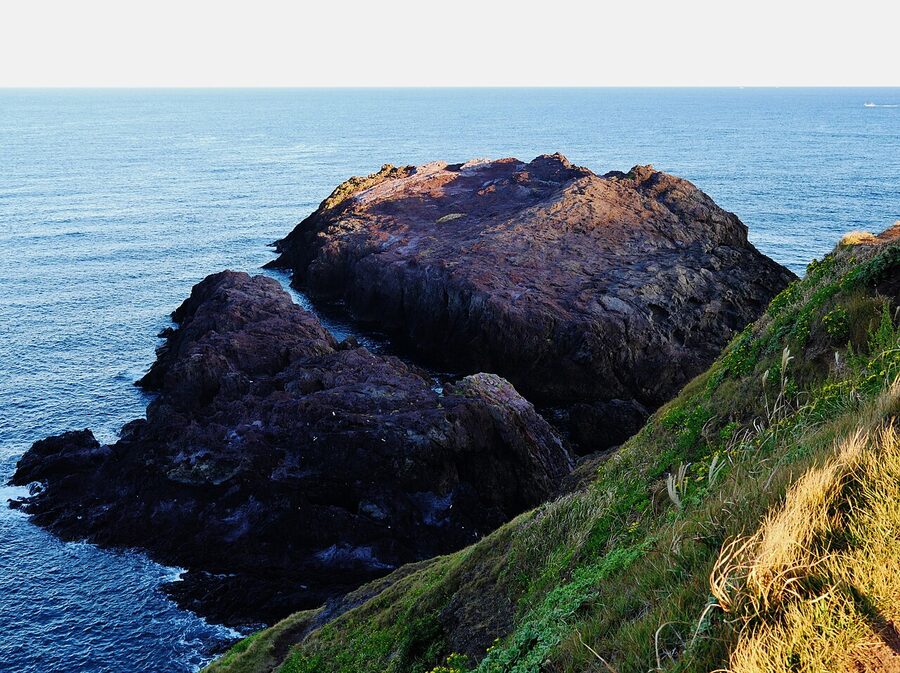
The shrine is a ~2-hour drive from Yamaguchi city, or a JR train + bus combination that takes 3+ hours. A rental car is the only practical way to visit unless you have a full day. Pair with Tsunoshima Bridge (30 minutes west) and/or Hagi (40 minutes east) to make the drive worthwhile.
Tsunoshima Bridge and the western coast
The western tip of Yamaguchi prefecture has one of Japan’s most photographed road bridges — the Tsunoshima Ōhashi, a 1,780-metre span linking Honshū to Tsunoshima Island, running straight across turquoise water that looks more Okinawan than Sea-of-Japan. The bridge opened in 2000. It’s been in every major Japanese car commercial since roughly 2005, and in a good half of the domestic TV dramas set in Yamaguchi.
The reason the water is that specific turquoise is, actually, interesting: Tsunoshima sits over a shallow white-limestone seabed that reflects sunlight upward through the clear Japan Sea water, producing a Caribbean-looking blue that’s geologically specific to this cove. The colour peaks between 10:00 and 14:00 on sunny days.
Tsunoshima itself is a small island (3.3 km²) with a 19th-century lighthouse, a couple of fishing villages, and a wild-camping beach. You can drive across, do a 15-km island loop, and come back in about 90 minutes. Motonosumi Inari is 30 minutes north-east from here, which makes a good half-day loop from Hagi.
Iwakunism Yamaguchi city history
A bit of context, because Yamaguchi the city is often overshadowed by the neighbouring towns. In the 14th-16th centuries, Yamaguchi was one of the wealthiest and most cosmopolitan cities in Japan — the seat of the Ōuchi clan, who controlled the Yamaguchi-Nagato region and grew rich from the Japan Sea trade with Ming China and Korea. Ōuchi Yoshitaka (1507-1551) was a famous patron of the arts who brought Kyoto court culture to Yamaguchi and nearly made it an alternate capital during the Ōnin War chaos.
It’s in this Ōuchi era that Francis Xavier — the Spanish Jesuit, one of the founders of the Society of Jesus — came to Yamaguchi in 1551 and was granted permission by Ōuchi Yoshitaka to preach publicly. Xavier spent about two years here and converted several hundred local people; Yamaguchi was, briefly, the seat of the first Catholic mission in Japan. The mission ended in 1551 when Yoshitaka was overthrown and the Ōuchi clan destroyed. Christianity in Yamaguchi went underground, then was persecuted, then largely vanished by the 1620s.
The Xavier Memorial Church you see today was built in 1952 on the site of the original mission, rebuilt again in 1998 after a fire, and remains an active Catholic parish. The curved twin towers are meant to represent open palms in prayer. A small museum in the basement documents Xavier’s two years in Yamaguchi in detail.
Rurikoji’s founder was Ōuchi Moriharu, another 14th-century Ōuchi lord, who built the pagoda in 1442 in memory of his younger brother killed in the same Ōnin-era politics. The same Ōuchi patronage network explains why Yamaguchi city has such an unusually dense concentration of high-quality Muromachi-era religious architecture — the clan spent its fortune building them, and then vanished, and then the buildings were left alone.
Yuda Onsen
Just south of Yamaguchi city centre is Yuda Onsen (湯田温泉), a 800-year-old hot spring town that runs as Yamaguchi city’s main onsen district. The legend goes that a white fox with an injured leg led a local monk to the hot spring source in the 14th century — the fox is the town mascot, and a large white fox statue stands at the district’s entrance.
Eleven ryokan operate in Yuda. Mid-range options include Umi no Ryokan Yuda and Kotobuki Ryokan, both ¥12,000–¥18,000 with half-board. The local foot-bath (ashi-yu) in the town centre is free and open to passers-by.
Food in Yamaguchi
Fugu (pufferfish). Yamaguchi prefecture, specifically the southwestern city of Shimonoseki, is Japan’s fugu capital — about 80% of the country’s fugu passes through Shimonoseki’s auction market. Yamaguchi city has several specialist restaurants; Fugu Cuisine Tokufuku does a full fugu course for ¥12,000+ (mid-range for Japan; Tokyo prices would be double). Season is October through March.
Kawara soba is the odd local specialty — soba noodles served on a hot roof tile, garnished with egg, beef, and seaweed. Sounds ridiculous. Works. ¥1,500 at Takase Honten in Kawatana Onsen.
Wild wagyu. Mimasaka and Chōshū beef are both from the wider Yamaguchi region; expensive but excellent.
Getting there
By Shinkansen. Shin-Yamaguchi Station is 7 km south of the city centre on the Sanyō Shinkansen. Kodama and Sakura stop here; Nozomi does not. From Tokyo 4h 30, from Osaka 2h, from Hiroshima 30 min.
From Shin-Yamaguchi to the city. JR Yamaguchi Line, 20 minutes, ¥230.
Airport. Yamaguchi Ube Airport (UBJ) has Tokyo Haneda and Osaka Itami flights. About 50 minutes from Yamaguchi city by bus.
Where to stay
Yuda Onsen ryokan (see above) — best for atmosphere.
Hotel Kameya — mid-range hotel in central Yamaguchi city, ¥10,000–¥14,000.
Yamaguchi Grand Hotel — the reliable business-class option near Yamaguchi Station.
Planning your visit
Half-day. Rurikō-ji + Xavier Church + Kōzan Park. Possible as a stopover from Shin-Yamaguchi.
Full day. Morning Rurikō-ji, lunch in central Yamaguchi (kawara soba or a fugu course), afternoon at Akiyoshidai + Akiyoshidō, evening soak at Yuda Onsen.
Two days. Day one city + Akiyoshidai. Day two Motonosumi + Tsunoshima Bridge (car needed), or onward to Hagi for a broader Chōshū trip.
The moment to remember
Be at the base of the Rurikō-ji pagoda at 18:30 in mid-April. The evening illumination has just come on. The cherry blossoms around the pagoda are at peak bloom. Nobody is there — the tourist buses have left, the local families have gone home for dinner. You have a 1,442-year-old pagoda, a 600-year-old cherry grove, and a quiet park to yourself.
The Ōuchi lord who commissioned the pagoda is long dead. The Meiji state that reduced Yamaguchi from “the Kyoto of the west” to a quiet prefectural capital is also long gone. The pagoda is still here. That is the thing Yamaguchi does better than almost anywhere else — it preserves the obscure, quiet, local version of Japanese history, without the Kyoto crowds. Come once. Go back to your hotel. Go to Yuda Onsen and sit in the bath. That’s the trip.



