
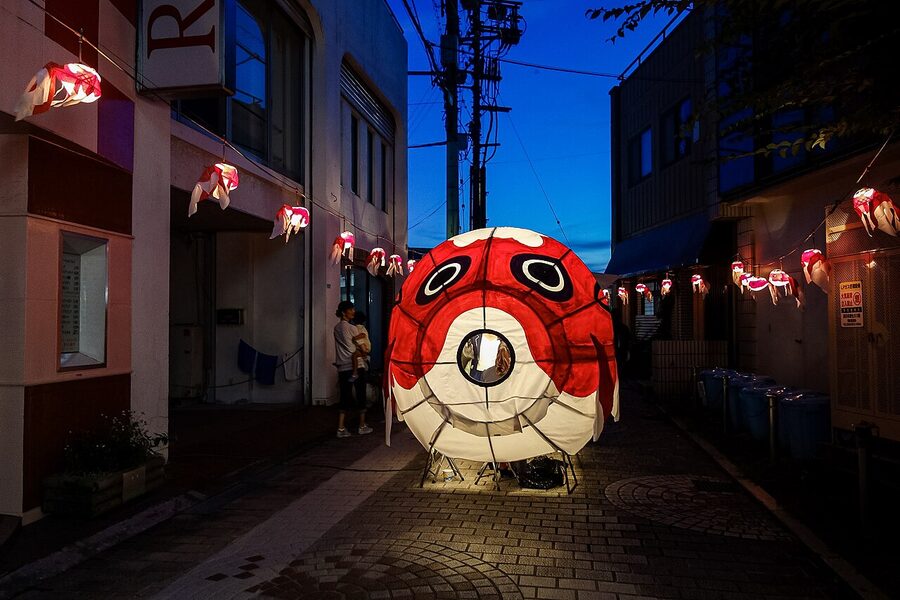
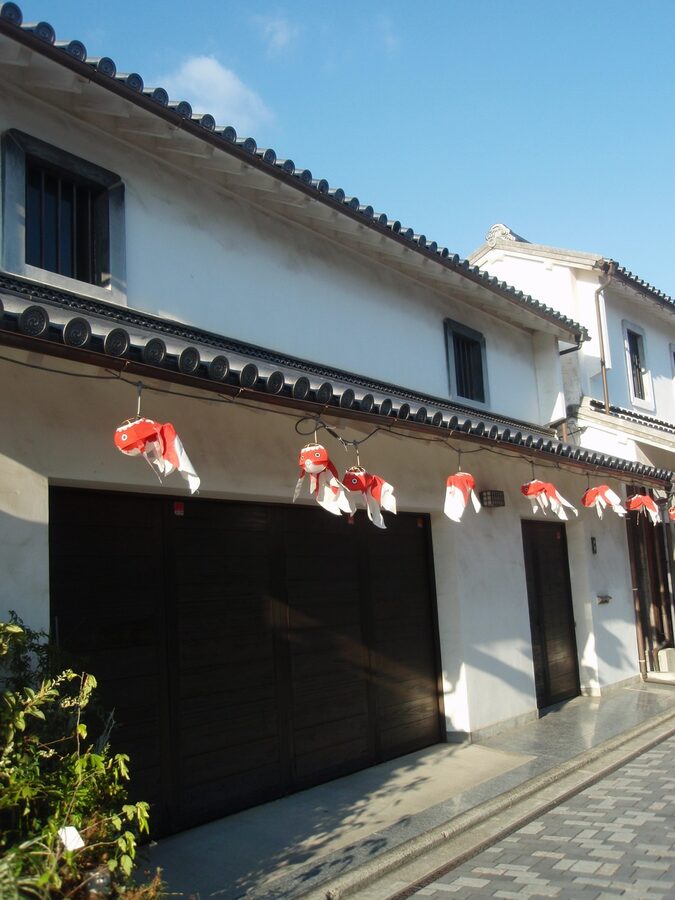
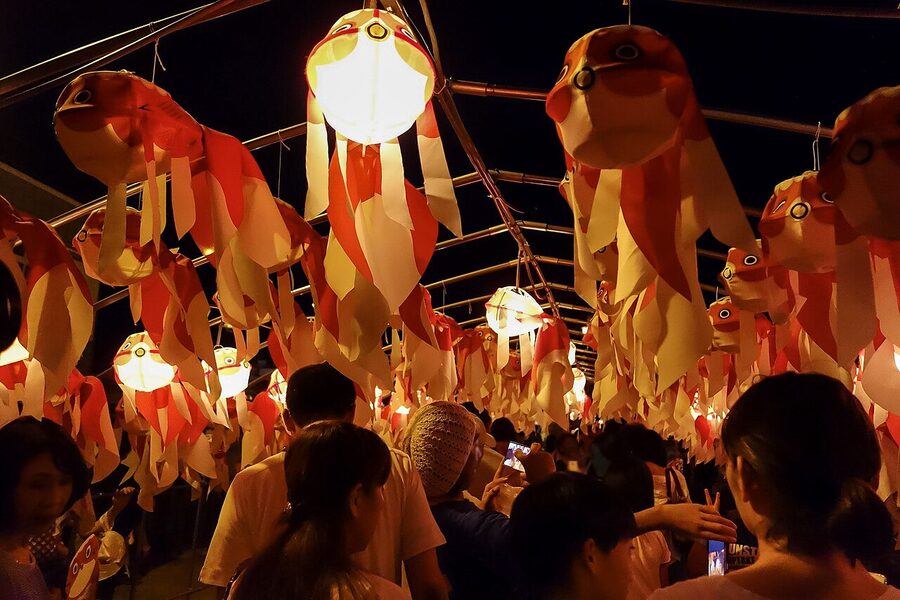
Late in the evening, in August, during the Yanai goldfish lantern festival, the main street of Yanai’s old merchant quarter fills with about 4,000 hand-made paper goldfish lanterns. They hang from ropes strung between the second-storey eaves of whitewashed Edo-period merchant houses, swinging gently in the Seto Inland Sea breeze. The lanterns are lit from inside with LED candles; the light through the red-orange paper turns the whole street into a long drifting school of luminescent fish.
This is the specific image that draws visitors to Yanai (柳井), a quiet coastal town of 30,000 in south-east Yamaguchi prefecture. The festival is the peak, but the goldfish lanterns hang year-round along the town’s Furuichi-Kanaya preserved street, and the lantern-making tradition — going back about 160 years — is one of Yanai’s two surviving major crafts. The other is soy sauce. Both are worth a day.
The goldfish lantern story
The kingyo chōchin — “goldfish lantern” — was invented in Yanai around 1860 by a local merchant named Kumaga Yoshirōbei. Kumaga had seen Aomori’s famous nebuta lanterns on a trading trip up north and wanted to create a similar decorative tradition for Yanai’s summer festival. He settled on goldfish because they were associated with good fortune and because their bright orange colour showed up well against the town’s distinctive white plaster walls.
The lanterns are made of washi (Japanese paper) stretched over a bamboo frame, painted red-orange, with black-ink eyes and fins. A traditional lantern is about 40 cm long, 20 cm tall, and weighs maybe 200 grams. Each one is entirely hand-made by local artisans; there are still three families in Yanai making them commercially.
You can watch the lanterns being made at the Yanai Nishigumi workshop in the preserved district. They sell their own lanterns from about ¥2,500 (small) to ¥8,000 (large). You can also make your own at the Kingyo Chōchin Workshop, which runs 90-minute hands-on classes for ¥2,000 (reservations required, Japanese-language instruction).
The white-wall merchant district
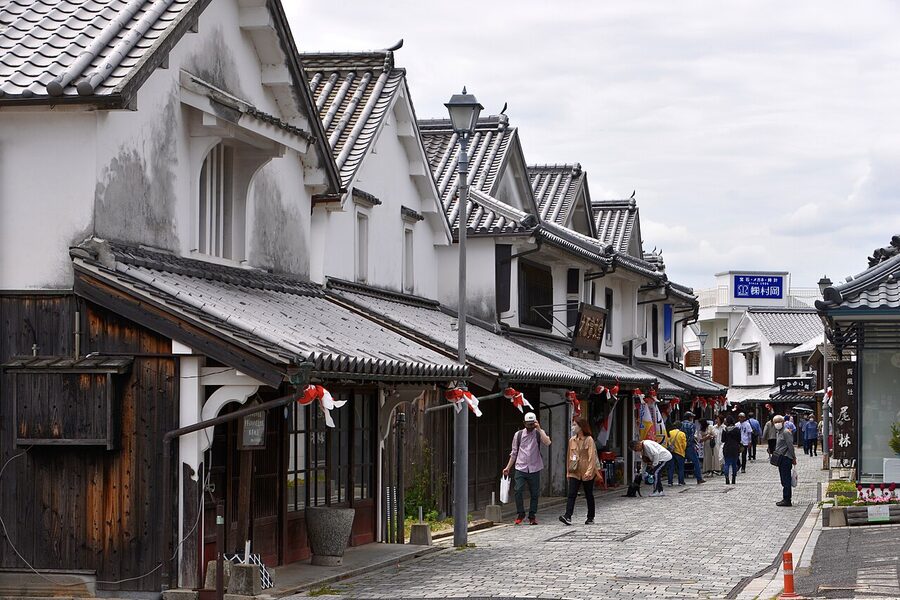
The reason Yanai matters — and the reason the goldfish lanterns have the backdrop they have — is the town’s Furuichi-Kanaya preserved merchant quarter. Two blocks of continuous Edo-period architecture, designated as a National Important Preservation District in 1984. The quarter runs for about 200 metres along the old main street, and the buildings date from roughly 1680 through the early 1900s, with essentially no modern interventions.
Yanai was historically a minor port on the Seto Inland Sea that specialised in trade between Honshū and Shikoku. During the Edo period it became wealthy from soy sauce, sake, and cotton trading. The merchant houses in the preserved district are what survives of that wealth — large two-storey townhouses with specific merchant-district features: lattice shop fronts (mushiko-mado), narrow street frontage but long back depths, inner courtyards, and fire-resistant white plaster walls topped with black tile.
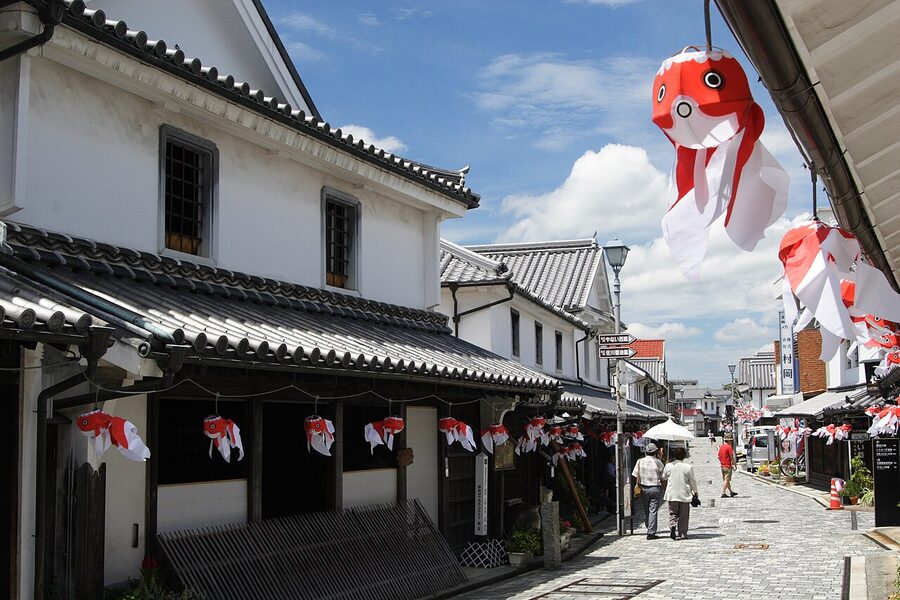
Several of the preserved houses are now open to the public:
Muroya Residence (室屋旧楽家住宅). The largest merchant house in the district, originally a cotton-trading family. Two-storey main hall, inner courtyard, traditional wooden beams. ¥200 entry.
Kokura Family Residence. A 350-year-old house that was the official measuring office for the Yanai rice trade. Contains historical measuring instruments and a small merchant museum.
Shōgaku Kumagai-tei. The birthplace of Kumagai Yoshirōbei, the goldfish-lantern inventor. Small museum about him and the lantern tradition. ¥300.
Soy sauce
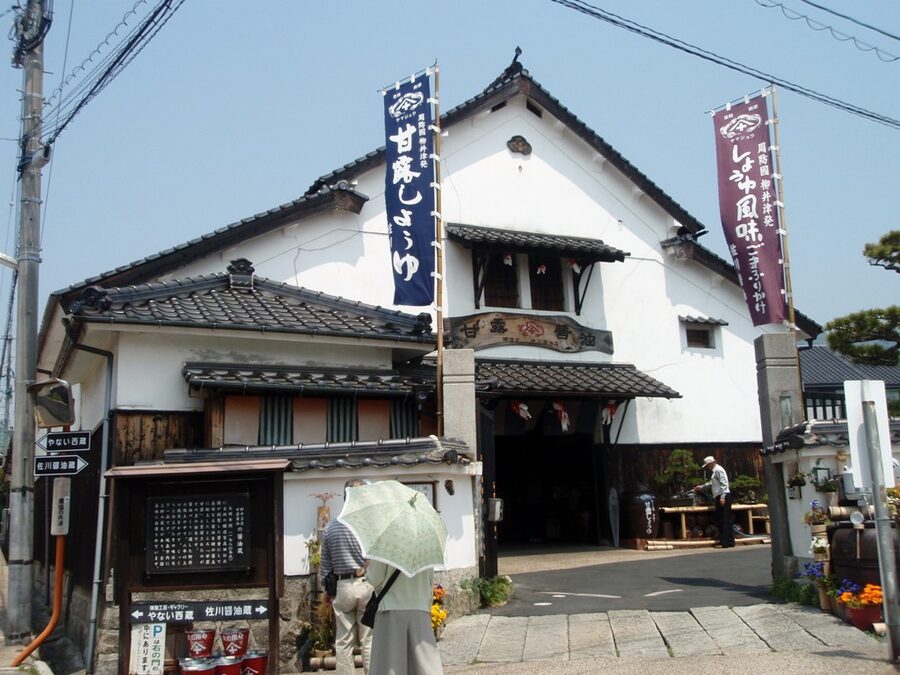
Yanai has been making soy sauce for 400 years. The town’s Edo-period salt-making industry (from the nearby Seto Inland Sea) plus the Yamaguchi grain trade plus year-round access to freshwater from the local rivers made Yanai one of the major regional soy-sauce producers. Three working soy-sauce breweries still operate in town, all of them still using traditional wooden-barrel kioke fermentation (rather than the modern steel-vat method used by commercial producers).
Sagano Honten — the oldest, founded 1781. 8-generation family business. Runs 30-minute brewery tours for ¥500 including tasting; call ahead to book.
Takasago Shōyu — 1855 founding, smaller operation, produces an unusual amber-coloured “white soy sauce” that’s only available here.
Fukumochi-tei — the brewery-attached restaurant, does a soy-sauce ice cream (¥400) that’s better than it sounds.
Other things to do
Yanai Gofuku Shōtengai. The covered shopping arcade running from Yanai Station into the preserved district. Mostly ordinary Japanese-town shops, but a few interesting stops including a vintage kimono shop, a local sake shop (Shōei Sake Brewery has its outlet here), and a 1920s-era coffee shop.
Shirakabe no Machi “Shiroi Machi” Museum. A small museum about the preservation history of Furuichi-Kanaya, with good English-language exhibits explaining the town’s wider cultural context. ¥200.
Kōmyōji Temple. A 15-minute walk south of the preserved district — a 500-year-old Zen temple with a small garden. Usually empty.
Yashiro-jima. The offshore island accessible by bridge from Yanai. It’s a drive-around island (45 minutes total), with Kaburajima (a peaceful fishing village), a small aquarium, and a citrus-orchard region that grows iyokan oranges. A half-day detour if you have a car.
The festival (if you can time it)
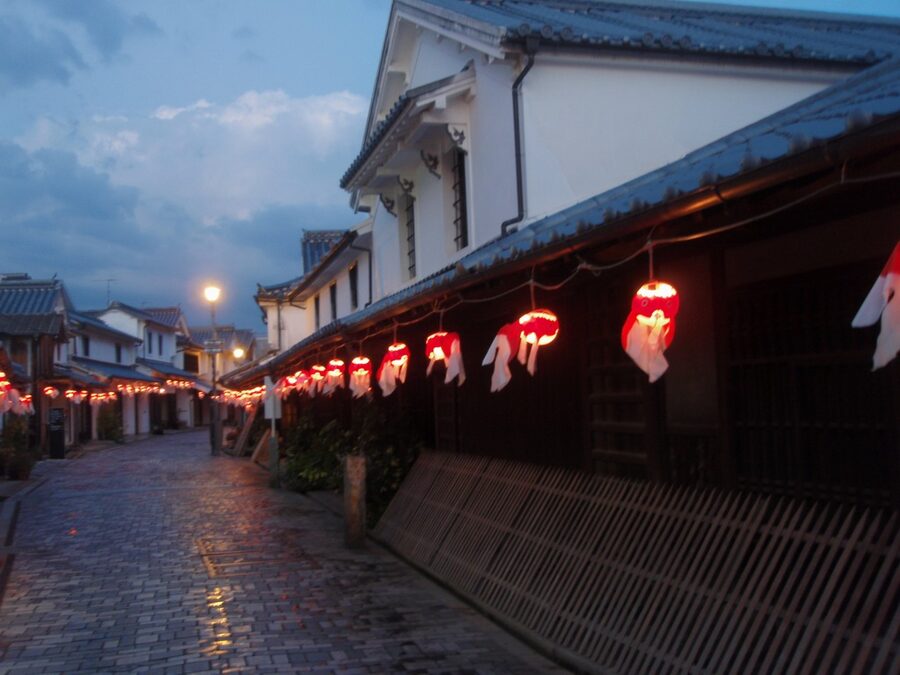
The Yanai Kingyo Chōchin Matsuri (柳井金魚ちょうちん祭り) runs the second weekend of August (usually 11-13 August, overlapping with Obon). The central event on the Saturday evening includes:
- A parade of 4,000+ lanterns through the preserved district.
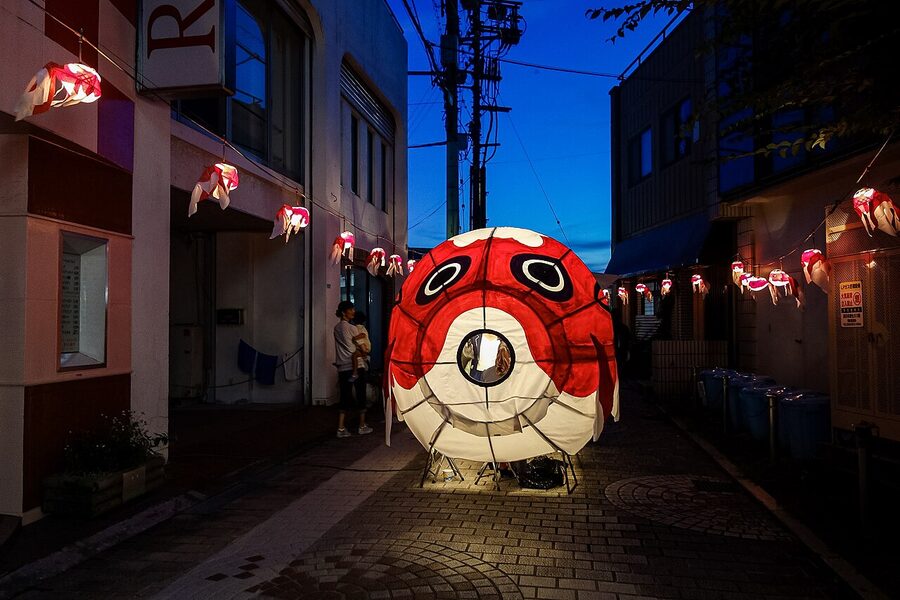
- Dancing groups carrying large paper-mache goldfish (up to 4 metres long) through the streets.
- A kingyo nebuta — a 6-metre illuminated goldfish float, a direct tribute to the original Aomori influence on Kumaga’s 1860s invention.
- Fireworks over Yanai harbour at 21:00.
- Food stalls along the main shopping street.
The festival draws about 100,000 people across the three days, which is significant for a town of 30,000 but small by Japanese festival standards. If you’re in western Japan in early August, this is one of the more atmospheric evenings you can find.
How the goldfish lantern got to Yanai
The origin story is genuinely worth knowing. In the early Edo period, Yanai became a sister-port to Tsugaru (modern Aomori prefecture) via the kitamae-bune Japan Sea trade route — wooden cargo ships moved rice, fish, cotton, and lacquer between the northern and southern halves of Honshū, and Yanai was one of the Seto Inland Sea’s main waypoints.
In the 1850s, a Yanai merchant named Kumaga Denbei travelled to Tsugaru to negotiate a cotton shipment, and saw the Tsugaru nebuta festival — giant paper-mache illuminated floats paraded through the streets in summer. He came home determined to create a Yanai equivalent, but with two modifications. First, smaller: proper nebuta floats are 9 metres tall and need 100 people to carry them; Yanai couldn’t supply that. Second, shaped like a goldfish — because Yanai children of the era had goldfish as pets, and the white-walled district’s miniature ornamental canals ran with them in summer.
The first Yanai Kingyo Chōchin was made in 1862 out of bamboo, washi paper, and red lacquer. By 1880 they were hanging outside shops for good luck. By 1920 the Meiji-modernised town had institutionalised them as a summer decoration. The festival format, paradoxically, is only from 1962 — it was consciously created that year by the Yanai town council as a local-tourism initiative, using the lantern tradition that already existed.
What’s striking: the tradition never spread. The goldfish lantern shape remained essentially unique to Yanai for the 160 years that followed. You can find other Japanese goldfish-decorated objects — Kyoto has a paper goldfish wagashi sweet, Nara has goldfish-scale kimono patterns — but the red-and-white hanging paper goldfish lantern is still mostly a Yanai thing. Tourism drew other towns in the 2010s (a few in Shikoku now make them), but the craft itself is still centred here.
The white walls: why they’re white
The Furuichi-Kanaya district’s famous white walls are a specific architectural style called shirakabe-zōri (“white plaster and roof tiles”). Three technical things make them work:
Shikkui plaster. A lime-and-seaweed-paste render that was applied over a bamboo-lattice inner wall in thin layers, then burnished smooth. Shikkui is both fireproof (lime resists flame to about 900°C) and waterproof (the seaweed paste stabilises the lime against rain). It’s also expensive — shikkui walls were a merchant-class status marker in Edo-era Japan.
Black namako-kabe. The diamond-patterned raised tilework at the base of most Yanai walls isn’t decoration. The black clay tiles protect the lowest section of wall from splash damage during the Seto Inland Sea’s heavy summer storms. They also look great, which is why they appear on postcard photographs far more than any other element of the architecture.
Deeply overhanging tile roofs. The eaves project 1.5 metres out from the wall line — far more than you’d see in modern Japanese domestic architecture — because the purpose was to shield the shikkui from horizontal rain on the Yamaguchi coast, which gets a lot of it from May typhoons.
Maintenance is expensive. Owners in the preservation district get municipal grants (¥500,000 every five years for re-plastering) and technical support from a dedicated preservation office — which is how a 400-year-old technology is still practically viable in a 2020s town.
Food in Yanai
Chagayu. Yamaguchi-style tea-infused rice porridge. Yanai’s specific version uses locally-grown sencha tea and is served at breakfast at most local ryokan and at a few specialist morning restaurants. ¥600 for a bowl.
Karashi-renkon. Lotus root stuffed with mustard and deep-fried — a regional variation on the Kumamoto classic. ¥700 as an izakaya side.
Soy-sauce-based bentō at the Yanai Station kiosk. A simple bento using Sagano Honten’s local sauce — cheap, good, the lunch option if you’re catching a train.
Getting there
By train. Yanai is on the JR Sanyō Main Line between Hiroshima and Iwakuni. From Hiroshima: 1h 15min, ¥1,520. From Iwakuni: 20 min, ¥420. The Shinkansen doesn’t stop in Yanai — you change at Shin-Iwakuni (20 min local west).
From Yanai Station to the preserved district: 10-minute walk south.
By car. 90 minutes from Hiroshima via the Sanyō Expressway.
Where to stay
Most travellers day-trip from Hiroshima or Iwakuni. If you’re overnighting for the festival:
Hotel Sun Lite Yanai — reliable business hotel near the station, ¥7,500.
Yanai Yoshida Ryokan — small family-run traditional inn in the preserved district, ¥11,000+ with breakfast. Book 2+ months ahead for festival dates.
Planning your visit
Half-day. Preserved district + Shirakabe museum + a soy-sauce brewery tour + lunch. Doable as an easy side trip from Hiroshima or Iwakuni.
Festival day. Arrive mid-afternoon on the second Saturday of August, evening lantern parade and fireworks, overnight in Yanai (pre-booked), morning visit to the workshops, train out by lunch.
Yanai pairs best with Iwakuni (20 minutes east) for a one-day south-eastern-Yamaguchi loop — Iwakuni Bridge in the morning, Yanai preserved district in the afternoon, back to Hiroshima for dinner.
The quiet moment to seek out
Walk the Furuichi-Kanaya street at 07:30 on a weekday morning in late July. The goldfish lanterns are already up but the shopkeepers haven’t opened yet. There’s nobody on the street. The white walls are soft pink in the early light. The air smells faintly of the soy-sauce breweries at the end of the block. An elderly woman sweeps the step of her merchant house.
Stand for five minutes. This is why Japan preserves these districts. Not for the tourist photograph at 14:00 when the coaches come. For the 07:30 morning where you can see what the whole town looked like for three centuries. Then walk on.



