
Reviewed · ISLAND HOPPING & FERRIES
Okunoshima Rabbit Island Cycling Tour with Local Guide
Okunoshima’s rabbits are the easy reason to visit. The harder, more important story is the one beneath them: this quiet island once housed a secret poison gas operation and was removed from maps. A bicycle tour with local guide Junko connects the cute, peaceful present with that unsettling past.
I like the mix of wildlife and serious history, and I like that the ride reaches several scattered sites in about two hours. The main consideration is that the tour is outdoors and weather dependent, with a moderate fitness requirement and a ferry fee of 360 yen not included.
In This Review
- Key points at a glance
- Why Okunoshima is more than a rabbit stop
- What the two-hour bicycle route covers
- The lighthouse and the first look across the Seto Inland Sea
- Cycling through Okunoshima’s peaceful present
- Okuno Shrine and the island’s rabbit-filled sacred space
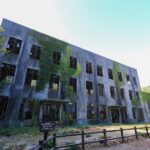
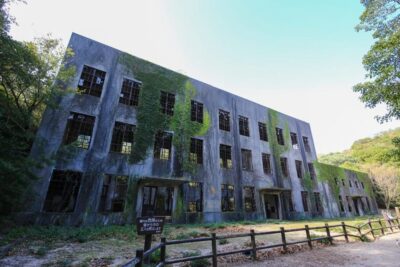
- Nagaura’s poison gas storage ruins
- The power plant ruins and the machinery behind the secret
- Northern Cannon Battery Remnants
- What Junko adds to the experience
- Price, ferry cost, and what you receive
- Timing, weather, and practical planning
- Who should book this Okunoshima cycling tour
- Should you book it?
- FAQ
- How long does the Okunoshima cycling tour last?
- What is included in the tour price?
- Is the ferry to Okunoshima included?
- Where does the tour start and finish?
- How many people can join the tour?
- Can I enter the lighthouse?
- Can I enter the poison gas storage ruins?
- Can I enter the power plant ruins?
- What happens if the weather is bad?
- What is the cancellation policy?
Key points at a glance
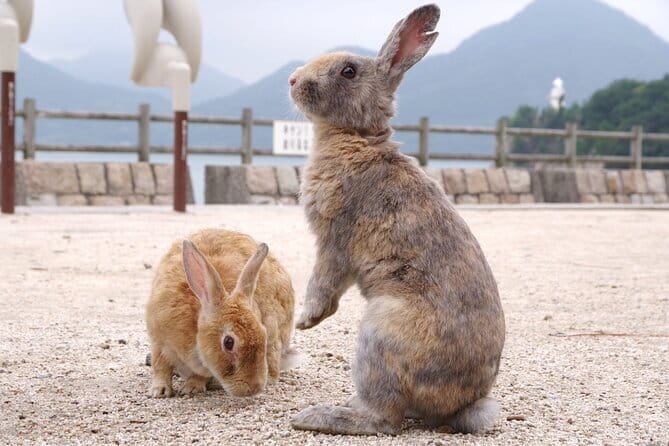
- Wild rabbits share the route: You can see Okunoshima’s famous rabbits around the island, including at the shrine.
- Junko brings the past into focus: Her personal passion for explaining the island’s wartime story is a major part of the experience.
- Six stops fit into two hours: The route covers the lighthouse, shrine, poison gas storage ruins, power plant ruins, and northern cannon battery.
- Cycling makes the island practical: Okunoshima has a circumference of about 4 kilometers, so a bicycle helps you cover more ground without turning the visit into a long hike.
- The group stays small: The maximum is five people, though the tour needs at least two participants to run.
- Bring ferry money: The 360-yen ferry from Tadanoumi to Okunoshima is separate from the tour price.
Why Okunoshima is more than a rabbit stop

Okunoshima sits in the Seto Inland Sea, a small island surrounded by the sea and many other islands. Its modern identity is gentle and unusual: wild rabbits roam freely, the shoreline feels calm, and the island offers a welcome break from crowded city sightseeing.
Yet the island’s past is grim. During wartime, Okunoshima was used for secret poison gas production and storage. Its name was removed from maps, helping keep the work hidden. The old facilities are now silent ruins, but they give the island a weight that a simple rabbit visit would miss.
That contrast is what makes this tour worthwhile. You can stop to watch rabbits, then hear how the same island once operated as a concealed military site. The experience does not treat the rabbits as a distraction from history. Instead, the two sides of Okunoshima sit together, sometimes uncomfortably.
A guide matters here because the ruins alone cannot explain what happened. Junko has been praised for her passion and for helping visitors see the island as more than a place to feed animals. You get context as you cycle, rather than a series of disconnected photo stops.
A few more Hiroshima tours and experiences worth a look
What the two-hour bicycle route covers
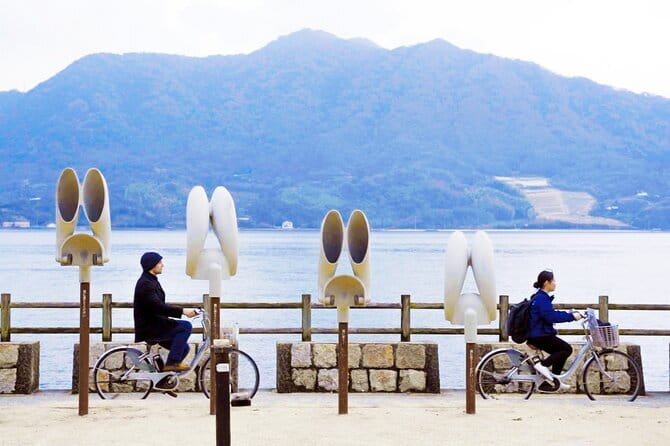
The tour uses bicycles to follow a route around the island, whose circumference is about 4 kilometers. That distance is modest, but cycling still helps because the notable sites are spread out and the tour has several short stops.
The listed schedule adds up to roughly 115 minutes:
- Okunoshima Lighthouse, 10 minutes
- Okunoshima island route, 1 hour
- Okuno Shrine, 10 minutes
- Nagaura Poison Gas Storage Ruins, 10 minutes
- Power Plant Ruins, 10 minutes
- Northern Cannon Battery Remnants, 15 minutes
The timing is fairly brisk. You will not spend a long period at each ruin, so think of this as a guided overview with strong historical interpretation, not an extended archaeology visit. The bicycle keeps the route moving and leaves enough time to see the island’s main points in one outing.
The ride also gives you a better sense of place than a vehicle would. You pass between open views, quiet buildings, rabbit areas, and wartime remains at human speed. That change of mood is central to the tour.
The lighthouse and the first look across the Seto Inland Sea
The lighthouse is a short opening stop, lasting about 10 minutes. You cannot enter it, so this is an exterior viewing point rather than a climb.
That limitation is worth knowing before you book. You are going for the setting and the view, not access inside the tower. From here, you can look out across the Seto Inland Sea and its many islands, which gives the tour an immediate sense of Okunoshima’s location.
I like this as a first stop because it places the island in its wider setting. The sea is not just scenery here. It helped make Okunoshima feel separate and discreet, an important part of understanding why the island could be used for secret work.
Because the stop is short, have your camera ready and listen closely to the guide’s explanation. The tour does not linger at the lighthouse, and the value comes from the combination of the view and the historical setting.
Cycling through Okunoshima’s peaceful present
The main island portion takes about an hour. This is where the bicycle format earns its keep. You can cover much of the island while Junko explains what you are seeing and how the modern rabbit population has shaped Okunoshima’s reputation.
The island is known for hundreds of wild rabbits. They are not confined to a single enclosure, so you may encounter them in different parts of the route. That makes the experience feel less like a standard animal attraction and more like sharing the island with its familiar residents.
Still, keep the rabbit encounters in perspective. They are free-roaming animals, so no particular number or close interaction is guaranteed. The tour’s purpose is also historical, and the guide may shift your attention from the animals to the places and events that shaped the island.
The hour of cycling is likely to be the most varied part of the tour. You get moving views, brief stops, and a chance to notice how a quiet recreation area can conceal a difficult past. The route is not presented as a hard athletic ride, but you should be comfortable on a bicycle and able to manage moderate physical activity.
Okuno Shrine and the island’s rabbit-filled sacred space

Okuno Shrine is the only shrine on Okunoshima. The stop lasts about 10 minutes, and the shrine is also home to rabbits.
This is one of the tour’s more unusual combinations. A shrine already gives you a quiet cultural pause, but seeing rabbits around it adds a distinctly Okunoshima touch. You get a small piece of Japanese religious scenery without leaving the island’s central character behind.
The short time here means you should not expect a long temple-style visit or an extensive religious tour. Instead, it is a compact stop that lets you take in the shrine, the animals, and the surrounding calm.
I would pay attention to how Junko frames this place. The guide is the part of the tour that turns a quick stop into something meaningful. Without explanation, it could be just another pleasant rabbit photo opportunity. With the island’s wider story in mind, it becomes another layer of Okunoshima’s present identity.
Other cycling tours in Hiroshima


Nagaura’s poison gas storage ruins
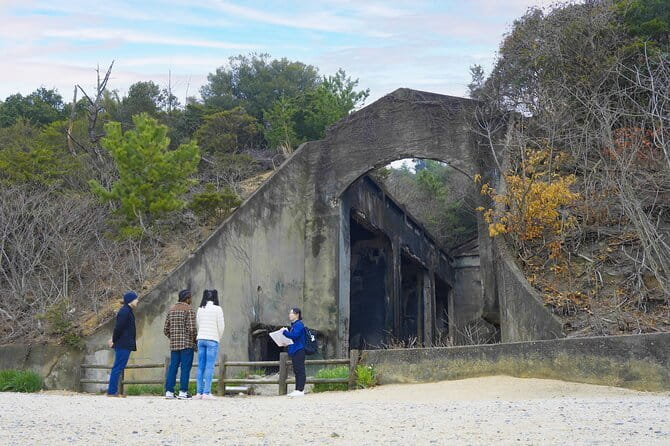
The Nagaura Poison Gas Storage Ruins are one of the clearest reminders that Okunoshima’s peaceful image is incomplete. The building was used to store tanks filled with poison gas.
You cannot enter the ruins for safety reasons. The tour views them from a short distance, so this is not an interior exploration. That may disappoint anyone hoping to walk through the building, but the restriction is sensible given the site’s former use and current condition.
The distance also shapes the mood. You are looking at a quiet structure while learning about the dangerous materials once connected to it. The contrast between the stillness of the island and the purpose of the facility can be more affecting than a polished museum display.
This is a place where a guide’s explanation carries most of the value. The building itself cannot tell you why the island was hidden or what role it played. Junko’s historical account helps supply that missing context.
The power plant ruins and the machinery behind the secret
The Power Plant Ruins receive another 10-minute stop. The plant was used when poison gas was secretly made on Okunoshima.
As with the storage facility, entry is prohibited for safety reasons. You view the ruins from outside and move on. The stop is brief, but it helps you understand that the wartime operation was not limited to one isolated building. Production required an entire working system, including power.
I find this stop useful because it adds structure to the story. The storage ruins show where dangerous materials were kept. The power plant points to the industrial work required to produce them. Together, the sites make the island’s wartime role easier to grasp.
Do not expect a restored industrial complex or a long technical lecture. The tour gives you a concise look at the remains, then connects them to the island’s larger history as you continue cycling.
Northern Cannon Battery Remnants
The northern cannon battery is the longest of the shorter ruin stops, at about 15 minutes. Unlike the poison gas buildings, you can see these gun battery remnants closely.
That access gives the stop a different feel. You are not simply viewing a sealed structure from a distance. You can get nearer to the remains and better understand how the island was also part of a wider defensive network.
The cannon battery adds another military chapter to the tour. Okunoshima was not only a secret production site. Its position in the Seto Inland Sea also made defense a concern. The remains help broaden the story beyond poison gas alone.
This is probably the best stop for readers who want to see physical military remnants up close. Even so, the visit is still limited to about 15 minutes, so the guide’s explanation will matter more than a long period of independent inspection.
What Junko adds to the experience
The guide can make or break a short history tour, and Junko appears to be the key human element here. She has been described as kind and deeply committed to explaining the island’s difficult past, while also helping people appreciate its beauty and rabbits.
That combination matters. A guide who focuses only on rabbits could leave you with a pleasant but shallow outing. A guide who talks only about wartime suffering could make the island feel severe and one-dimensional. Junko’s role is to connect both sides.
You should expect interpretation throughout the ride, not just directions between stops. The experience is built around questions such as why the island disappeared from maps and what happened behind its quiet exterior.
The group size helps. With a maximum of five people, this is more personal than a large coach excursion. It is still a shared tour, so you may ride with other participants, and the minimum group size is two. The small format should make it easier to hear the guide and ask questions, although the precise feel depends on the final group.
Price, ferry cost, and what you receive
The tour costs $59.12 per person. That price includes bicycle use, all tour fees and taxes, and travel insurance.
The ferry is separate. You pay 360 yen for the trip from Tadanoumi to Okunoshima. Food and drinks are also not included, and there is no private transportation provided. These are not large surprises, but add the ferry cost when comparing this tour with a self-guided island visit.
I consider the price reasonable if you want the island’s story explained while you ride. A bicycle alone gives you mobility, but it does not give you the context behind the map removal, poison gas facilities, shrine, and cannon battery. You are paying for the bicycle and for a focused local history experience.
The value is strongest for a first visit. If you already know the island well and prefer to explore every ruin at your own pace, the two-hour format may feel short. If you have limited time and want the main sites tied together, the tour is more efficient than figuring out the route alone.
Timing, weather, and practical planning
The experience lasts about two hours and begins and ends at Kyukamura Ohkunoshima, written in Japanese as 休暇村大久野島. The meeting and end point is in front of the hotel on Okunoshima.
Plan around the ferry. The 360-yen fare from Tadanoumi is not included, and you need to reach the island before the cycling tour begins. Since the meeting point is at the island hotel, do not assume the tour starts on the mainland.
The tour requires moderate physical fitness. You will cycle, make several stops, and spend the experience outdoors. The island is only about 4 kilometers around, but the pace and weather can affect how comfortable the ride feels.
Weather rules are unusually clear. If the Japan Meteorological Agency forecasts a 60 percent or higher chance of rain by noon the day before, the tour can be canceled without a cancellation fee. If poor weather cancels it, you are offered another date or a full refund.
You can cancel for a full refund up to 24 hours before the start time. Changes or cancellations inside that window are not accepted for a refund. Confirmation is sent within 48 hours of booking, subject to availability, and the tour is commonly booked about 27 days ahead, so reserving early is sensible for a particular date.
Who should book this Okunoshima cycling tour
I would choose this tour if you want three things in one short outing: rabbits, island scenery, and a serious account of wartime Okunoshima. It suits first-time visitors who might otherwise see only the animals and miss why the island matters.
It is also a good fit if you prefer a small group. The maximum of five people keeps the experience from feeling like a mass excursion, while Junko’s role gives the ride a personal voice.
Families and casual cyclists may like the manageable island distance, but the moderate fitness requirement still matters. Anyone who dislikes outdoor activities, bicycles, or weather-dependent plans should think twice.
You should not book it expecting long interior visits to the ruins. Several important buildings are closed for safety, and the lighthouse cannot be entered. The tour is about seeing the sites from permitted areas and understanding their purpose.
Should you book it?
Book this tour if you want Okunoshima to mean more than rabbits. The small group, bicycle route, and Junko’s passionate historical guidance make the island easier to understand in a short time.
Skip it if you want a slow, independent day with long stops, or if you are unwilling to plan around the ferry and possible rain. For most first-time visitors who can manage a moderate ride, the $59.12 price offers solid value because it joins the island’s charm to a past that deserves careful attention.
FAQ
How long does the Okunoshima cycling tour last?
The tour lasts approximately two hours.
What is included in the tour price?
The price includes bicycle use, all fees and taxes, and travel insurance.
Is the ferry to Okunoshima included?
No. The ferry from Tadanoumi to Okunoshima costs 360 yen and is paid separately.
Where does the tour start and finish?
The tour starts and ends at Kyukamura Ohkunoshima, at 5476-4 Tadanoumichō, Takehara, Hiroshima. The ending point is in front of the hotel.
How many people can join the tour?
The tour is shared and can have a maximum of five participants. At least two participants are required for it to operate.
Can I enter the lighthouse?
No. Entry to the lighthouse is currently prohibited, so you view it from a short distance.
Can I enter the poison gas storage ruins?
No. For safety reasons, the Nagaura Poison Gas Storage Ruins can only be viewed from a short distance.
Can I enter the power plant ruins?
No. The Power Plant Ruins are closed for safety reasons and are viewed from outside.
What happens if the weather is bad?
If the tour is canceled because of poor weather, you will be offered a different date or a full refund. A cancellation may be made if the Japan Meteorological Agency forecasts a 60 percent or higher chance of rain by noon the day before.
What is the cancellation policy?
You can cancel up to 24 hours before the experience start time for a full refund. Cancellations or changes made less than 24 hours before the start time are not accepted for a refund.
More Guided Tours in Hiroshima


More Cycling Tours in Hiroshima
More Island Hopping & Ferries in Hiroshima

More tours in Hiroshima we've reviewed




Island Hopping & Ferries, compared.
 ★ 5.0Hiroshima and Miyajima Day Trip with Itsukushima Shrine & FerryFrom $45
 ★ 5.0Hiroshima and Miyajima by Bike and BoatFrom $142
 ★ 4.9Hiroshima to Miyajima: Private Custom Tour with Ferry RideFrom $2936 hours
 ★ 5.0Dinner Cruise on HANAIKADA (Raft-Type Boat) with Scenic View of MiyajimaFrom $95
 ★ 5.0Hiroshima: City and Miyajima Bike and Boat TourFrom $1387h 30m
 ★ 5.0From Hiroshima: Rabbit Island and Takehara Town TourFrom $1709h 30m
