
Reviewed · PEACE MEMORIAL TOURS
Hiroshima Walking Tour Why A Bomb was dropped to Hiroshima
Hiroshima’s story becomes easier to grasp when you walk through the city in the order this tour presents it: from the old castle town to the places that now speak for peace. The route connects Hiroshima Castle, the Atomic Bomb Dome, the Children’s Peace Monument, and the Victims Memorial Cenotaph, while your guide explains the events leading to August 6, 1945 and the city’s long recovery.
I like the small-group format, which keeps the walk personal and leaves room for questions. I also like the use of maps, photographs, and short seated talks, especially when guides such as Thomas, Chihiro, Katya, and Emi explain difficult subjects in clear English. The main consideration is that the tour can give you a broad introduction rather than the full detail of a museum visit, and one account found it too focused on general Japanese history.
In This Review
- Key points at a glance
- Why this Hiroshima walk matters
- Starting at Hiroshima Gokoku Shrine
- Hiroshima Castle and the city before 1945
- Hiroshima Green Arena and time to absorb the history
- Orizuru Tower and the change in the city center
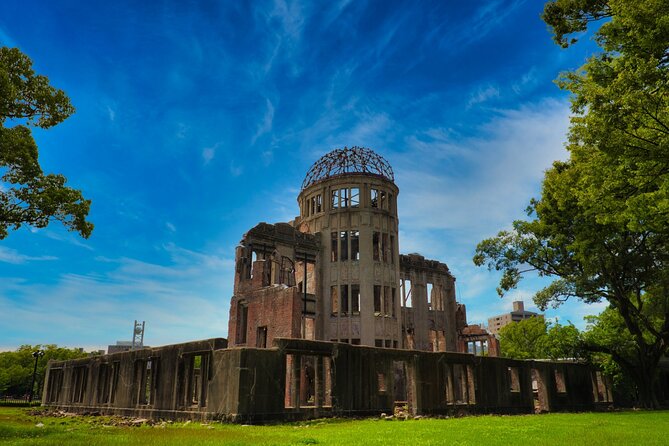
- Facing the Atomic Bomb Dome
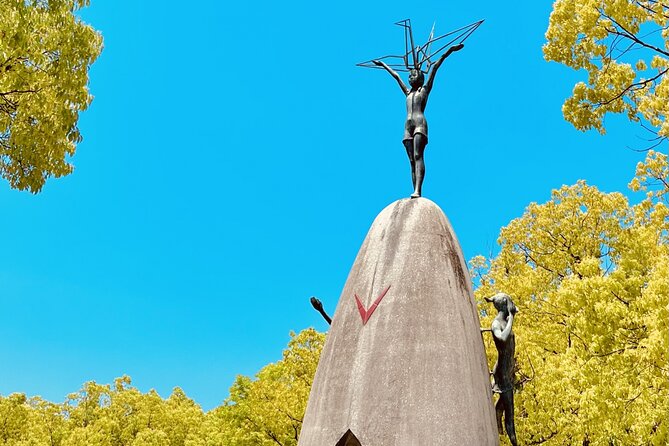
- The Children’s Peace Monument and Sadako’s story
- The Victims Memorial Cenotaph and Peace Park
- How the guides handle a difficult subject
- Walking comfort, group size, and practical details
- Is $28 a fair price?
- Who should book this Hiroshima tour?
- Should you book it?
- FAQ
- How long does the Hiroshima walking tour last?
- Where does the tour begin?
- Where does the tour end?
- What places are included on the route?
- Is admission included?
- How many people can join the tour?
- Can I cancel for a full refund?
Key points at a glance
- A 2.5-hour route with purpose: Walk from Hiroshima Gokoku Shrine through the castle area and Peace Memorial Park.
- Personal local guiding: Guides including Chihiro, Thomas, Katya, Chisa, and Emi bring different stories and teaching styles.
- Useful visual aids: Maps and old photographs help you connect the modern city with its wartime past.
- Mostly easy walking: The route is largely flat, with stops to sit and listen.
- Important memorial sites: See the Atomic Bomb Dome, Children’s Peace Monument, and Victims Memorial Cenotaph.
- Good value at $28: The fee is modest for a guided introduction, though the museum visit itself needs separate time.
Why this Hiroshima walk matters
Hiroshima is not simply a place to check off a few war memorials. It is a functioning Japanese city shaped by a terrible event and by an active commitment to peace. A good guide helps you see both sides: the city before the bombing, the destruction of 1945, and the rebuilt community you see today.
This tour begins away from the most famous memorials. That is a smart choice. Starting at Hiroshima Gokoku Shrine and Hiroshima Castle gives you a sense of Hiroshima as a castle town before the atomic bomb. You then move toward Peace Memorial Park, where the tone becomes more solemn and reflective.
The title promises an explanation of why the bomb was dropped on Hiroshima. The strongest guides appear to handle that subject by setting out the wider Japanese and American wartime context, the development of the bomb, and the effects on civilians. You should expect history rather than a political argument. The best part is the chance to ask questions and hear how the guide connects the event to Hiroshima today.
A few more Hiroshima tours and experiences worth a look
Starting at Hiroshima Gokoku Shrine
The meeting point is Hiroshima Gokoku Shrine, at 21-2 Motomachi in Naka Ward. The shrine offers a calm beginning, with traditional architecture and a quiet setting near the castle grounds. It was created to honor protective deities associated with Hiroshima domain, giving the first stop a link to the city’s older identity.
You spend about 20 minutes here, and admission is free. This is not a long shrine tour, so think of it as an orientation stop rather than a major religious sightseeing visit. Your guide uses the setting to begin explaining Hiroshima before 1945.
This opening also helps you settle into the walking pace. You are not thrown straight into the most painful part of the city’s story. Instead, you first see that Hiroshima had a long civic and cultural life before it became known around the world for the atomic bombing.
Hiroshima Castle and the city before 1945
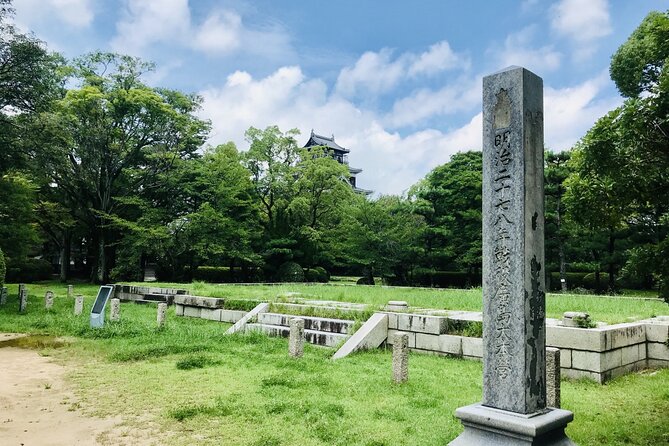
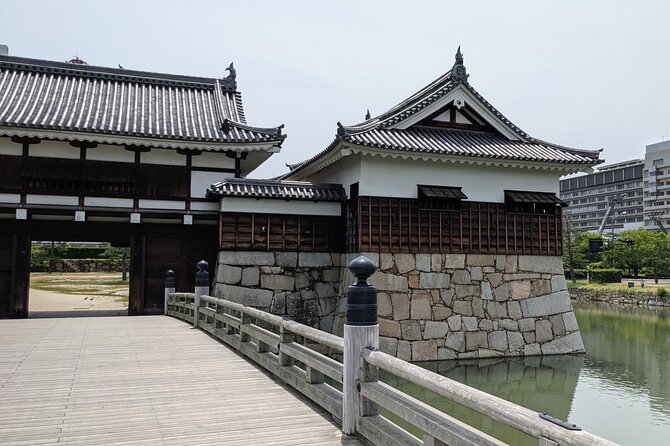
Hiroshima Castle, often called Carp Castle, was first built in the 1590s as the residence of the feudal lord of Hiroshima domain. The castle grounds provide a useful contrast with the later memorial sites. Here, the focus is on political power, urban growth, and the city’s place in Japanese history.
The tour allows about 20 minutes at the castle, with no separate admission charge for this stop. The stated route takes you to the grounds rather than promising an interior visit. If entering the castle is important to you, ask your guide about the plan on the day or return later with extra time.
I like this stop because it prevents Hiroshima from being reduced to one date and one tragedy. You begin to understand the city as a historic center, not only as the target of a wartime weapon. That context makes the later walk through Peace Memorial Park more meaningful.
Hiroshima Green Arena and time to absorb the history
The route includes about 30 minutes at Hiroshima Green Arena, officially Hiroshima Prefectural Sports Center. It is a modern multipurpose indoor venue used for sports and other events. At first, this may seem less connected to the tour’s central subject than the castle or Atomic Bomb Dome.
Its value is the contrast. Hiroshima is not frozen in 1945. People gather here for ordinary modern life, public events, and recreation. A walk that includes a present-day civic building shows how the city has rebuilt and how daily life continues alongside memorial spaces.
The longer stop may also offer a chance to pause. Several guides have been praised for breaking up the walk with short talks while the group sits. That matters on a subject this serious. A nonstop stream of facts can become tiring, but a measured pace gives you time to listen and ask questions.
Orizuru Tower and the change in the city center
The route also passes Orizuru Tower, the modern 13-story building beside Hiroshima Peace Memorial Park. It opened in 2016 and adds a contemporary architectural note next to the park’s memorial spaces.
The supplied schedule does not give a fixed duration for this stop, so you should treat it as a passing point or brief visit rather than assume a long tower experience. The building’s location is useful in itself. Within a short walk, you see new Hiroshima beside places that preserve the memory of the bombing.
That contrast is one of the tour’s recurring ideas. Hiroshima remembers, but it also keeps moving. Your guide may use the modern buildings and renewed streets to explain how the city rebuilt itself after the destruction.
A few more Hiroshima tours and experiences worth a look

Facing the Atomic Bomb Dome
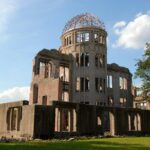
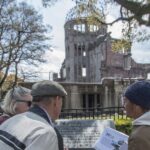
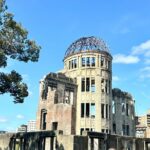
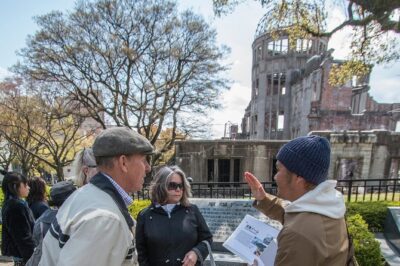
The Atomic Bomb Dome is the emotional turning point of the walk. Before the bombing, the building was the Hiroshima Prefectural Industrial Promotion Hall. Because it stood near the blast’s center and part of its structure remained, it became one of the clearest physical reminders of the destruction.
The tour allows about 20 minutes here, with admission listed as free. You will have time for photographs and questions, but this is not an extended architectural study. The guide’s explanation is what gives the damaged structure its full meaning.
I recommend paying attention to the setting as much as the building itself. The dome is surrounded by a living city, river views, paths, and people going about their day. That ordinary activity can feel unsettling at first, yet it also shows the distance between the destruction of 1945 and Hiroshima’s present.
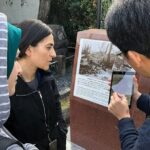
Several guides use old photographs and maps at stops like this. Those visual aids help you understand the blast’s location, the spread of damage, and the difference between the prewar city and the city you see now. If you have children, a guide such as Thomas may keep them involved with simple explanations and even a bit of Pokémon knowledge, according to one family’s experience.
The Children’s Peace Monument and Sadako’s story
The Children’s Peace Monument is in Peace Memorial Park and honors Sadako Sasaki along with the many children who died in the atomic bombing. Sadako’s story has become closely linked with paper cranes and the hope for a world without nuclear weapons.
The planned visit lasts about 10 minutes. That is enough for an explanation and a quiet look, but not enough for a long personal reflection if the site affects you strongly. You may want to return later after the tour when you can spend time at your own pace.
This stop often makes the history more immediate for families. The subject is still painful, but focusing on children and on Sadako’s life gives the memorial a human scale. A guide who explains the story carefully can help you avoid treating the monument as just another photo stop.
The Victims Memorial Cenotaph and Peace Park
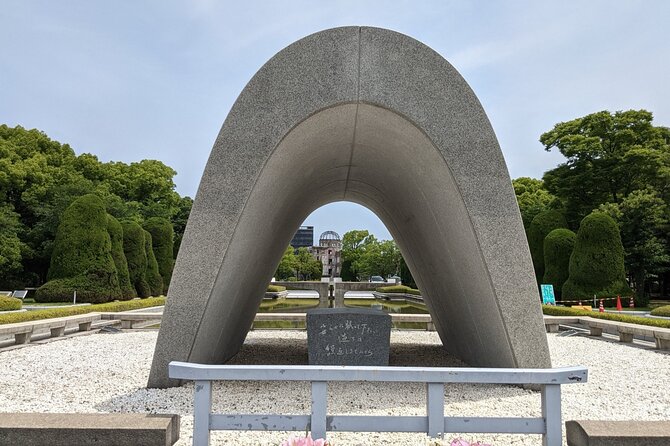
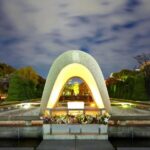
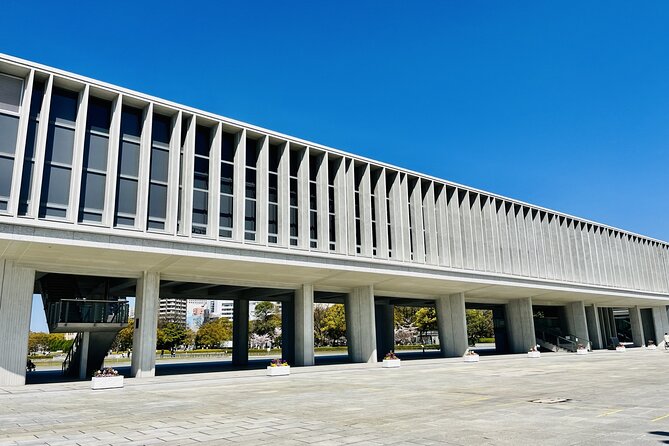
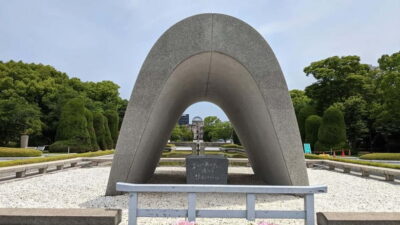
The Hiroshima Victims Memorial Cenotaph is the longest scheduled stop, at about 30 minutes. It sits in Hiroshima Peace Memorial Park, a place dedicated to those who died in the atomic bombing on August 6, 1945.
This is where the tour’s separate threads come together. You have seen Hiroshima’s older castle identity, modern public life, the physical remains of the bomb, and a memorial dedicated to children. At the cenotaph, the focus turns directly to the victims and to the city’s message of peace and reconciliation.
Guides have been praised for explaining not only the bombing but also Hiroshima’s development after the war. That second part deserves attention. The city’s message is not only about mourning. It is also about preventing another nuclear attack and teaching future generations what happened.
The walking route ends in front of the Hiroshima Peace Memorial Museum, at 1-2 Nakajimacho. The museum is not listed as one of the timed tour stops, so plan a separate visit if you want its exhibits. One guide specifically pointed out that the museum is well worth seeing.
How the guides handle a difficult subject
Guide quality is central here. The subject is too serious for a rushed script, and the strongest guide accounts describe people who were clear, warm, and able to answer questions without losing focus.
Thomas is repeatedly described as easy to talk with, well prepared, and good at making complicated history simple. He reportedly used two short talks to explain the factors leading to the bombing and the aftermath, while keeping the group on schedule. That style may suit families and anyone who prefers a structured explanation.
Chihiro is praised for combining strong historical knowledge with a personal element. Chisa is noted for explaining the Japanese view of the events and their long effect on the city. Katya has been described as enthusiastic and especially good at covering Hiroshima before and after 1945.
One especially meaningful detail is that a guide has spoken about having a family connection to a bomb survivor. Personal experience can add depth, but it should never replace careful historical context. The best version of this tour appears to use personal stories as a human link while still explaining the larger events.
English ability has generally been strong, with guides praised for clear explanations. Still, different guides have different delivery styles. One 3-star account found the walk too general and felt it could be followed from a guidebook. That is a useful warning: if you want a specialist-level study of military planning or nuclear policy, you will need the museum and further reading.
Walking comfort, group size, and practical details
The experience lasts about 2 hours and 30 minutes. The route is described as mostly flat, with sites close together and several chances to stop for photographs or questions. You should wear comfortable shoes, but this is not presented as a strenuous hike.
The group is advertised as small, with a maximum of 12 in the main tour description. The additional booking information gives a maximum of 15, so the exact size may vary. Either way, it is designed to be more personal than a large coach excursion.
The tour uses a mobile ticket, and confirmation arrives when you book. It starts at Hiroshima Gokoku Shrine and ends at the Peace Memorial Museum, which makes the location practical if you plan to continue exploring Peace Memorial Park afterward.
Bring your own water, since bottled water is not included. Service animals are allowed, and the activity is near public transportation. Most people can take part, but anyone who finds long periods of standing difficult should tell the operator or guide in advance.
Is $28 a fair price?
At $28 per person, this is a reasonable price for a guided 2.5-hour introduction to Hiroshima’s central historic and memorial sites. The route covers several places that are free to enter, so you are paying mainly for the guide’s explanations, organization, visual materials, and the chance to ask questions.
The value is highest if you are visiting Hiroshima for the first time and want help connecting the sites. A guide can explain why the castle matters, how the Atomic Bomb Dome fits into the city’s story, and why Peace Memorial Park is arranged as it is. That saves you from treating each stop as an isolated landmark.
The value is lower if you already know Hiroshima’s history well or prefer reading at your own pace. The tour does not replace the Peace Memorial Museum, and one account found the history too broad. I would see the $28 fee as a good first step, then use the museum to add detail and emotional weight.
Free cancellation is available up to 24 hours before the start time. Changes or cancellations inside that window are not accepted for a refund.
Who should book this Hiroshima tour?
I would recommend this walk to first-time visitors, families, and anyone who wants a clear introduction before entering the museum. It also suits people who want to understand Hiroshima from a Japanese perspective rather than rely only on a short textbook account.
The tour is a good fit if you value conversation. The guides have been praised for answering questions about Japan more broadly, not just the bombing. Children may stay engaged because the walk includes varied sites, photographs, maps, and breaks rather than one long lecture.
I would choose another option, or add more time afterward, if your main interest is detailed military history, the mechanics of the bomb, or a full account of civilian life in wartime Hiroshima. The title may sound narrower than the actual route, which includes general Japanese history and the city’s long-term development.
Should you book it?
Book this tour if you want a thoughtful, affordable way to connect Hiroshima’s major sites in one morning or afternoon. Its best qualities are the manageable pace, personal guides, small-group setting, and movement from historic Hiroshima to the memorial park.
Do not treat it as a substitute for the Peace Memorial Museum. Use the walk to build a framework, listen carefully at the Dome and cenotaph, then give yourself time at the museum and Children’s Peace Monument. With that plan, the tour offers a humane introduction to Hiroshima’s past and its continuing call for peace.
FAQ
How long does the Hiroshima walking tour last?
The tour lasts approximately 2 hours and 30 minutes.
Where does the tour begin?
The meeting point is Hiroshima Gokoku Shrine, at 21-2 Motomachi, Naka Ward, Hiroshima.
Where does the tour end?
The tour ends in front of the Hiroshima Peace Memorial Museum at 1-2 Nakajimacho.
What places are included on the route?
The route includes Hiroshima Gokoku Shrine, Hiroshima Castle, Hiroshima Green Arena, Orizuru Tower, the Atomic Bomb Dome, the Children’s Peace Monument, and the Hiroshima Victims Memorial Cenotaph.
Is admission included?
All fees and taxes are included, and the listed stops have free admission. The tour ends at the Peace Memorial Museum, but a separate museum visit is not listed as a timed tour stop.
How many people can join the tour?
The main description gives a maximum of 12 guests for the small-group tour. Additional information lists a maximum of 15 travelers, so the group size may vary.
Can I cancel for a full refund?
Yes. You can cancel at least 24 hours before the experience start time for a full refund. Cancellations or changes made less than 24 hours before the start time are not accepted for a refund.
More Walking Tours in Hiroshima

More Hiroshima City Tours in Hiroshima
More Peace Memorial Tours in Hiroshima

More tours in Hiroshima we've reviewed



Peace Memorial Tours, compared.
 ★ 4.8Hiroshima Historical Walking Tour – Why A-Bomb was DroppedFrom $352h 30m
 ★ 5.0Hiroshima Peace (Heiwa) Walking Tour at World Heritage SitesFrom $94
 ★ 4.9Hiroshima: Miyajima Peace Memorial Icons of Peace and BeautyFrom $1638 hours
 ★ 5.0Hiroshima 2hr Peace Cycling Tour with Local GuideFrom $59
 ★ 4.8Hiroshima: Peace Cycling Tour with Local GuideFrom $522 - 3 hours
 ★ 4.9Hiroshima: Peace Walking Tour of World Heritage SitesFrom $924h 30m
