
Reviewed · PEACE MEMORIAL TOURS
Walking Through History: Hiroshima’s Path to Peace
Hiroshima’s Peace Park is easier to understand when someone connects its monuments, names, and personal stories. This two-hour walking tour moves from the Atomic Bomb Dome through the park’s major memorials, ending at the Gates of Peace, with guides such as Ghani and Sheraz explaining what you are seeing.
I like the small maximum group of eight, which allows for questions and a pace that can suit the group. I also like that the Peace Memorial Museum ticket is bought ahead of time, saving you from waiting at the entrance.
The main consideration is that the museum visit is self-guided. Your guide cannot speak inside, and the listed museum time is only about 10 minutes, so you should plan extra time afterward if you want to read the exhibits carefully.
In This Review
- Key points at a glance
- Why this Hiroshima walk works so well
- Starting at the Atomic Bomb Dome
- Hearing the Peace Bell and considering its message
- Remembering Korean victims and survivors
- The Children’s Peace Monument and Sadako’s cranes
- The Peace Flame and the Cenotaph
- A quiet pause at the National Peace Memorial Hall
- The Peace Memorial Museum, with entry arranged ahead
- Ending at the Gates of Peace
- Pace, group size, and practical comfort
- Is $31.63 a fair price?
- Who should book this Hiroshima tour?
- Should you book Walking Through History: Hiroshima’s Path to Peace?
- FAQ
- How long does the Hiroshima peace tour last?
- How much does the tour cost?
- What landmarks are included?
- Is the Peace Memorial Museum ticket included?
- Does the guide accompany me inside the museum?
- How large is the group?
- Can I cancel the tour for a refund?
Key points at a glance
- A complete Peace Park route: Visit the Atomic Bomb Dome, Peace Bell, Korean Victims Monument, Children’s Peace Monument, Peace Flame, Cenotaph, Peace Museum, and Gates of Peace.
- Small-group attention: The tour accepts no more than eight people, making it easier to ask questions and adjust the walking pace.
- Personal stories matter: Guides explain the human cost of the bombing through survivor accounts, local stories, and the story of Sadako Sasaki.
- Flat, manageable walking: The route is generally an easy walk, though you should wear comfortable shoes and prepare for heat in summer.
- Museum entry included: Your ticket is purchased in advance, but the museum portion is completed on your own.
- Useful for a short Hiroshima visit: The two-hour format works well if you are coming from Kyoto for the day or fitting Hiroshima into a tight schedule.
Why this Hiroshima walk works so well
Hiroshima’s Peace Park can feel calm and open, yet nearly every path leads to something heavy. Without context, you may see a bell, a flame, a child’s statue, and a stone monument without understanding how they connect.
This tour gives those sites a clear order. You begin at the Atomic Bomb Dome, then walk through monuments that broaden the story from destruction to remembrance, international reconciliation, and the hope of abolishing nuclear weapons.
I especially like the way the route combines famous sights with memorials many people might pass without noticing. The monument to Korean victims and survivors is an important part of that wider story. It reminds you that the bombing affected people from outside Japan as well as Hiroshima residents.
The guides also keep the walk interactive. Sheraz has used questions to involve the group rather than simply speaking at everyone, while Ghani has been praised for patient pacing, local anecdotes, and careful explanations. Cva has been described as putting a human face on an inhumane event, which is exactly the tone you want here: serious, but personal rather than coldly academic.
A few more Hiroshima tours and experiences worth a look
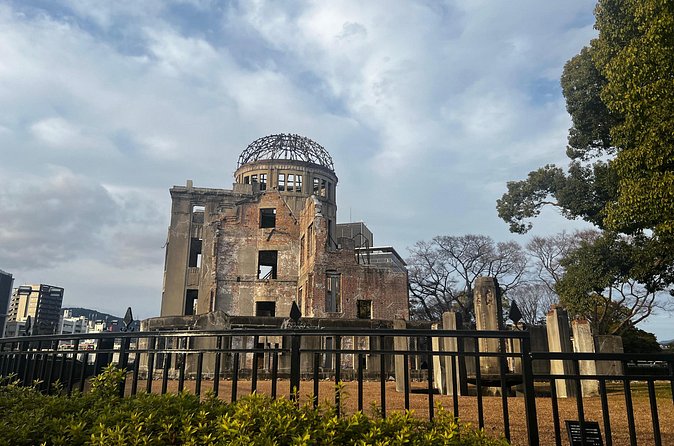
Starting at the Atomic Bomb Dome
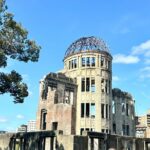
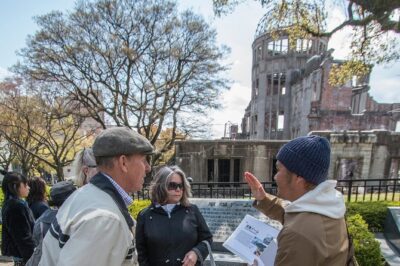
The tour begins at 1-chōme-10-1 Ōtemachi in Naka Ward, near the Peace Park area. Your first major stop is the Atomic Bomb Dome, the best-known reminder of the city before and after August 1945.
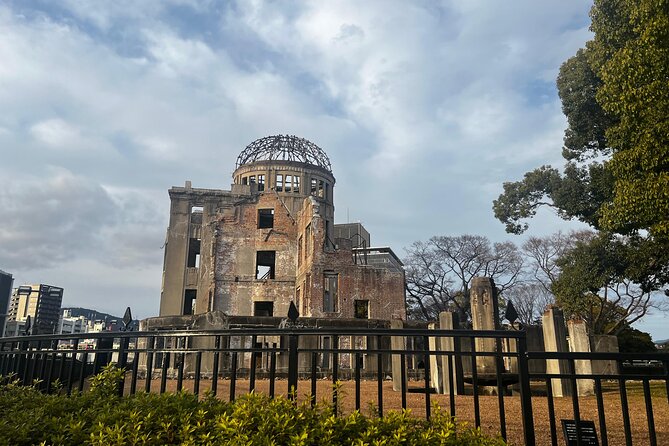
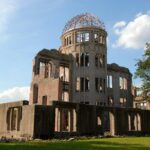
You have about 20 minutes here. That is enough time to look closely at the exposed brick, ruined walls, and skeletal frame, while your guide explains why this building survived in such a damaged form. The structure is powerful partly because it is not polished or restored into something comfortable. The broken remains force you to face the event directly.
Your guide can also help place the Dome within Hiroshima’s modern story. It is not just an old building or a photo stop. It links the city’s wartime past with its later role as an international voice for peace.
Admission to this stop is free. Bring your camera if you want it, but give yourself time to look rather than rushing straight to photographs. This is one of the moments when a guide adds real value, since the physical remains alone cannot explain everything you are seeing.
Hearing the Peace Bell and considering its message
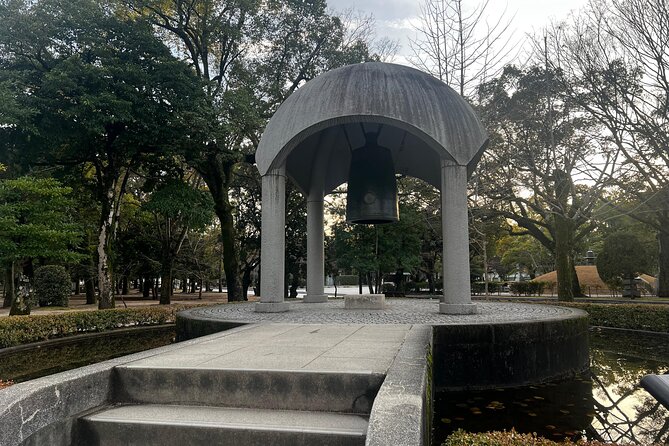
The Peace Bell receives about 10 minutes. Its message is simple: harmony and a world without nuclear weapons.
The attraction here is not a long list of facts. It is the chance to pause and think about how Hiroshima has chosen to present its future. The bell’s deep sound is meant to call people toward unity, and your guide can explain how this monument fits the larger purpose of the park.
Ten minutes may feel brief, but that is suitable for a reflective stop. The tour does not linger so long that every monument begins to blur into the next. At the same time, the small group makes it easier to ask for more detail if a particular site catches your attention.
Remembering Korean victims and survivors
The Monument to Korean Victims and Survivors gives the route a wider human frame. About 10 minutes are set aside here.
This stop recognizes Korean people who died or survived the bombing, along with their place in Hiroshima’s story. It is an important reminder that wartime suffering did not fit neatly inside national borders. A visit focused only on Japanese victims would leave out part of what happened.
I consider this one of the most valuable stops because it encourages a fuller conversation about memory. The monument is connected with remembrance, reconciliation, and the search for lasting peace, not only grief.
One point to keep in mind is that the tour’s peace message may not give equal attention to every part of Japan’s wartime conduct. If you want a detailed treatment of Japan’s role as the aggressor and its attempt to expand alongside Germany, you should raise that question with your guide or spend more time at the museum. The tour is primarily centered on Hiroshima’s victims, memory, and peace movement.
The Children’s Peace Monument and Sadako’s cranes
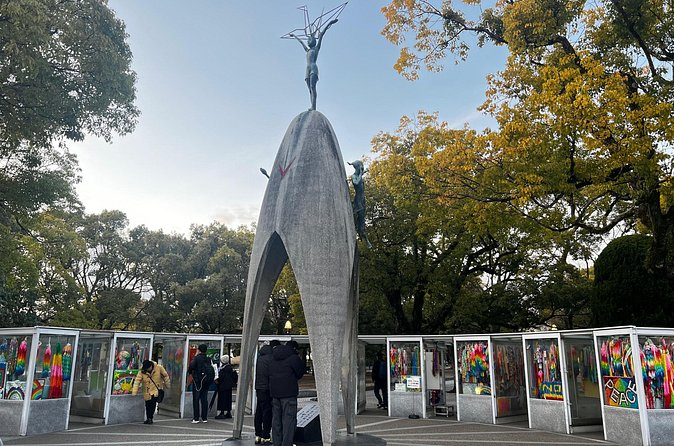
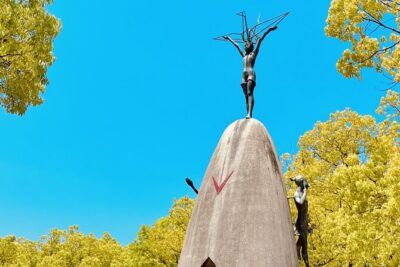
The Children’s Peace Monument is another 10-minute stop, and it brings the story down to an individual scale.
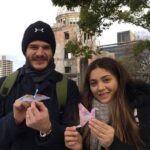
The monument was inspired by Sadako Sasaki, a young girl who folded paper cranes while hoping to survive the effects of the bombing. The cranes around the statue give this site a distinct visual character, but the story behind them is what makes the stop so moving.
Your guide can help you understand why Sadako’s story has become linked with children affected by war and with the wider message of peace. The monument is dedicated to children who died because of the bombing, so this is not simply a story about one person.
I would not rush this section. Ten minutes is the planned stop, but the park gives you room to look quietly and take photographs. The pace can also be adjusted. Ghani has been praised for slowing down when someone had a knee injury, and other groups have found him patient when stopping for photos. That flexibility matters on a walking tour built around solemn places.
A few more Hiroshima tours and experiences worth a look

The Peace Flame and the Cenotaph
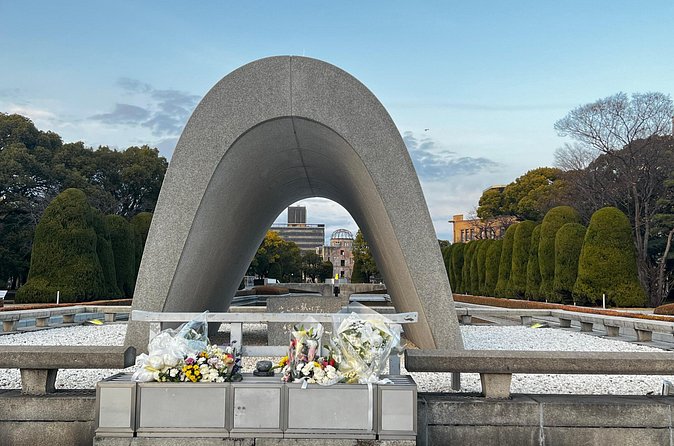
The Peace Flame has burned continuously since 1964. It represents a commitment to a world without nuclear weapons and is intended to remain lit until nuclear arms are abolished.
You have about 10 minutes here. The flame is a small physical object carrying a very large idea, and your guide can connect it to the other peace symbols you have already seen. After the Dome’s ruined structure and the Children’s Monument’s personal story, the flame shifts attention toward a continuing global goal.
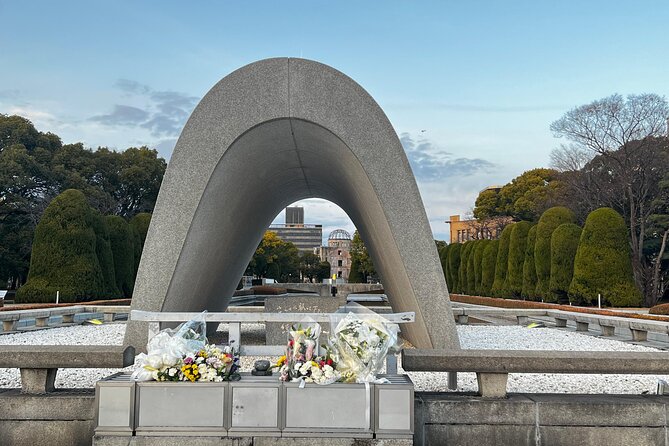
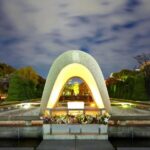
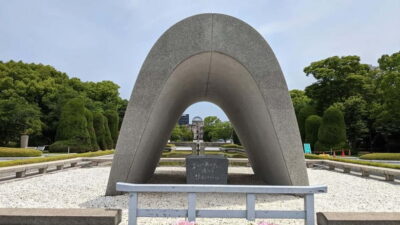
The Hiroshima Peace City Monument Cenotaph for the Atomic Bomb Victims receives another 10 minutes. Its curved form contains the names of known victims and aligns with the Peace Flame and the Atomic Bomb Dome. The design creates a visual line through the park, linking the dead, the city’s memory, and its hope for peace.
The inscription asks that the souls resting there find peace and that the evil not be repeated. Even without spending a long time here, the shape and position of the cenotaph make the park’s message easy to grasp.
This portion of the route is also useful for understanding why the park feels carefully planned rather than like a random collection of monuments. Each stop adds another layer: the destroyed city, the victims, the children, the international community, and the wish to prevent another nuclear attack.
A quiet pause at the National Peace Memorial Hall
The Hiroshima National Peace Memorial Hall for the Atomic Bomb Victims offers about 20 minutes of quiet reflection. It honors the dead through photographs, personal accounts, and survivor testimonies.
This is one of the most intimate parts of the walk. Outdoor monuments are public and symbolic. Inside the hall, the focus shifts toward individual lives and memories. That change helps prevent the bombing from becoming only a date in a history lesson.
The 20-minute visit gives you enough time to absorb the setting, though you may want to return later if you prefer to move slowly through personal material. This stop is especially useful for anyone who wants more than military history. It brings attention to ordinary people and the long human cost of the bombing.
If you have mobility concerns, tell your guide early. The walk is generally flat, but the group’s pace and rest points can make a real difference. One guide has already shown care for a participant with a knee problem, and the small group makes that kind of adjustment more realistic.
The Peace Memorial Museum, with entry arranged ahead
The Hiroshima Peace Memorial Museum is the tour’s main indoor visit, but the format needs careful explanation. Your entrance ticket is purchased in advance, so you can skip the long ticket line.
The listed time is about 10 minutes, which is not enough for a full museum visit. Your guide is not allowed to speak inside, so you enter on your own and view the exhibits independently. Think of this tour as an introduction to the museum, not a complete museum tour.
The museum is where you can spend more time with artifacts, photographs, survivor testimonies, and explanations of the bombing’s effects. If you have only two hours available, the prepaid ticket is useful. If you have a free afternoon, return to the museum after the walking tour and give it the time it deserves.
The museum portion also offers a chance to consider the tour’s balance. The walk focuses strongly on remembrance and peace. Museum exhibits can help you build a broader understanding of Hiroshima, the war, the bombing, and Japan’s own wartime actions.
Ending at the Gates of Peace
The route ends at the Gates of Peace at 4-15 Nakajimachō. You have about 20 minutes here.
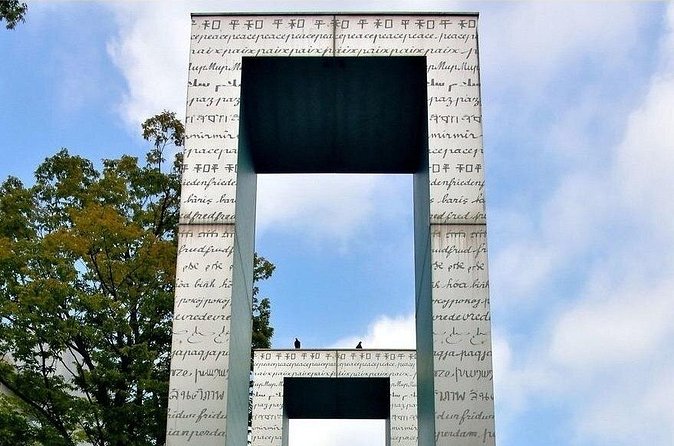
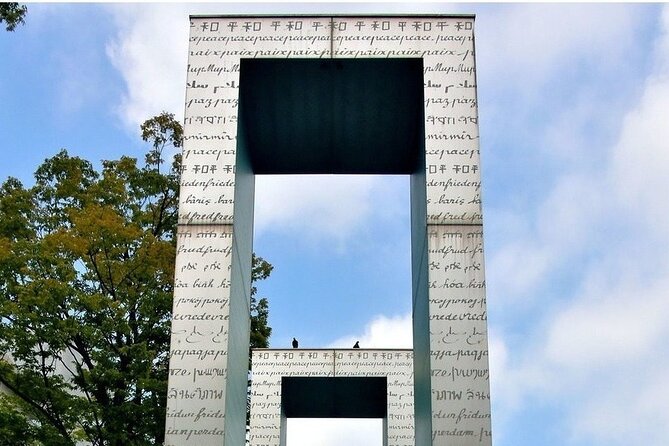
The ten glass gates are inscribed with the word peace in many languages. They present Hiroshima’s message as a global one, not a concern limited to Japan. After the darker stops earlier in the route, the gates provide a clear closing image.
Ending here also makes practical sense. You finish with a visible landmark and a straightforward point for continuing your day. The start and end points are in the Peace Park area, and the route is near public transportation.
Pace, group size, and practical comfort
The tour lasts about two hours, with roughly 120 minutes assigned across the nine stops. That makes it an efficient overview rather than a slow, open-ended walk.
The small group limit of eight is a major advantage. You can hear the guide more easily, ask questions without holding up a large crowd, and tell the guide if you need a slower pace. The walking is generally flat, but the total time on your feet still makes comfortable shoes a smart choice.
Summer heat can be severe. One group completed the walk on an oppressively hot day, and the guide used shaded places for explanations and allowed quiet time at each stop. You should still bring water and avoid treating the two-hour estimate as a reason to rush.
The experience is designed for most people, and service animals are allowed. Confirmation arrives when you book. Free cancellation is available up to 24 hours before the start time, but cancellations or changes made inside that window are not accepted for a refund.
Is $31.63 a fair price?
At $31.63 per person, the value depends on how much help you want with context. All the outdoor monuments have free admission, so you are paying mainly for the guide’s time, organization, interpretation, small group, and prepaid museum entrance.
I think the price is fair for a first visit, particularly if Hiroshima is a day trip from Kyoto. One couple came from Kyoto by train, hoping to make the most of a short visit, and found the two-hour format worthwhile. That is the key value here: you can cover the major memorials in a sensible order without spending your limited time figuring out what each one means.
The tour is less useful if you prefer to read every plaque alone or already know the park well. It is also not a substitute for spending a full session inside the museum. Still, having an engaged guide such as Ghani, Sheraz, Cva, or Sharain can turn a series of monuments into a connected story.
Who should book this Hiroshima tour?
I would choose this walk if you are visiting Hiroshima for the first time, have only a few hours, or want a thoughtful introduction before exploring the museum independently. It suits people who enjoy asking questions and hearing personal stories rather than simply ticking off famous sights.
It is also a good fit for families and mixed-age groups, since the pace can be adjusted and the route is mostly flat. People with knee or stair concerns should mention this at the start, even though the route is described as an easy walk.
I would choose something longer if you want extensive museum time, a detailed account of Japan’s wartime actions, or a slow photography walk. This experience gives you the framework. You may want to add your own time afterward for the parts that call for more thought.
Should you book Walking Through History: Hiroshima’s Path to Peace?
Yes, if you want a well-paced introduction to Hiroshima’s Peace Park and need to make good use of a short visit. The combination of the Atomic Bomb Dome, lesser-known memorials, personal stories, and prepaid museum entry gives you more than a quick stroll.
Book it with realistic expectations. The museum is self-guided, the two-hour schedule moves along, and the emotional subject deserves time beyond the formal route. Wear good shoes, prepare for heat, and ask questions about any historical angle you feel is missing.
For $31.63, the tour offers solid value for first-time visitors, day-trippers from Kyoto, and anyone who wants Hiroshima’s memorials explained with care rather than viewed in isolation.
FAQ
How long does the Hiroshima peace tour last?
The tour lasts approximately two hours.
How much does the tour cost?
The price is $31.63 per person.
What landmarks are included?
The route includes the Atomic Bomb Dome, Peace Bell, Monument to Korean Victims and Survivors, Children’s Peace Monument, Peace Flame, Hiroshima National Peace Memorial Hall for the Atomic Bomb Victims, Cenotaph for the Atomic Bomb Victims, Hiroshima Peace Memorial Museum, and Gates of Peace.
Is the Peace Memorial Museum ticket included?
Yes. The entrance ticket is purchased in advance and included with the experience.
Does the guide accompany me inside the museum?
No. Guides are not allowed to speak inside the museum, so you visit the museum on your own.
How large is the group?
The tour has a maximum of eight people.
Can I cancel the tour for a refund?
Yes. You can cancel up to 24 hours before the experience starts for a full refund. Changes or cancellations made less than 24 hours before the start time are not accepted for a refund.
More Walking Tours in Hiroshima

More Hiroshima City Tours in Hiroshima
More Peace Memorial Tours in Hiroshima

More tours in Hiroshima we've reviewed



Peace Memorial Tours, compared.
 ★ 4.8Hiroshima Historical Walking Tour – Why A-Bomb was DroppedFrom $352h 30m
 ★ 5.0Hiroshima Peace (Heiwa) Walking Tour at World Heritage SitesFrom $94
 ★ 4.9Hiroshima: Miyajima Peace Memorial Icons of Peace and BeautyFrom $1638 hours
 ★ 5.0Hiroshima Walking Tour Why A Bomb was dropped to HiroshimaFrom $28
 ★ 5.0Hiroshima 2hr Peace Cycling Tour with Local GuideFrom $59
 ★ 4.8Hiroshima: Peace Cycling Tour with Local GuideFrom $522 - 3 hours
