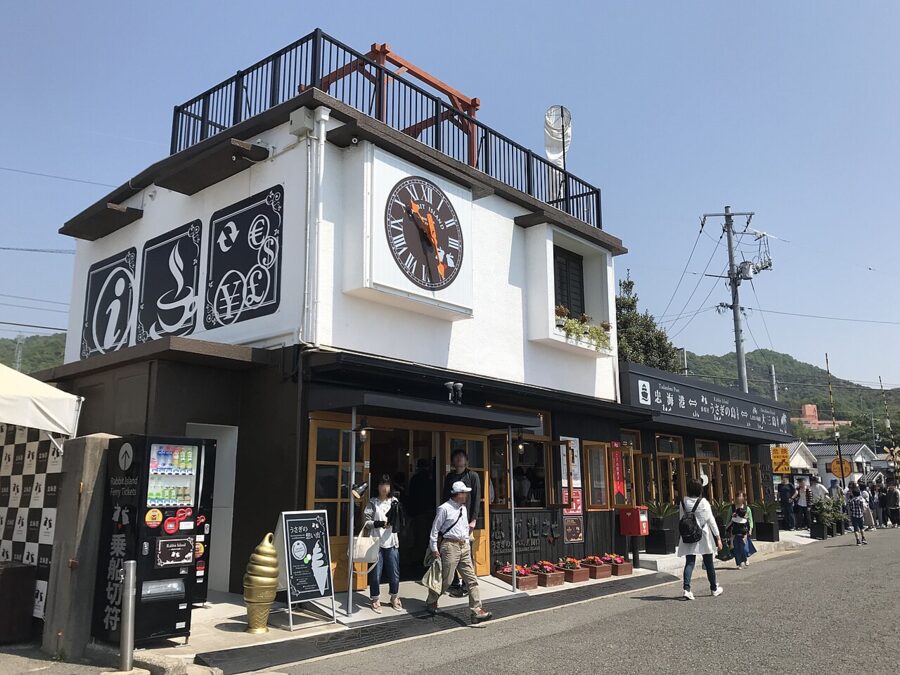
The ferries at Tadanoumi (忠海) leave by a clock two metres across, mounted on the port building, and the rabbit on its face sits at four o’clock for a reason the port leaves you to puzzle out. Fifteen minutes after the boat pulls away, the first real rabbits are waiting on the pier at Ōkunoshima (大久野島), noses twitching at every bag that comes ashore.
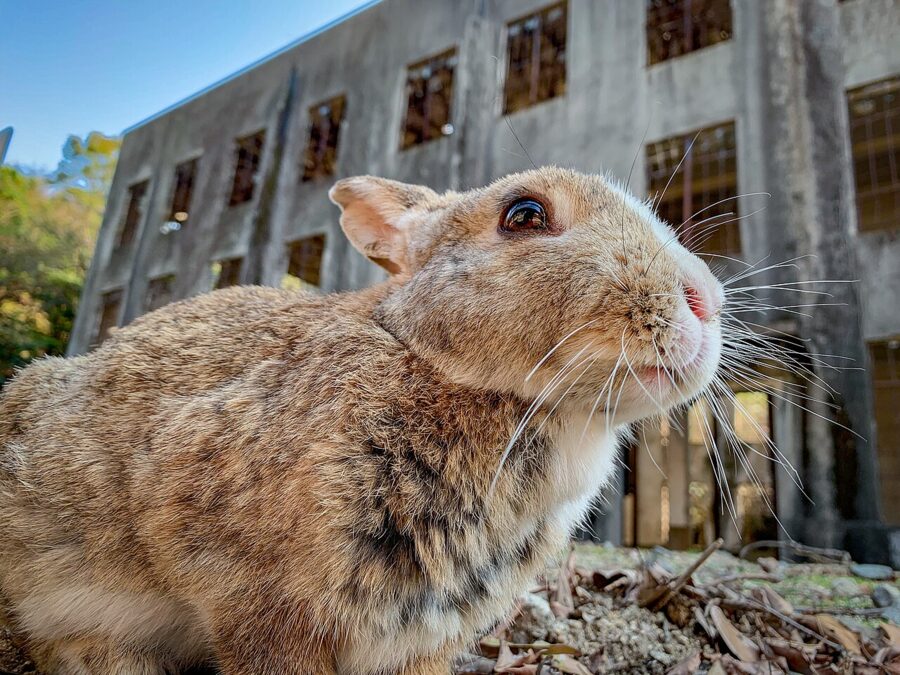
A few minutes’ walk from that pier stands the other half of the island’s story: a tall concrete power station with empty window frames, built to run a factory that made mustard gas and lewisite for the Imperial Japanese Army from 1929 until 1945. For years the island was left off public maps. Now it sits inside the Setonaikai National Park, about 200,000 people a year come across, and nearly all of them come for the rabbits.
You can see both sides in half a day from Hiroshima, and plenty of people do. I would give it longer: an early boat, the four-kilometre loop past the ruins, an hour in the museum, and if you can manage it, a night at the island’s one hotel, when the day visitors leave on the evening boats and the rabbits come out in the cool.

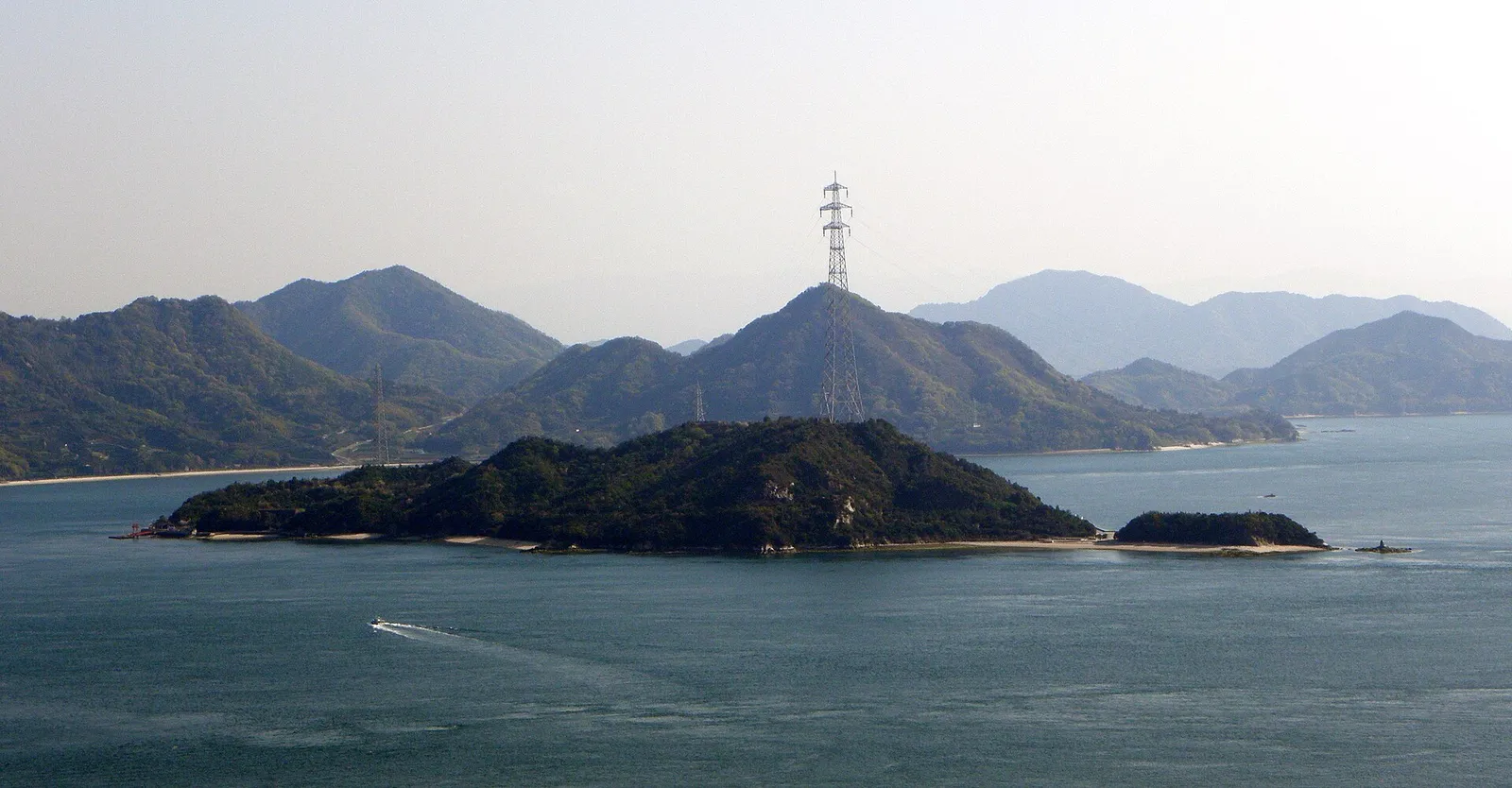
The island is small: about 70 hectares and 4.3 kilometres round, three kilometres off the coast of Takehara in eastern Hiroshima Prefecture. Apart from the hotel staff nobody lives there, there are no ordinary cars, and everything you need for the day, from rabbit food to cash, is easier to sort out at Tadanoumi before you board.


Half a day or the night?
Half a day works if you start early. Take a boat over before 09:00, walk the loop clockwise, give the museum 40 minutes, eat lunch at the hotel and you can be back on the mainland by mid-afternoon with time left for Takehara’s old streets.
The night is better if rabbits are the point. They are most active in the early morning and the evening and spend hot afternoons flattened in the shade, so the day visitor sees the sleepiest version of them. Stay at the hotel and you get the island after the last boat, a sunset bath looking out over the Inland Sea, and a dawn walk before the first ferry lands.
Either way, plan the history in. The museum is small and plain and closes at 16:00, and the ruins are spread around the island rather than in one place.
Getting there: Tadanoumi and the boats
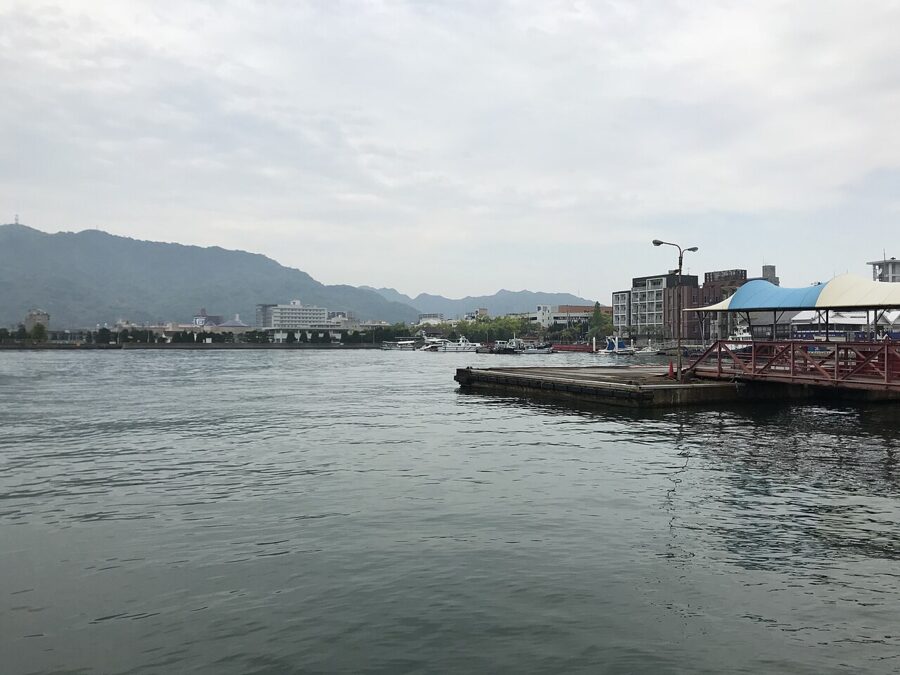
Every crossing to Ōkunoshima now starts at Tadanoumi Port in Takehara, a few minutes’ walk from JR Tadanoumi Station. The port runs its own Tadanoumi Port site with the current timetable and fares, and the Japan Rail Pass covers the train to Tadanoumi but not the boat.
From Hiroshima, Mihara and Onomichi
The quickest route from Hiroshima is the Sanyō Shinkansen to Mihara, where the Kodama stops, then the JR Kure Line west to Tadanoumi, about 20 to 25 minutes. Coming from Onomichi, take the San’yō Line to Mihara and change to the same line. With a good connection at Mihara you can be at the port about an hour after leaving Hiroshima.
The slow alternative is to ride the Kure Line all the way from Hiroshima along the coast, roughly two hours twenty minutes, which is one of the best train rides on the Inland Sea. Sit on the right heading east for the oyster rafts and the islands.
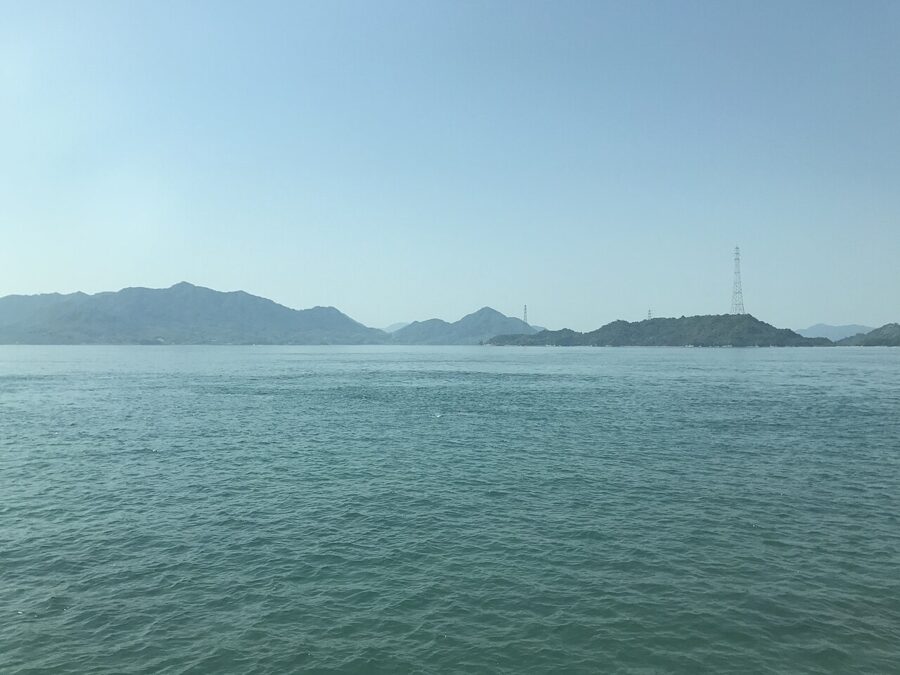

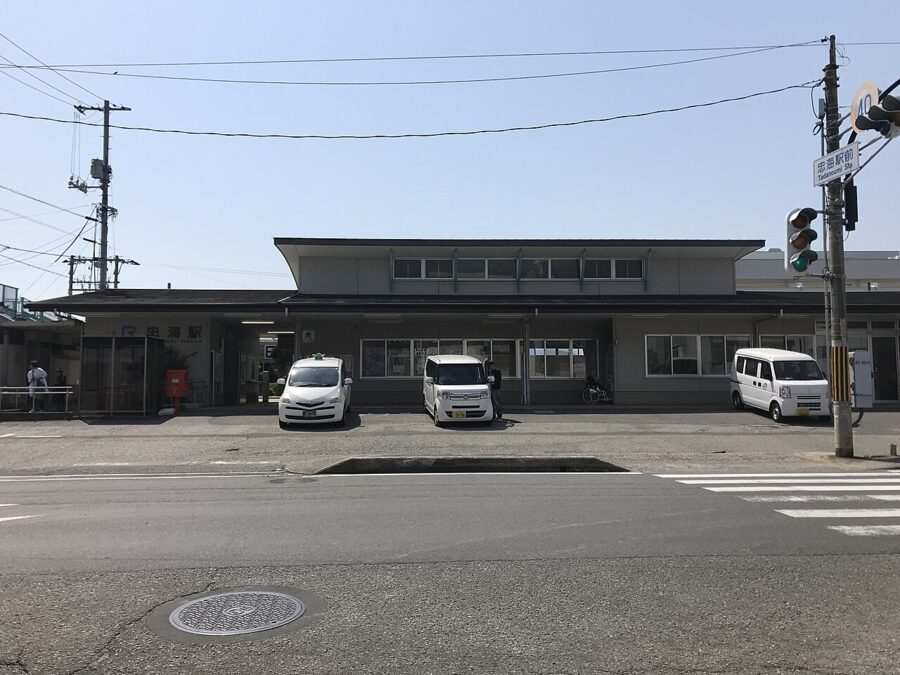

There is also a direct bus. Geiyō Bus runs the Kaguyahime highway bus between Hiroshima Bus Center and Takehara, and four buses a day each way extend to Tadanoumi Ekimae, by the station. From Hiroshima Bus Center they leave at 08:20, 09:15, 13:10 and 17:00 and take about an hour and forty minutes, for ¥1,600 (about US$10.50) one way as of 2026. Seats are unreserved, and IC cards such as ICOCA and Suica work.
Driving, you leave the car on the mainland: ordinary vehicles are not allowed to drive on the island. Tadanoumi Port has a free public car park for around 200 cars, which fills on weekends and holidays.
The boats from Tadanoumi
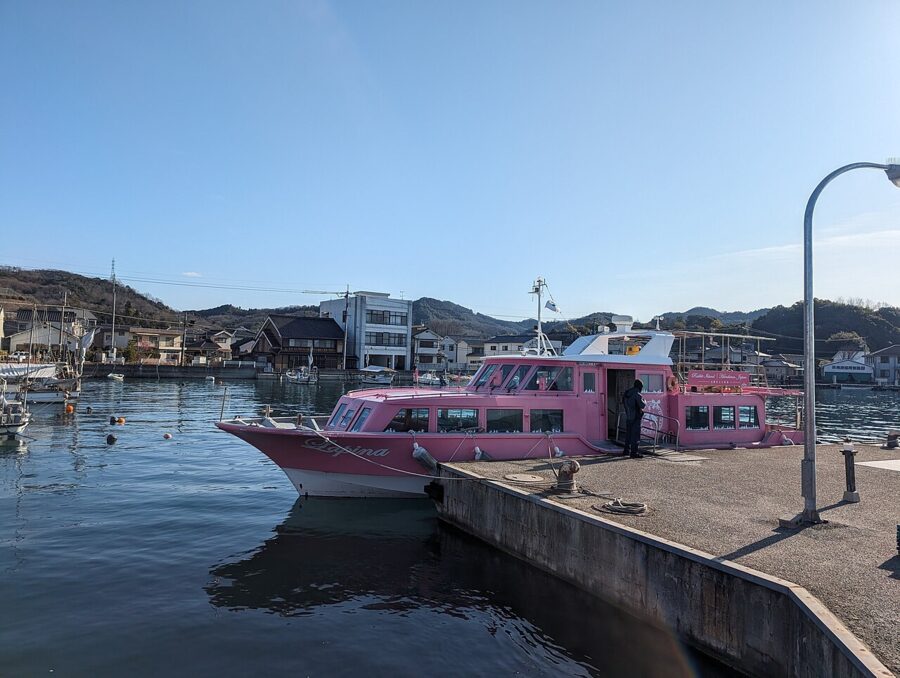
Two operators share the crossing. The Ōmishima Ferry carries cars and continues to Sakari Port on Ōmishima, and Kyūkamura Ōkunoshima (休暇村大久野島), the island’s hotel, runs a smaller passenger boat that fills the gaps. The crossing takes 10 to 15 minutes and costs ¥360 (about US$2.40) one way for adults, ¥720 return, and ¥180 for children; a bicycle is ¥120 more. Buy tickets at the port windows, and bring cash.
The timetable below was revised on 25 April 2026 and is the same on weekdays and weekends except for one extra lunchtime round trip on Saturdays, Sundays and holidays.
| Kyūkamura passenger boat | Ōmishima Ferry | |
|---|---|---|
| Tadanoumi to Ōkunoshima | 07:40, 08:40, 10:25, 11:20, 13:00 (weekends and holidays), 15:00, 16:00, 17:55, 18:40 | 08:30, 09:40, 10:50, 12:00, 14:05, 15:15, 16:25 |
| Ōkunoshima to Tadanoumi | 08:10, 09:10, 10:50, 12:30, 13:20 (weekends and holidays), 15:35, 16:35, 18:20, 19:15 | 09:20, 10:30, 11:40, 13:48, 14:56, 16:06, 17:16 (February to October only) |
The early and late passenger boats (07:40, 08:40, 17:55 and 18:40 out, and 08:10, 09:10, 18:20 and 19:15 back) use Pier No. 1, five minutes’ walk from the hotel; everything else uses Pier No. 2, where the shuttle bus waits. The hotel warns that its boat may switch piers when it is busy, and it posts the current timetable on its access page. From November to January the 17:16 ferry skips the island, so on a winter afternoon the passenger boats are your only way back after 16:06.
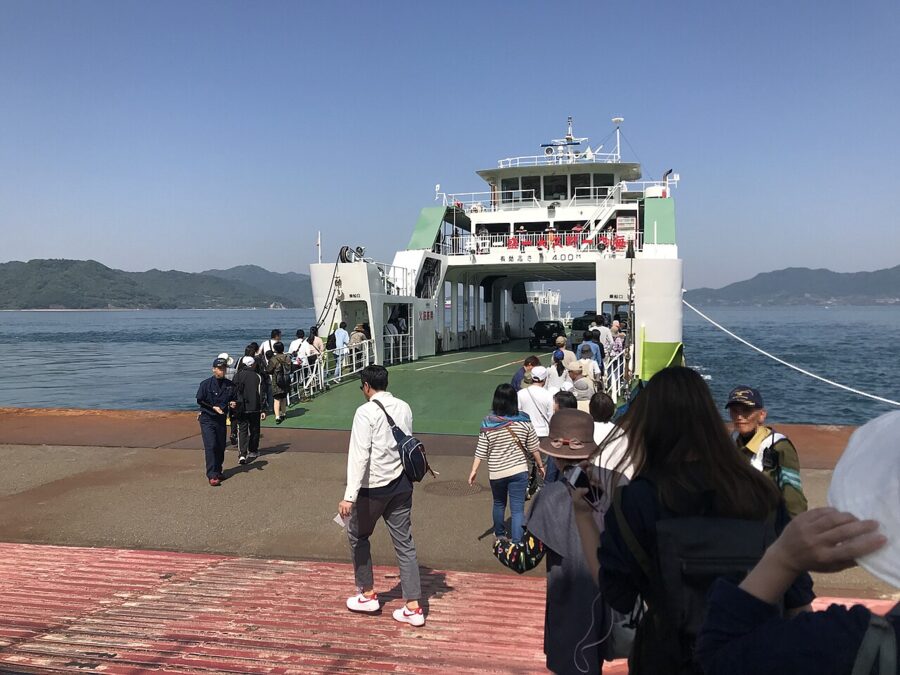

That onward leg is useful if you are on the Shimanami Kaido. Sakari is on the north coast of Ōmishima, and ferries leave there for Ōkunoshima at 09:05, 10:15, 11:25, 13:35, 14:40, 15:50 and, from February to October, 17:00, taking 15 minutes. It makes a neat side trip for anyone cycling between Onomichi and Imabari.
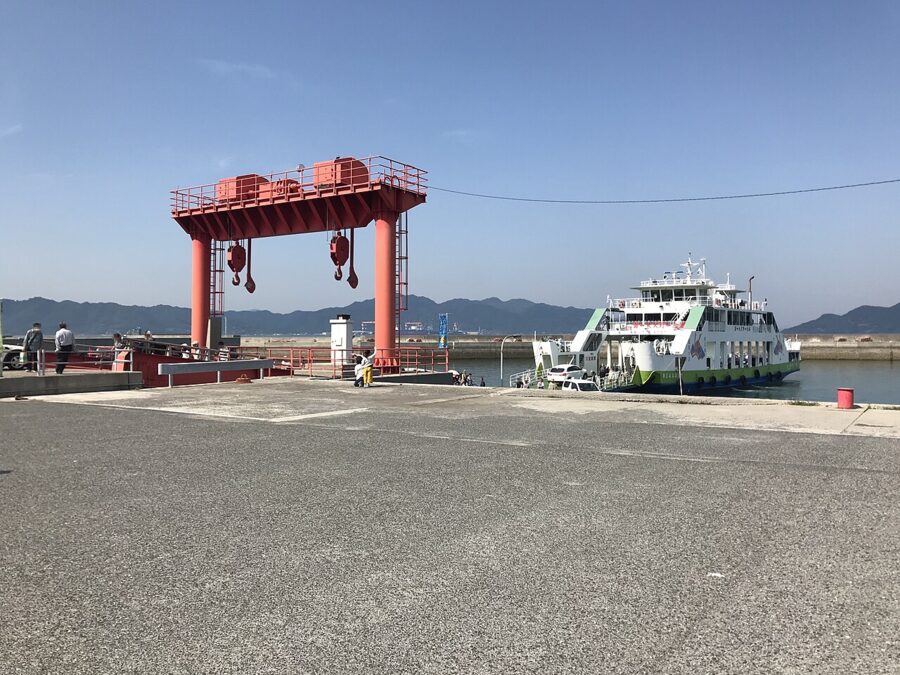

The Mihara boat is suspended
Older guides describe a high-speed boat, the Rabbit Line, from Mihara Port near Mihara Station to the island on weekends and holidays. It did not return after its winter break, and Mihara City’s page for the route says only that it is suspended, with no restart date. Until that changes, go to Tadanoumi.

Arriving: piers, shuttle bus and lockers
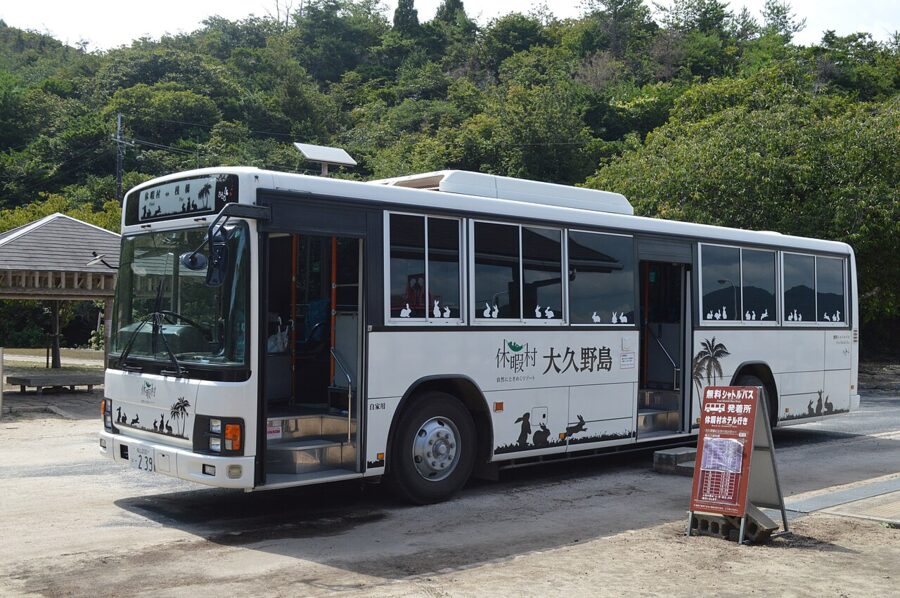
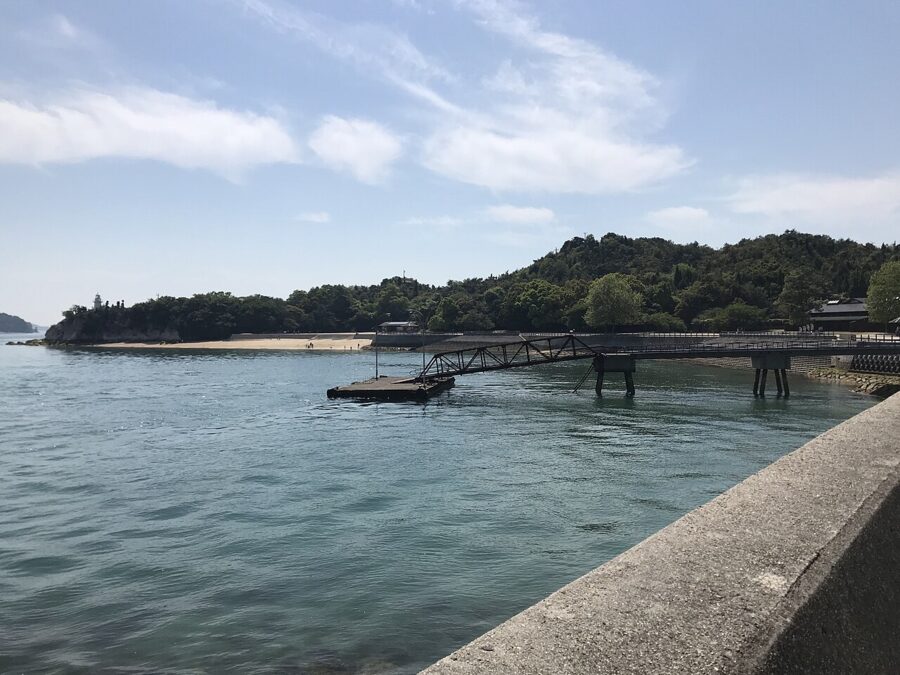
A free shuttle bus meets the boats at Pier No. 2 and runs about a kilometre to the hotel, stopping at the campsite, the visitor centre and the Poison Gas Museum on the way; tell the driver where you want to get off. No booking is needed and day visitors are welcome on it. Walking takes about 15 minutes along the shore, with rabbits the whole way.

Leave big bags on the mainland if you can. The port’s staffed luggage desk charges ¥800 a bag per day, raised from ¥500 in late 2025, and stays open until the last boat. On the island there are coin lockers in the Pier No. 2 waiting room, and the hotel only holds bags for its own guests.
The rabbits
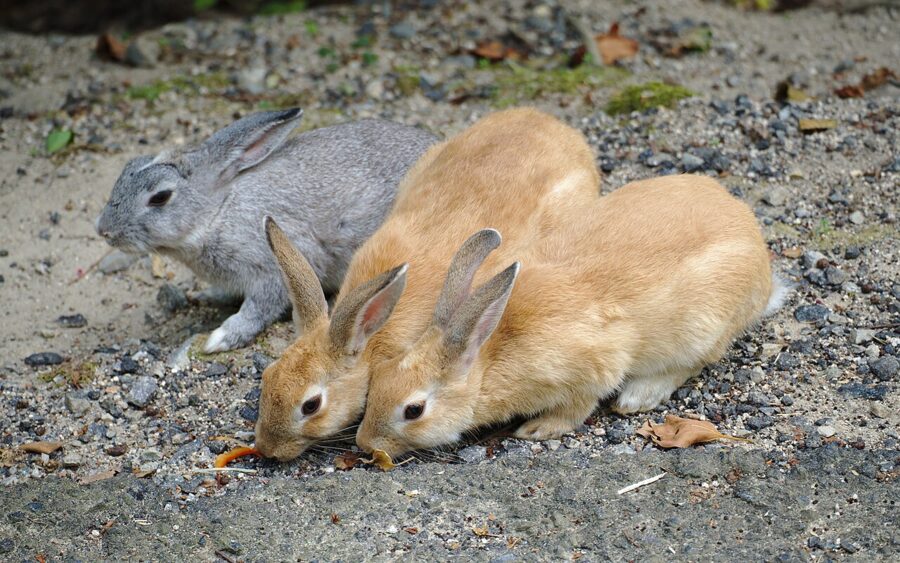
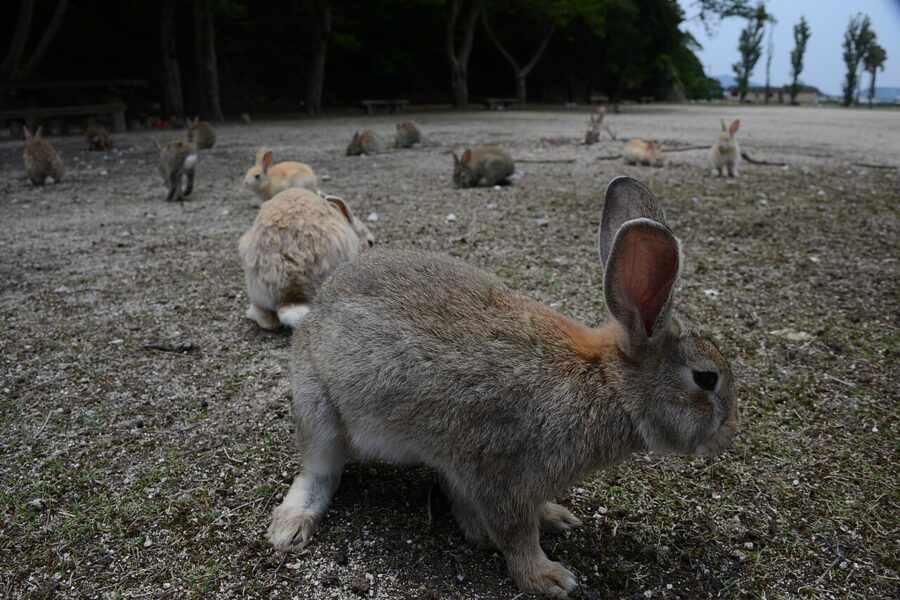
They are around from the moment you step off the boat, and they will come to you rather than the other way round. The biggest gathering is on the lawn in front of the hotel, where you can sit on the grass and have a dozen of them inspecting your shoes within a minute.

How many, and why they are here
The rabbits are domestic European rabbits gone semi-wild, a species that is not native to Japan. The island’s visitor centre traces them to 1971, when a local primary school that could no longer keep its eight rabbits let them go here, and the hotel calls that the most likely account. You will also hear that they descend from animals used to test the poison gas; the visitor centre does not say so, and former factory workers recalled that the wartime test rabbits were all killed when the plant was cleared.
Numbers swing with the food supply. A 2018 survey counted more than 920, the count fell to around 400 in 2021 when the pandemic emptied the island and the feeding stopped, and national press reports in 2026 put the population at more than 500. The hotel says about 600. Whatever the true figure, you will not be short of rabbits.

The island’s rules in 2026
In 2021 the Environment Ministry, which owns almost the whole island, set up a committee with Takehara City, the hotel, the ferry company, Tadanoumi residents and rabbit enthusiasts to agree on how people and rabbits should share it. The four rules they settled on are printed on signs and leaflets all over the island, and they are short:
- Don’t touch the rabbits, and don’t feed them from your hand. They can carry fleas, ticks and illnesses that pass to people; lifting one stresses it and a dropped rabbit can break bones; and food held out in your hand gets your fingers bitten, because their eyesight is poor.
- Don’t feed them on the road, and watch your feet. Bikes and the bus use the roads, and a rabbit running out for food is an accident waiting to happen.
- Stay until they have finished, and take leftovers away. Uneaten food rots and feeds wild boars and rats.
- Don’t bring pets, and don’t take rabbits away. Abandoning an animal is illegal, pet rabbits released here do not survive, and catching a wild one without permission breaks the wildlife law.
The port and the hotel add a few of their own: no chasing or picking up, no playing with rabbits by the road or the hotel entrance, no litter or fishing line, and a look under any vehicle before it moves. The port also asks visitors to top up the rabbits’ water dishes, because the rabbits living around the hotel have no springs to drink from.
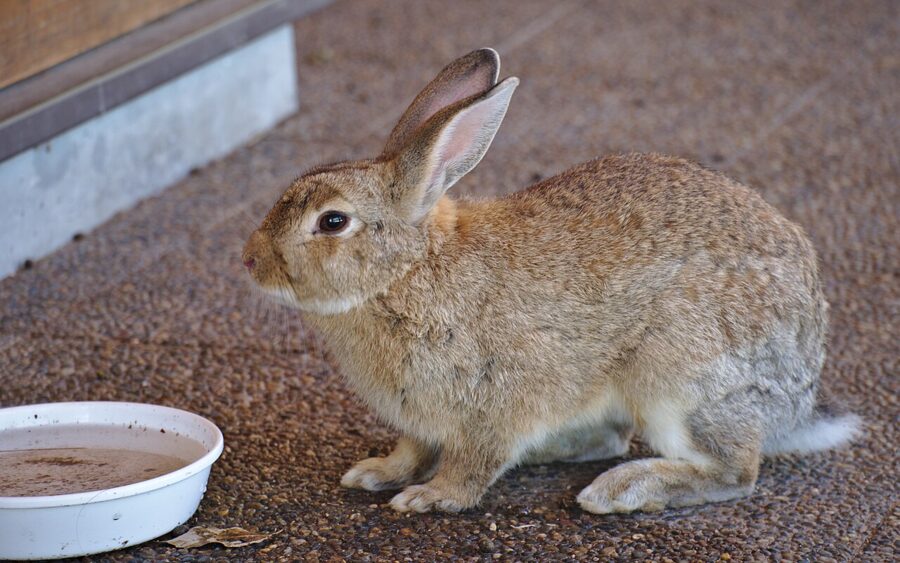

Feeding without harming them
Feeding is not against the law here, but the Environment Ministry says plainly that it is not something it wants to encourage, and the rules exist to limit the damage. Rabbit food is not sold anywhere on the island, so if you want to feed them, buy a small bag at the Tadanoumi Port shop or from the supermarket and convenience stores near the station. Bring the empty bag from the port shop back with you and they will swap it for a rabbit postcard.
Rabbit pellets or plain raw vegetables are what to bring. Bread, biscuits and other human snacks make rabbits ill, and so do onions, spring onions, potatoes and sweet potatoes. Put the food on the ground on the grass, away from roads and doorways, stay until it is gone, and take back anything left. A whole cabbage or a sack of pet food is exactly what the island is trying to discourage.
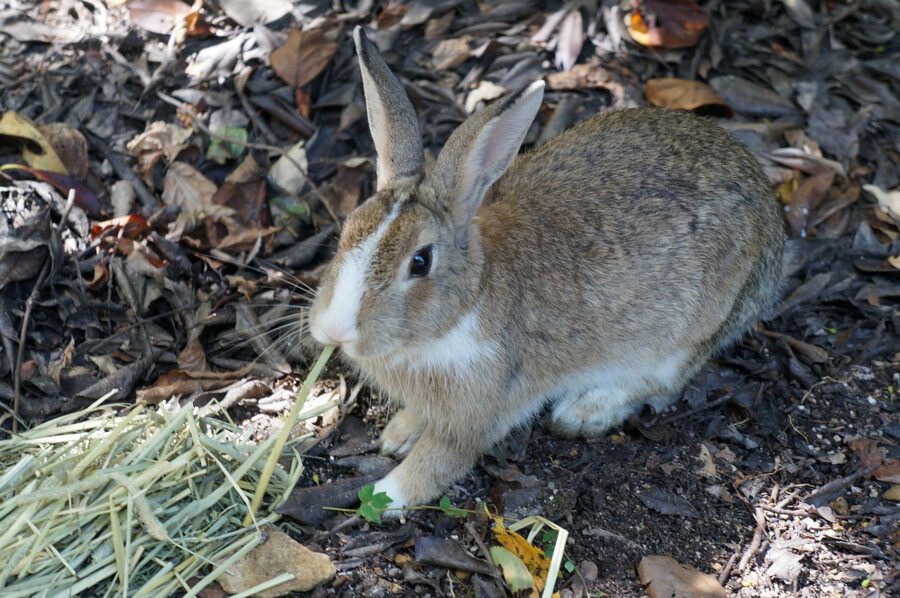
The welfare problem
The rabbits are only this numerous because people feed them. Wild boars appeared on the island about fifteen years ago, probably swimming across from neighbouring islands, and now breed there on leftover rabbit food. In July 2026 researchers from Fukushima University and the National Institute of Technology at Kure reported that in March 2024 they had watched a boar seize a healthy adult rabbit near the ferry pier and carry it into the woods, behaviour they describe as highly unusual. Boars have also been seen turning up around the evening boat times, when departing visitors tip their leftover food onto the ground.
The Environment Ministry traps boars, but the researchers’ bigger worry is a boar hurting a person: one of them watched a small child feeding rabbits close to a boar near the pier. They also point to the patches of bare earth where the overfed population has stripped the plants. Less food, put down carefully and cleared up after, is the most useful thing a visitor can bring.
The island has had uglier news too. Between late November 2024 and January 2025, 99 dead rabbits were found in a short space of time, and in January 2025 a visitor was arrested for kicking a rabbit to death; in April 2025 he was given a suspended prison sentence for abusing seven rabbits and killing one. The Ministry added security cameras and stepped up monitoring, and asks anyone who finds a dead rabbit to tell the hotel. Takehara City looked at charging a visitor tax to pay for upkeep and litter clearance, then dropped the idea in February 2026.
The poison gas island
None of that history is hidden from you once you are on the island. Takehara’s tourism office publishes a guide to the war ruins, the museum is a short walk from the hotel, and the biggest storehouses are on the walking route. What follows is the short version, so that what you see makes sense.
What was made here
Before the gas there were guns. In 1902, ahead of the Russo-Japanese War, the army fortified Ōkunoshima as part of the Geiyo Fortress, built to guard the Inland Sea channels, and the gun emplacements are still there. In 1927 the army took over the whole island, moving off the few farming families who lived on it, and in 1929 the Tadanoumi works of the Tokyo Second Army Arsenal began making poison gas.
Production ran until 1945: mustard gas and lewisite, which blister skin and lungs, plus sneezing agents and hydrogen cyanide. The agents were made here and shipped to Sone in Kitakyushu to be loaded into munitions. Secrecy was strict enough that the island was dropped from published maps and workers were told not to describe their jobs even to their families.
Near the end of the war, mobilised female students were set to testing balloon bombs inside the power station. The museum exists to record what the work did to the people who did it: many died, during the war and long afterwards, of illnesses the gas left them with.
After 1945
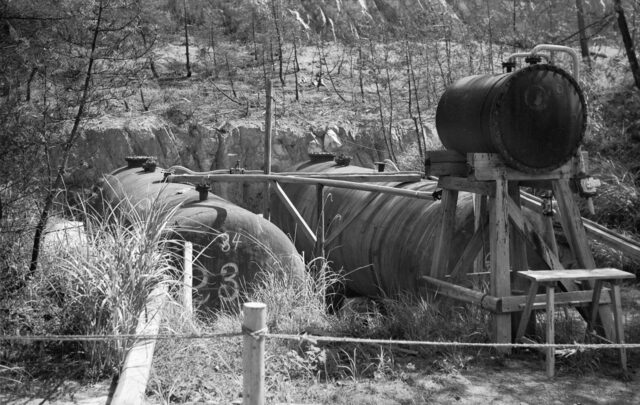
When the war ended, Allied occupation forces took over the island and spent 1946 and 1947 disposing of what was left. Gas was loaded onto ships and dumped in the Pacific off Tosa, some was buried or burned, and the walls of the largest storehouse were scorched with flamethrowers to destroy the residue. Leftovers kept surfacing for decades: arsenic was found in the soil at the north battery in 1996, and the ground there was cleaned up by the end of the decade.
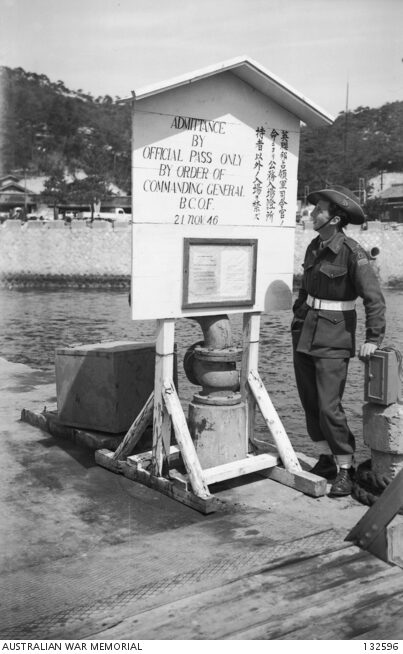
The island reopened in the early 1960s, when a national holiday village was built on it, and for a long time the past simply went unmentioned. Japan’s army gas programme was barely known to the public until newspapers reported on it in 1984. A cenotaph for those who died from the work went up in 1985, and the museum opened in 1988.
The Poison Gas Museum
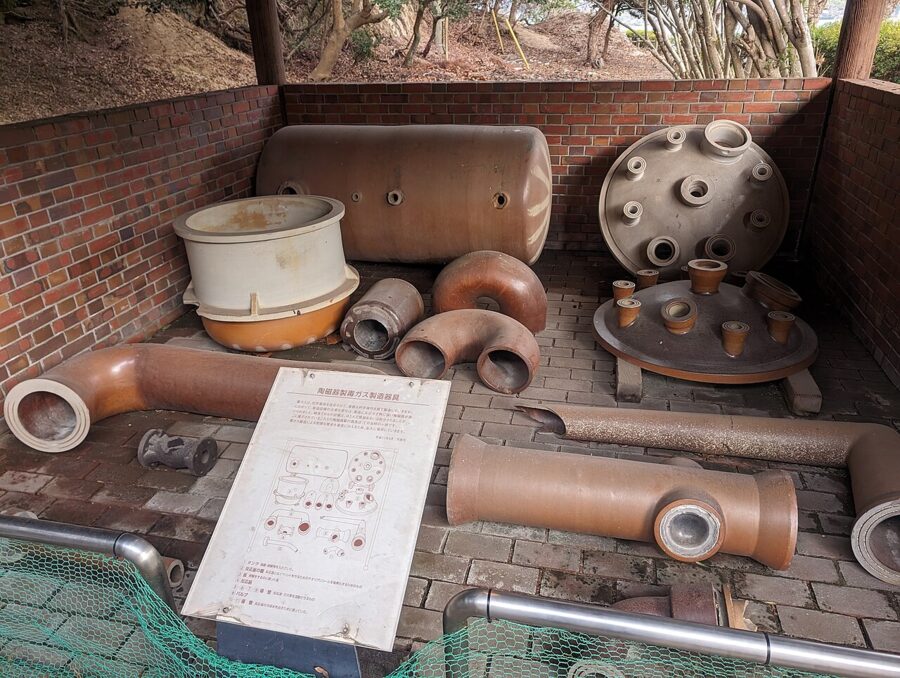
The Ōkunoshima Poison Gas Museum (大久野島毒ガス資料館) is a room of displays and a small screening room, run by Takehara City, and it does a lot with very little. There are workers’ notebooks, the men’s and women’s work clothes, the cooling section of a liquid gas production unit, the outer casing of a gas canister, and panels of photographs; one of the films is told through former workers’ testimony. Allow 30 to 45 minutes, longer if you watch the films.
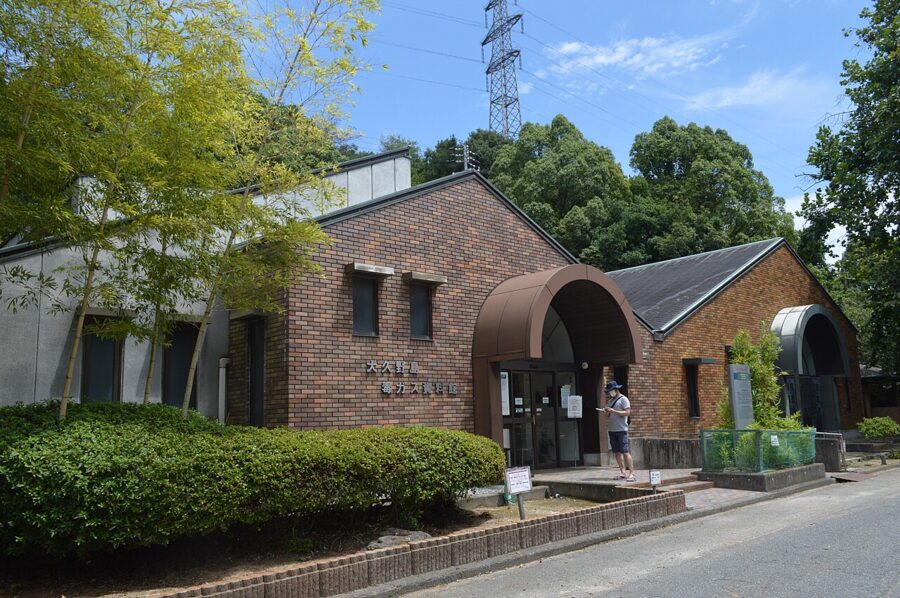

| Ōkunoshima Poison Gas Museum (as of 2026) | |
|---|---|
| Hours | 09:00–16:00, last entry 15:40 |
| Closed | 29 December to 3 January, plus occasional temporary closures |
| Admission | ¥150 (about US$1) for 19 and over; free under 19 and for disability certificate holders; ¥120 each for groups of 20 or more |
Those temporary closures are real. An overhead power line accident on 22 June 2026 blacked out part of the island, and the museum stayed shut until 8 August while repairs were made. Check the city’s page before a trip built around it.

The ruins worth finding
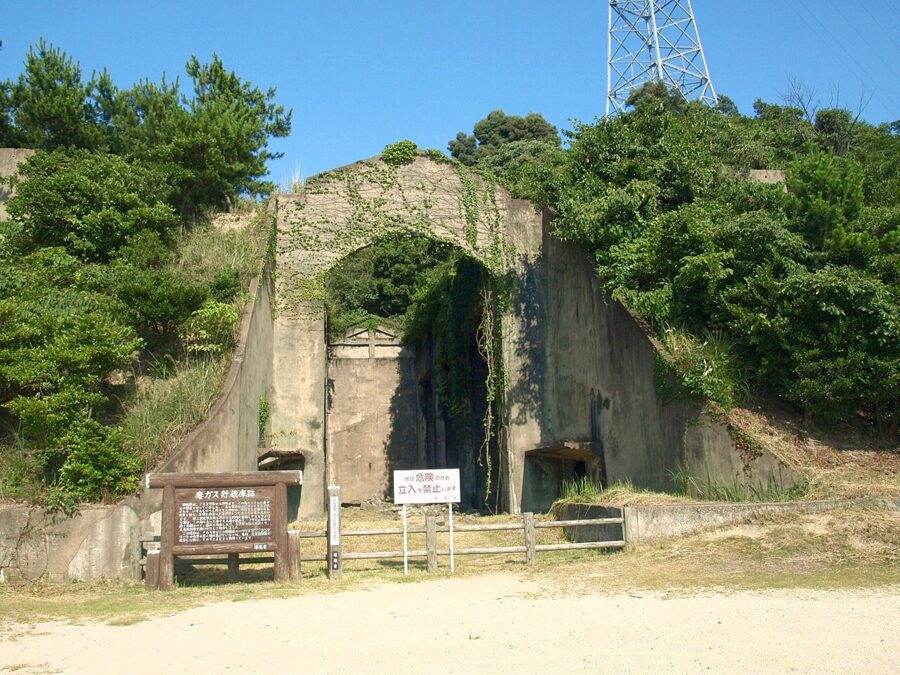
The Nagaura storehouse on the north-west coast is the one that stays with people. It was the largest store on the island, with six tanks of about 100 tonnes each, and after the war its walls were burned with flamethrowers; the scorch marks are still there. Elsewhere in the woods are the 32 concrete pedestals of an open-air tank yard, now overgrown.

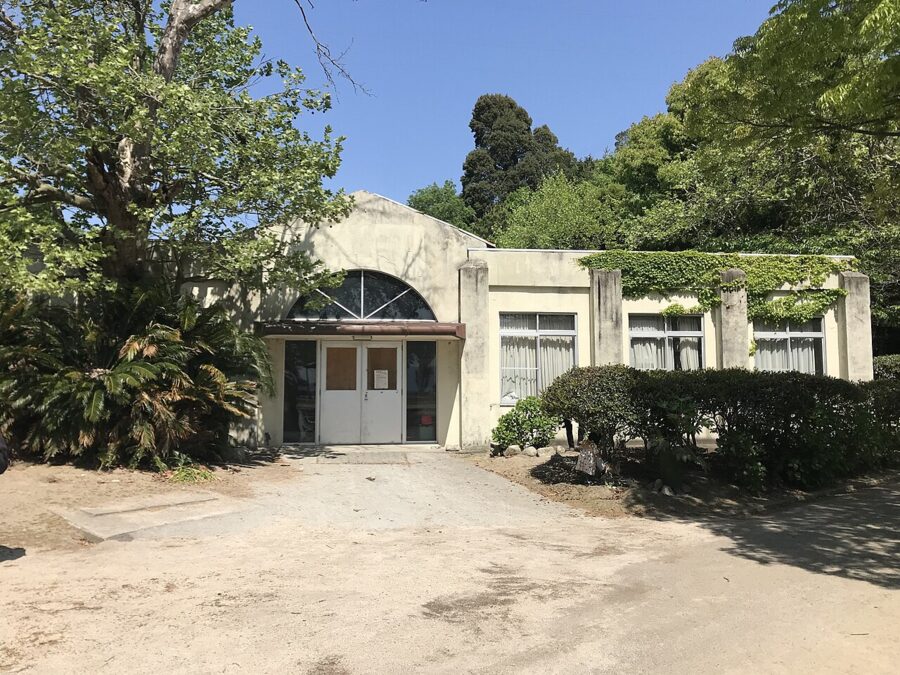
Close to the hotel, the white laboratory building where gases were developed stands next to the grey inspection wing where they were tested; both are fenced and closed. The Sangenya site, once the main factory area, is now an open plaza, with a storehouse ruin near the hotel. The cenotaph listing those who died making or disposing of the gas stands near the swimming beach, and a memorial service is held there every October.

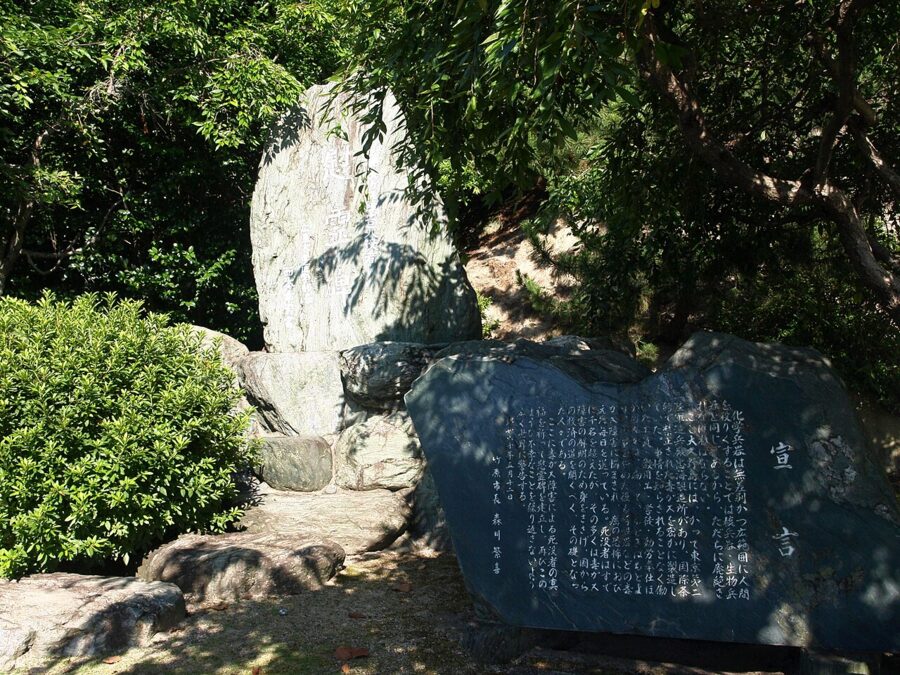

If you have spent a morning in the Peace Memorial Park, this is a different chapter of the same war, told in a much quieter voice. Keep your own voice down near the cenotaph and the old island shrine, whose grounds are closed for safety, and stay out of anything fenced.
The power station, the forts and the loop
The road round the island is a little over three kilometres, and the walking course that follows it, with a few detours to the ruins, is about four kilometres and 70 minutes on foot. The hotel’s walking map starts at the lawn and goes past the Sangenya and Nagaura storehouses, the north battery, the power station and the campsite, finishing at the visitor centre and the museum.
The power station
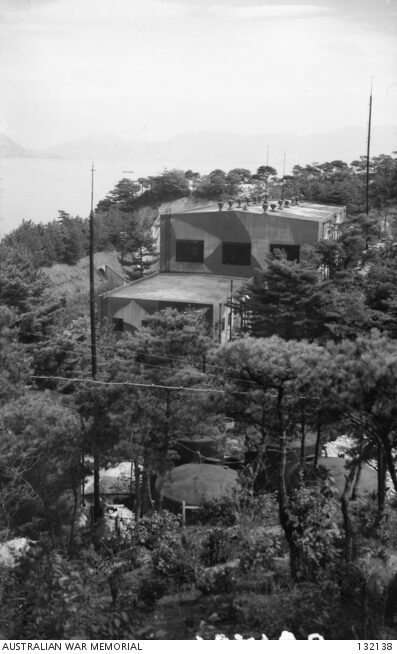
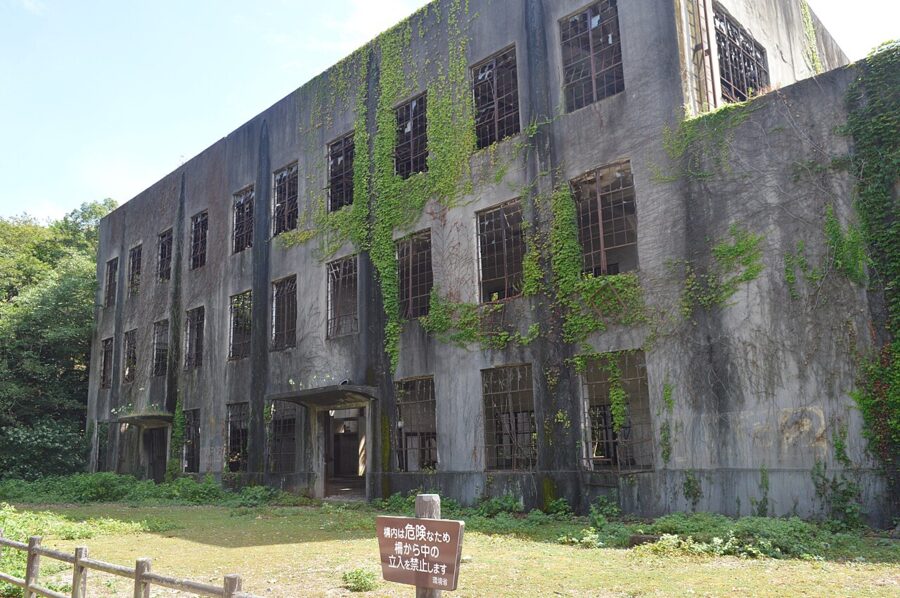
The power station is the ruin everyone photographs, a big concrete block near Pier No. 2, now wrapped in ivy. It ran on diesel generators, with more added in 1933 and 1934, and from 1941 it also took power from Tadanoumi through two submarine cables. Entry to the interior is prohibited, and the fence keeps you at a distance.

The Geiyo Fortress batteries
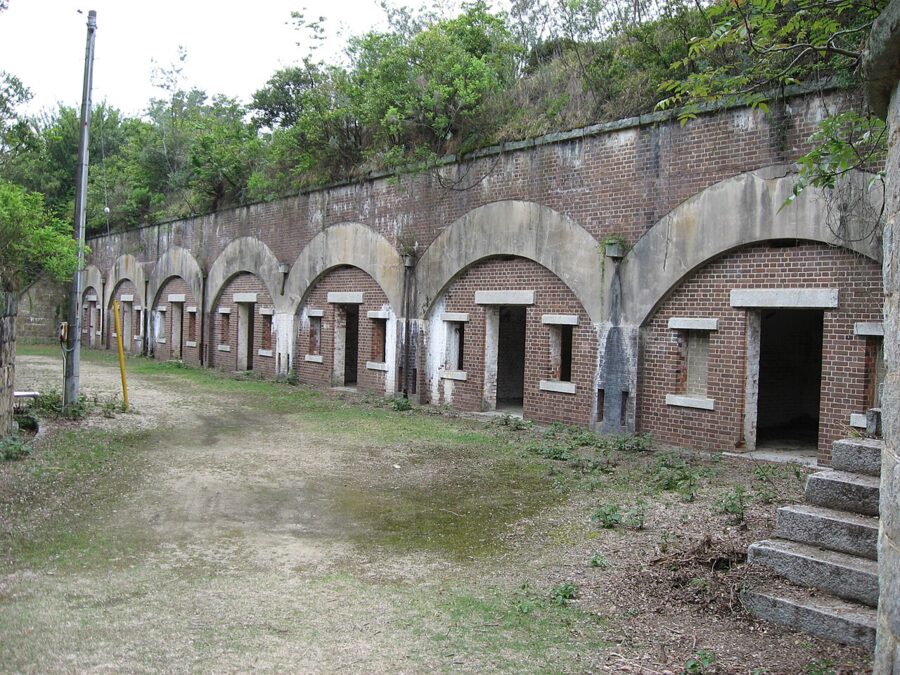
The Meiji-era batteries are in the north and the middle of the island. The north battery held eight guns, and in the gas years its gun pits were used for lewisite tanks, which is where the arsenic came from. The central battery had six 28-centimetre howitzers; two were sent to the siege of Port Arthur during the Russo-Japanese War, and the brick barracks behind the gun positions were later used to store gas and raw materials.
The lighthouse, the summit and the visitor centre
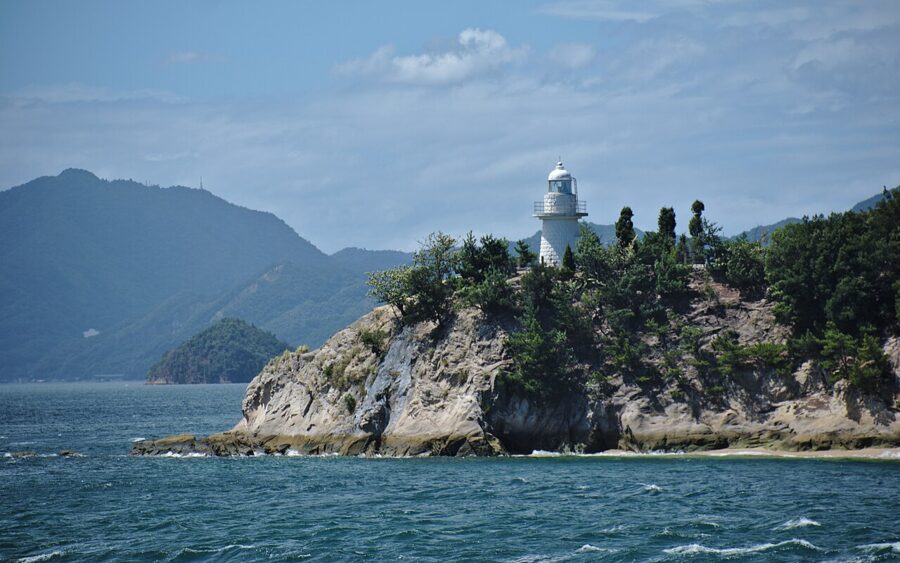
Ōkunoshima Lighthouse, first lit in 1894, before either the fort or the factory, stands on the southern tip above the beach, with stone posts marked as army land at the foot of its steps. The highest point, the Hyokkori observation deck at about 100 metres, has views across the islands of the Inland Sea, and the national park leaflet reckons on 30 minutes to walk up. Some of the paths to it have been closed since the July 2018 floods, and the hotel’s own pages disagree on whether any are open, so ask at the visitor centre before you set off.

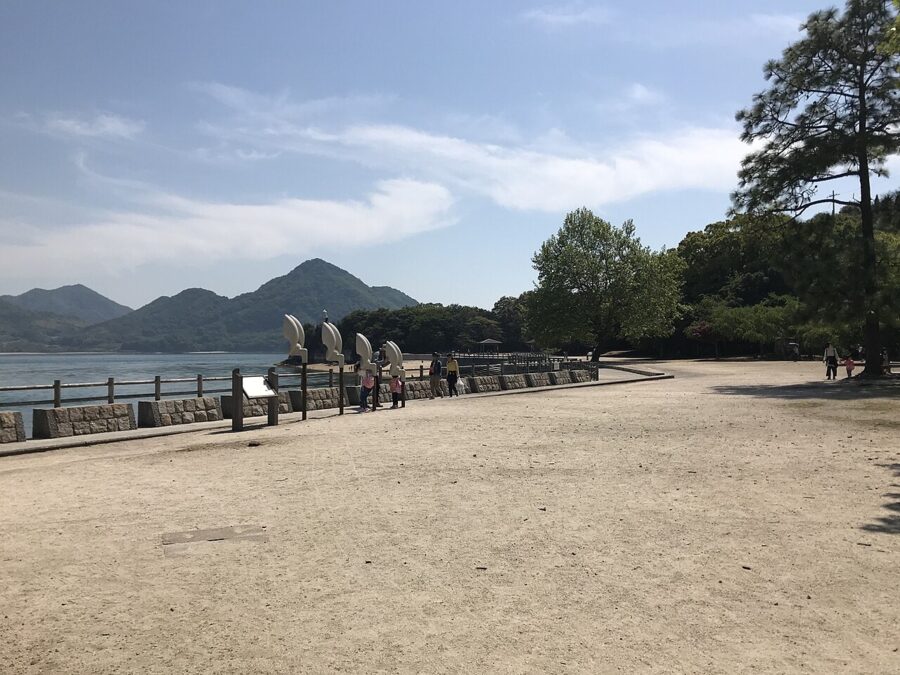
Along the shore near Pier No. 1 are the rabbit ears: sound collectors in family sizes. Put your head inside one and you hear the wind and the waves louder, the way a rabbit might. Children love them, and so do most adults when nobody is looking.

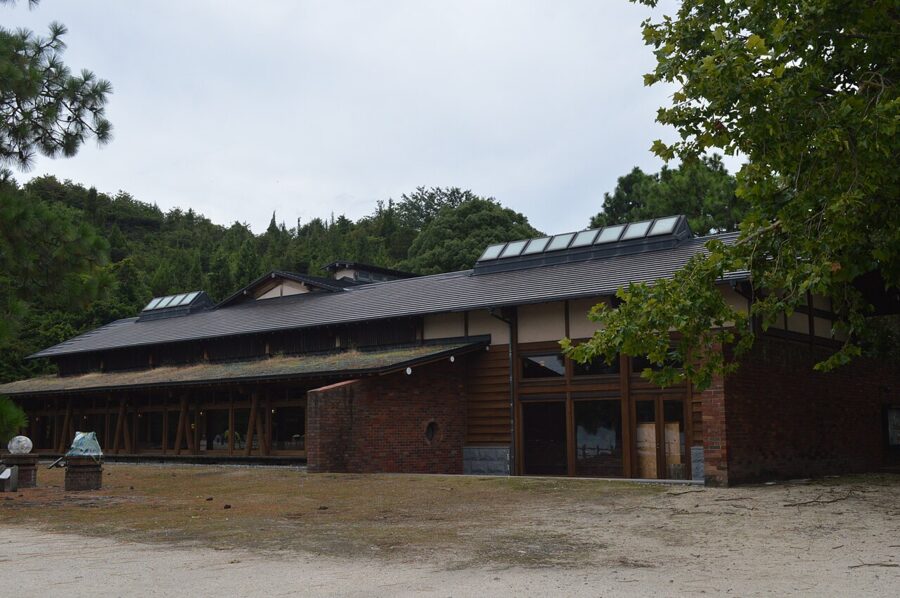
The Environment Ministry’s Ōkunoshima Visitor Center explains the island’s nature and history, runs small craft sessions such as bamboo paper making, and is free. It opens 09:00–16:00 and closes on Wednesdays, and on Thursdays as well from December to February, as of 2026.

Cycling round it
A bike turns the loop into an easy hour with plenty of stops. The hotel front desk rents ordinary, geared and electric-assist bikes, plus children’s sizes, and you can also bring your own across on the ferry. The national park leaflet gives ¥600 (about US$4) for two hours, or ¥800 for an electric bike.
The round-island road is one way for bikes: clockwise only. The national park asks riders to get off and walk the downhill stretches, slow right down wherever rabbits are sitting, and keep off the short section near the power station that is marked as no cycling.
For the history as you ride, a local guide leads a two-hour Okunoshima cycling tour for groups of up to five, stopping at the lighthouse, the shrine, the gas storehouses, the power station and the north battery; the ferry fare is extra. I have reviewed that cycling tour in more detail. The hotel also runs its own guided electric-bike tour of the island’s history, listed on its activities page at 10:30 and 13:30 for ¥9,000 (about US$59) an adult, for ages ten and up.
Staying overnight at Kyūkamura Ōkunoshima
Kyūkamura Ōkunoshima is the only place to stay, one of a chain of national park resort hotels: a big, plain, family-friendly block behind the rabbit lawn, with every room facing south over the sea. It is not a boutique hotel. You stay for what happens after 19:15, when the last boat has gone.
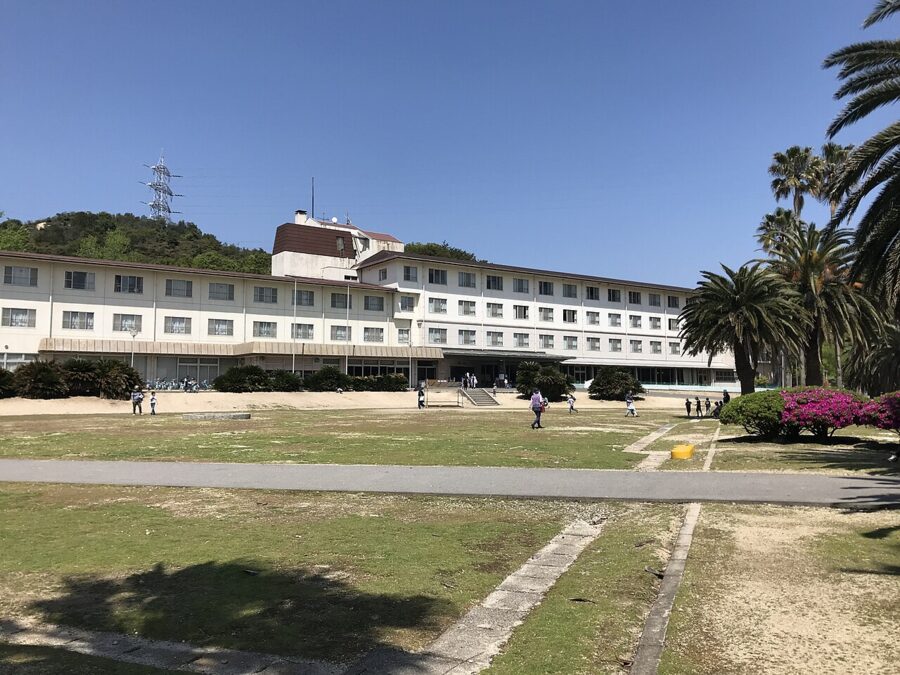

Check-in is from 15:00 and check-out at 10:00, and the front desk will hold your bags if you arrive early. Online booking opens six months ahead, and in the New Year, Golden Week and summer holidays stays are capped at three nights; weekends fill early. The hotel closes for a few days of maintenance now and then, as it did from 1 to 6 June 2026, so check its notices before you fix dates.
The baths are the Seto Onsen, a radon spring feeding two baths with sea views in the main building: the larger Ōkutsu-no-yu and the smaller Kokutsu-no-yu, which faces the sunset across the Inland Sea. Guests can bathe from 05:00 to midnight. Day visitors can use them too, as day-spa bathers, from 11:30 to 17:00 on weekdays (last entry 16:30) and 11:30 to 15:00 at weekends and on holidays, for ¥550 (about US$3.60), with towels for sale or rent at ¥110.
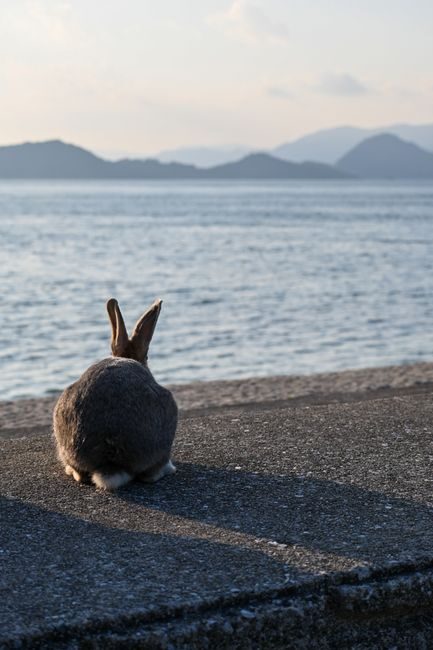
Evenings have a gentle routine. Dinner is a buffet of Setouchi produce, Hiroshima oysters and beef among it, from 17:30 to 20:00, with a new menu each season. At 20:00 every night staff take guests out to see sea fireflies, tiny crustaceans that glow blue in the water, and at 07:00 there is a half-hour morning walk with the rabbits; both are free and need no booking.
Eating on the island, and before you cross
Day visitors eat at the hotel. The Usanchu restaurant serves lunch from 11:30 to 13:30 (last orders 13:00), with set meals such as an octopus plate or fried oysters at ¥1,750 and a seafood curry at ¥1,150 as of 2026, and the café does coffee, cakes and light meals in the afternoon. The shop sells drinks, snacks and Takehara sake, but there is no convenience store anywhere on the island.
On busy weekends the restaurant fills, so a packed lunch from Tadanoumi or Takehara is a sensible backup; the port shop has rice-ball lunch boxes. Then take every scrap of rubbish back with you, and save the big meal for okonomiyaki in Hiroshima on the way home.
The campsite
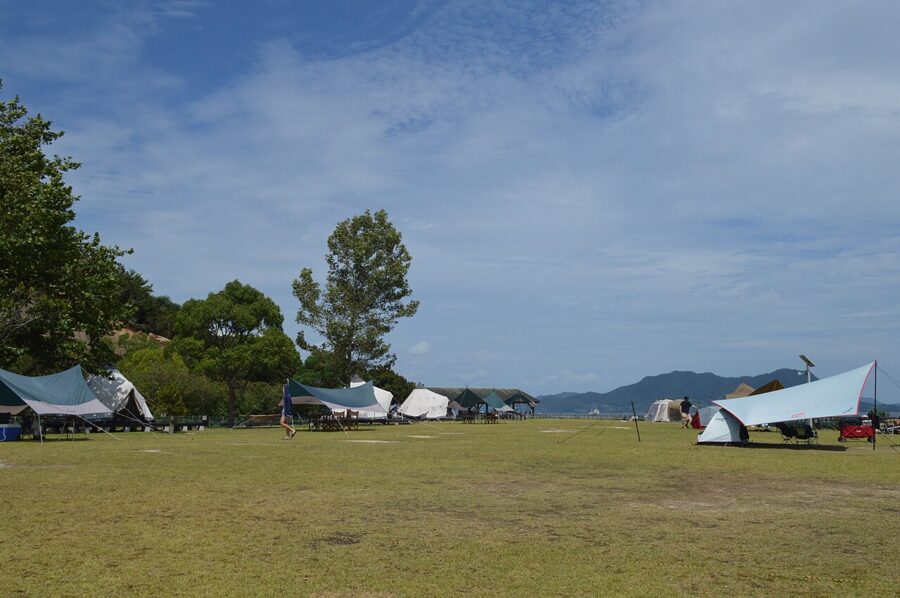
There is a small campsite by the sea between Pier No. 2 and the visitor centre, run by the hotel, with some pitches that come with a tent already set up. Rabbits wander up to the tents, the night sky is dark, and the hotel bath is a short walk away. Book it through the hotel.

Summer swimmers should know that the beach near the hotel stayed closed for the whole 2026 season after the June power cut, though the hotel’s outdoor pool opened from mid-July to the end of August. Takehara’s tourism office announced the closures; check again before you pack for 2027.

When to go
Spring and autumn are the easy seasons: mild, clear, and comfortable for the loop on foot. Rabbits have their young from spring into summer, though many move up into the woods to give birth; if you find a baby rabbit, leave it alone, because adult rabbits may attack one that smells of people. Summer afternoons are hot and the rabbits barely move, so go early or late. Winter is quiet and mild, but remember the 17:16 ferry does not call from November to January.
Weekends and holidays bring the crowds and fill the Tadanoumi car park. Weekdays are quieter. Avoid Wednesdays if you want the visitor centre, and the New Year week if you want the museum.
Takehara next door
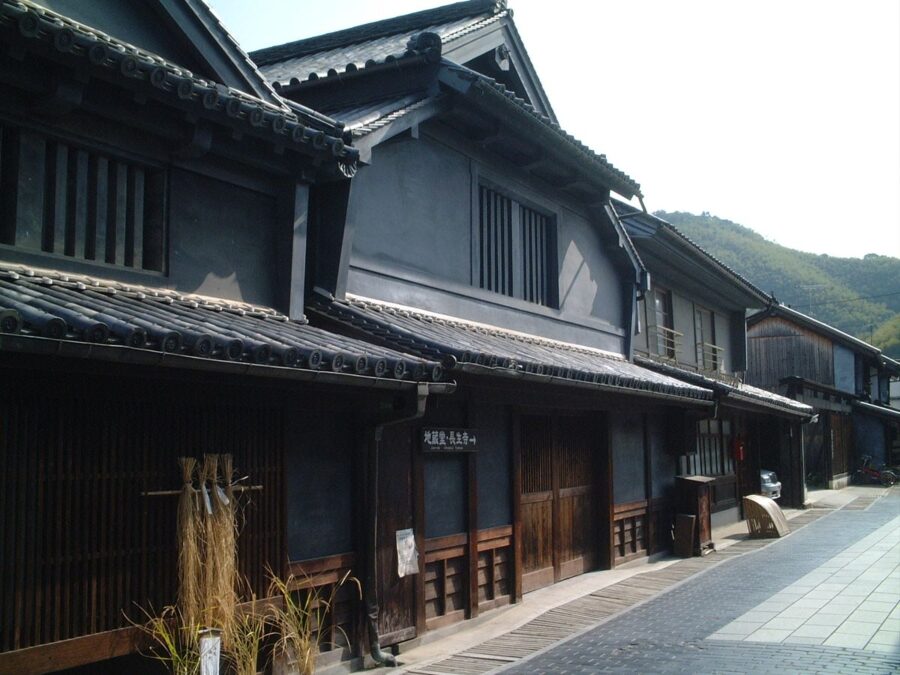
Tadanoumi is part of Takehara, and the old town is a few stops west on the Kure Line or the Kaguyahime bus. Its preserved merchant quarter, the “Little Kyoto of Aki”, grew rich on salt and sake, and it is the birthplace of Masataka Taketsuru, the founder of Nikka whisky, whose family’s Taketsuru Sake Brewery still stands in the old streets. Pair it with the island for a full day: the streets and breweries of Takehara are worth a morning on their own.

If you would rather someone else juggled the trains and the ferry, a guided Takehara townscape and Rabbit Island day trip leaves Hiroshima Station at 08:00 and covers both, with the ferry, entry fees and a bag of rabbit food included; lunch is on you. My review of the Takehara and Rabbit Island tour covers what the long day is like. It slots in well as a third day on a Hiroshima itinerary, after the city and Miyajima.
The first boat worth catching
From Hiroshima, catch a morning Kodama to Mihara and the Kure Line to Tadanoumi, or the 08:20 Kaguyahime bus from the Bus Center. Buy a small bag of rabbit food and a return ticket at the port, and if you make the 08:30 ferry or the 08:40 hotel boat you will be walking the loop before the island fills up. Keep an eye on the clock on the port building when you come back: the last boat leaves the island at 19:15.