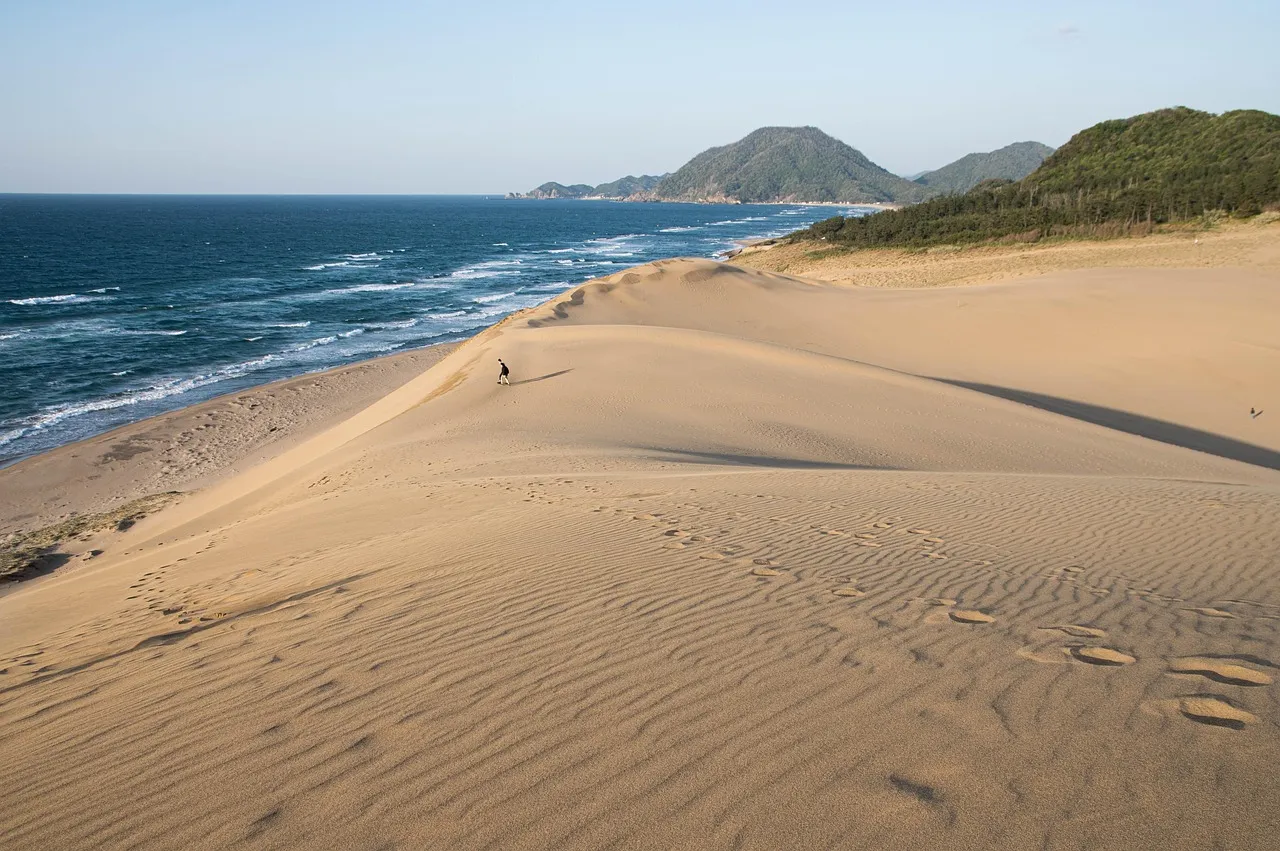
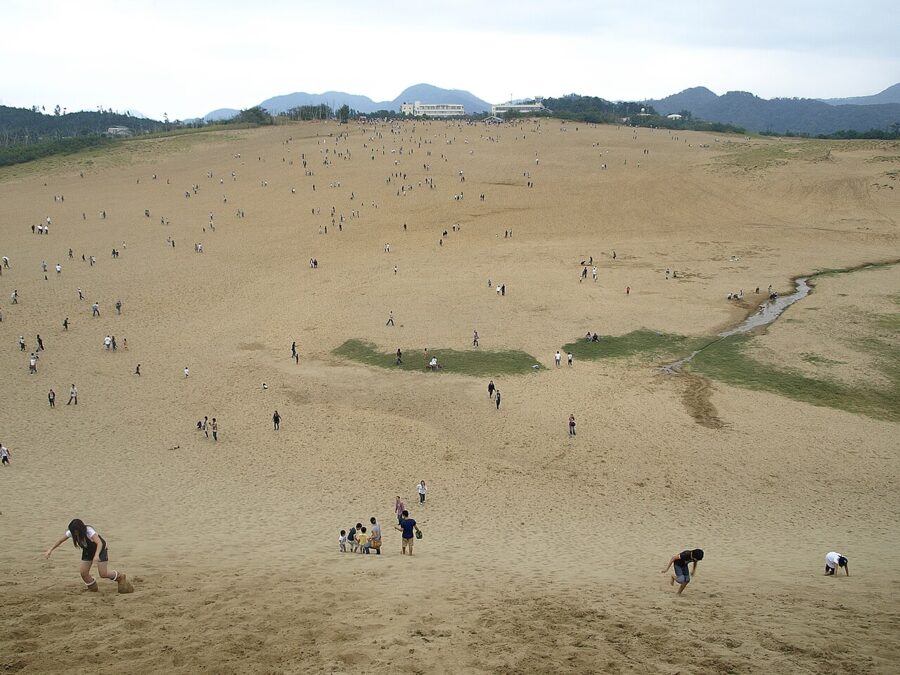
The Tottori Sand Dunes have no gate, no ticket office and no closing time. That one fact decides how to see them. At 10:30 on a Sunday the slope up to Umanose is a line of people in single file, the camels are posing for photos and the ripples nearest the entrance have long been trodden flat. At seven in the morning the same sand is unmarked, the wind has spent the night combing it into fine ridges, and you share the crest with a few joggers and a photographer or two.
So the first decision is the hour, not the day. Come early, or come in the last hour before sunset, and the dunes do what the posters promise. Come at midday in August and they are a heat trap with no shade for half a kilometre in any direction, which is why the prefecture has been posting heatstroke warnings every summer.
Everything else is easy. The bus from Tottori Station takes about 22 minutes, the walk to the top of the main ridge takes 15 or 20, and the Sand Museum, the camels, the sandboard school and the paragliders are all within a few minutes of the entrance. Here is the fuller picture than a day in Tottori city leaves room for: how the sand got here, why it is turning green, what each activity costs in 2026, and when the light is worth getting up for.
On this page12 stops
- The short version: time, timing and shoes
- What the Tottori Sand Dunes are
- Why the dunes are turning green
- Walking up Umanose
- Guided walks and the visitor centre
- Activities, with prices as of 2026
- The Sand Museum and its Spain exhibition
- The Sakyu Center, the lift and lunch
- Photography and the seasons
- Nearby, in short
- Where to stay nearby
- Getting there from Tottori Station


The short version: time, timing and shoes
Tottori city’s tourism office reckons on about an hour to walk from the entrance to the top of Umanose and back, and about 90 minutes if you add the Sand Museum. That is a fair minimum. With the observation deck, a camel photo and a slow wander along the crest, half a day goes quickly, and an activity such as sandboarding or paragliding takes two to three hours on its own.
- Entry: free, at any hour, every day of the year. The car park in front of the visitor centre has no barrier either.
- Visitor centre: 09:00–17:00 and free. In the 2026 financial year the visitor centre closes for maintenance on 9 December 2026, 13 January 2027 and 10 February 2027.
- Best hours: the first two hours after sunrise, or the last hour before sunset.
- Shoes: trainers you do not mind filling with sand. Barefoot is lovely in spring and autumn. In summer the surface can pass 60°C.
- Bring: water, a hat and some cash. There are no convenience stores or ATMs at the dunes.
Toilets are in the car park, in the visitor centre and at the Sakyu Kaikan drive-in opposite, and there are none out on the sand. The visitor centre has free foot showers in its covered outdoor area from 09:00 to 17:00, with towel vending machines beside them; Sakyu Kaikan has coin showers at ¥100 (about US$0.70) for three minutes, outside winter. The visitor centre’s own FAQ says it no longer lends out sandals or boots, so do not count on borrowing a pair.
Summer deserves a plain warning. By 24 August 2026 the prefecture had logged 77 heatstroke cases on the dunes that season, 11 of them taken to hospital by ambulance, against 28 cases at the same point the year before. Once you are on the sand there is no shade and nowhere to buy a drink. Do not run up the slope, however tempting it looks.
What the Tottori Sand Dunes are
The sand began as rock in the Chūgoku mountains: granite, andesite and basalt, weathered until it crumbled. Rain washed it into the Sendai River (千代川), the river carried it to the Sea of Japan, and currents and waves pushed it back onto the shore. Then the strong north-westerly winds of winter blew it inland. Repeat for about 100,000 years and you get dunes running some 16 kilometres along the coast and up to 2.4 kilometres deep.
The prefecture, refreshingly, does not claim they are Japan’s biggest sand area, because they are not.
Its case for calling them the best rests on three things. First, the sand still moves, so the wind keeps making ripples, bowls and slides. Second, the relief is unusually high: three parallel dune ridges run behind the beach, the second about 47 metres above sea level (this is Umanose) and the third about 60 metres. Third, the sand is layered with volcanic ash, which lets geologists date how the dunes grew.
The most obvious band is a yellowish layer of pumice that fell when Mount Daisen erupted about 55,000 years ago, and you can see it in a cut face behind one of the souvenir shops.
Is it a desert? No, and the rainfall alone settles that: about 2,000 millimetres a year, far wetter than London. The surface dries fast because sand holds little water, but dig a few centimetres down on a hot day and it is damp and more than ten degrees cooler. That is how the insects and spiders that live here get through summer.
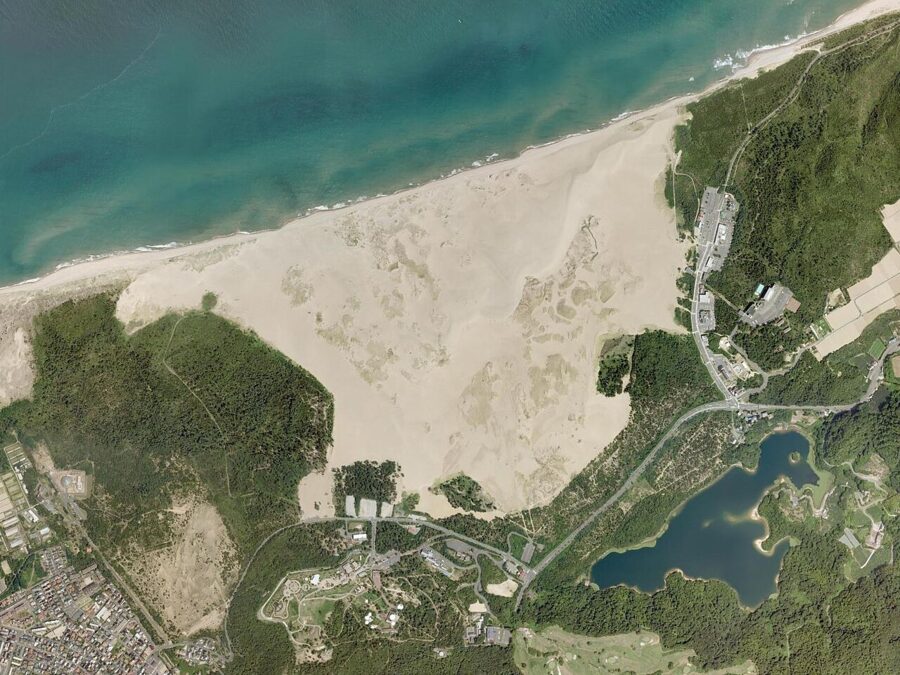

The core of the dunes was made a national Natural Monument in 1955 and enlarged several times, reaching 146.2 hectares in 1978. It lies inside San’in Kaigan National Park, with a special protection zone of 131 hectares around Umanose, which is why vehicles, tents and camels are kept off the ridge. The dunes are also part of the San’in Kaigan Geopark, which joined the Global Geoparks Network in October 2010 and was revalidated as a UNESCO Global Geopark in September 2024.
Why the dunes are turning green
Stand on Umanose and look inland, and you will notice that a good part of the “desert” is grass. That is not natural, and it is the biggest worry for the people who look after the place.
The story is told in the prefecture’s own history of the dunes. For centuries blowing sand buried fields and villages here, and from 1948 Tottori began planting sand-break pine forest on a large scale to stop it. The method had been worked out in the 1930s at the local agricultural college, now part of Tottori University. In 1952 the city took over the dunes from the state on condition that it plant them for 20 years.
By around 1957 almost everything was planted except a strip by the sea and the area around the big hollows. It worked. The sand stopped moving.
The trouble is that moving sand is what keeps a dune bare, and once it settled, plants crept in. The city cut 15 hectares of the windbreak forest in 1972 and 1974, and another 17.3 hectares in 1982 and 1983, but by then evening primrose, crabgrass and black locust had a foothold, and native grasses were spreading too. Plant cover across the dunes went from 24% in 1967 to 39% in 1979 and 42% in 1991. Around 1990, according to the same history, there were patches where you could not see the ground, with reeds two metres tall and even willows.
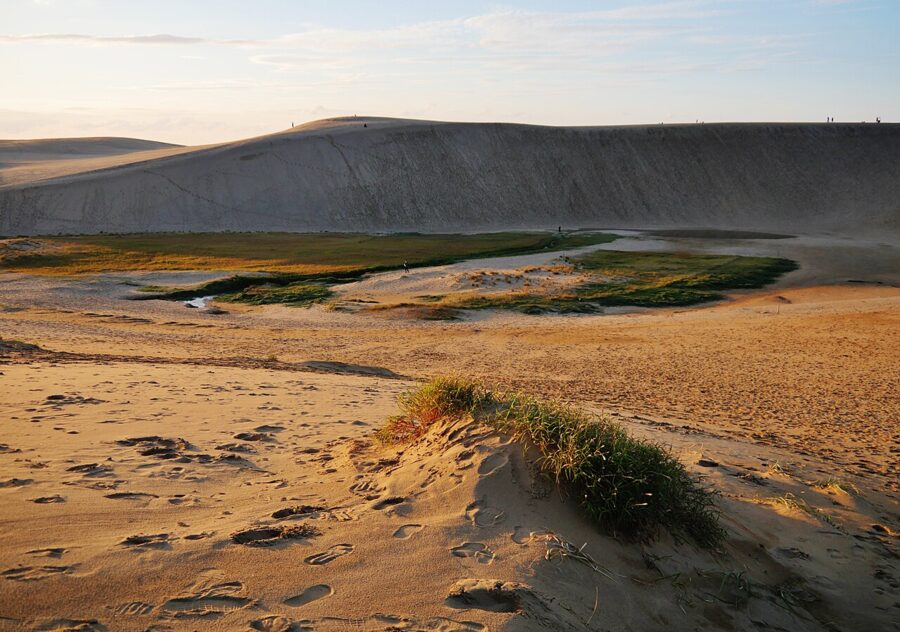

Regular weeding with machines began in the early 1990s, and in 2004 the prefecture began inviting the public to pull weeds by hand. After the 2006 weeding season the plant cover was down to 19%. In 2008 Tottori passed an ordinance to protect the dunes, and since 2009 a small team of rangers has patrolled them. The work has to be done before late August, when the weeds drop their seed.
The volunteer weeding still runs every year, and anyone can sign up through the dunes’ conservation council. The 2026 programme ran on Friday evenings from late May, on Friday and Saturday evenings through July (18:00 to about 19:30), at 06:00 on August weekends and at 07:00 on Saturdays in September and early October, all meeting in the dunes car park. Volunteers put in 4,148 sessions the year before. If you are in Tottori in summer, ninety minutes of weeding at dawn is a better souvenir than anything in the shops, though the forms are in Japanese.

Walking up Umanose
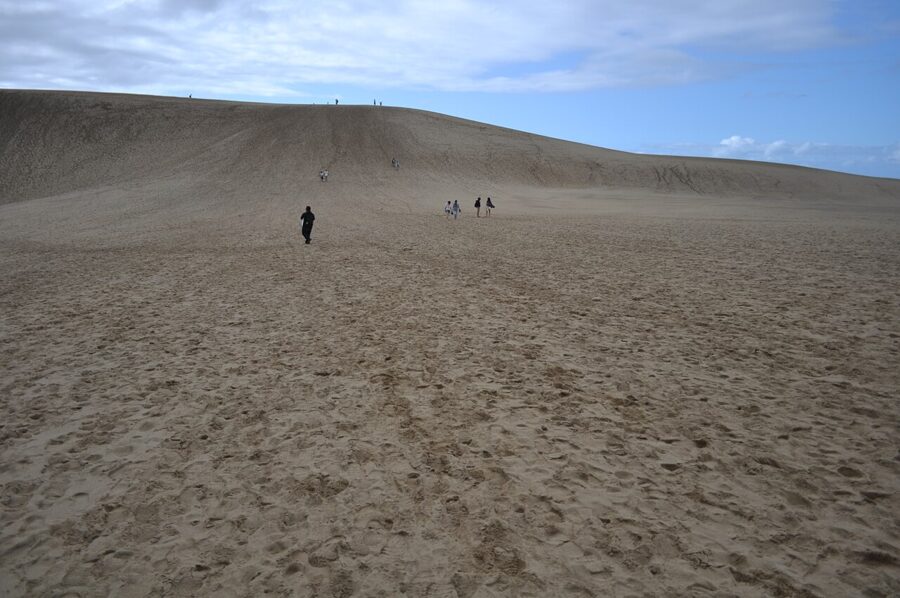
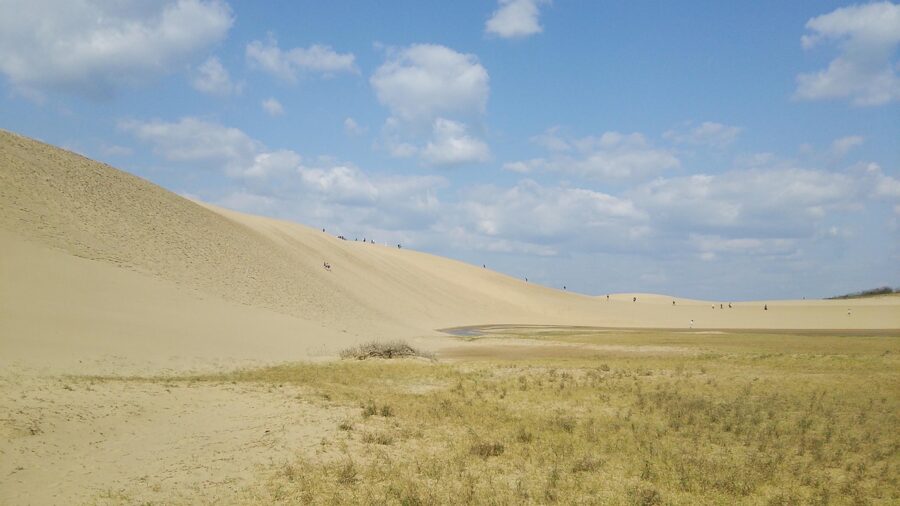
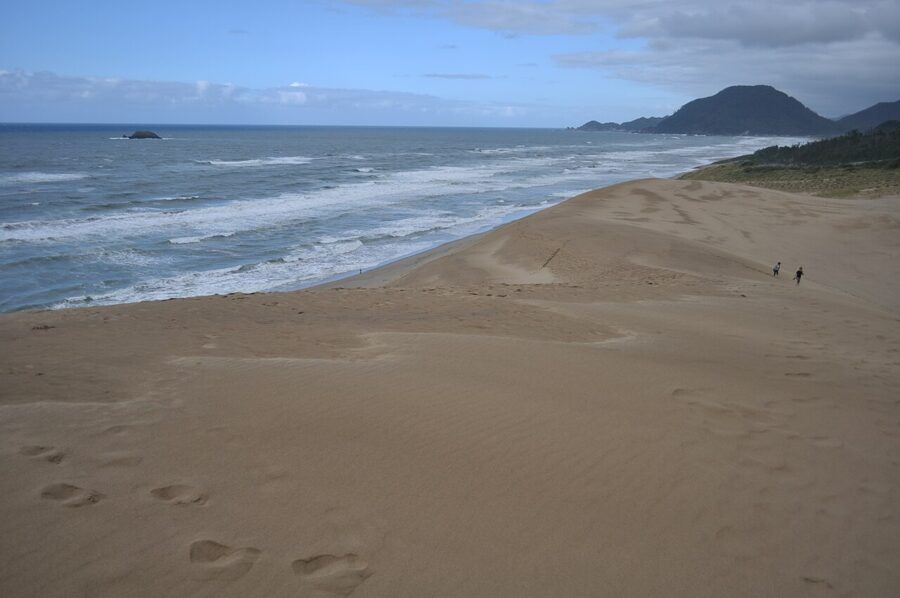
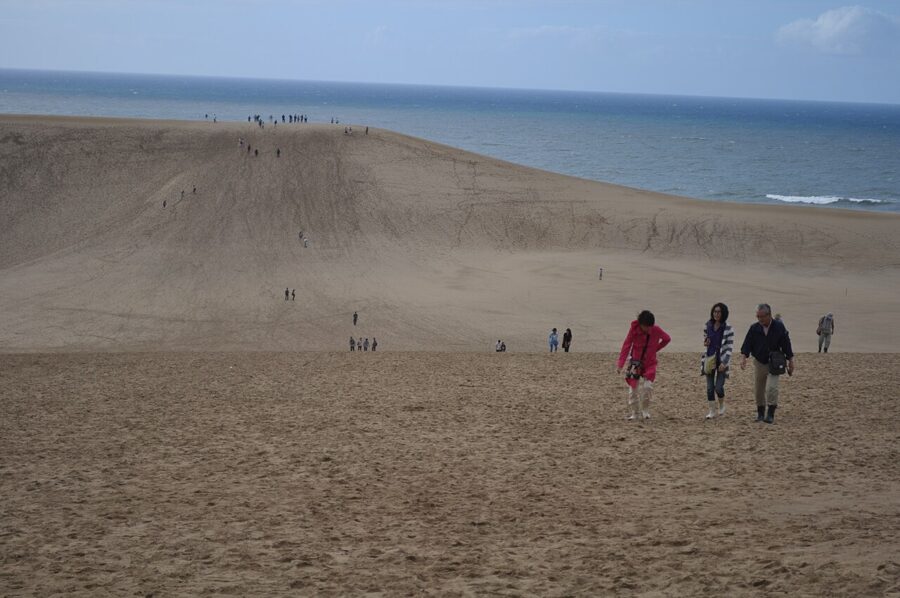
From the top of the entrance steps, Umanose (馬の背, “the horse’s back”) is straight ahead, about 400 metres away. The first part is flat. Then the ground tilts up, your feet start sliding back half a step for every step forward, and the last 20 metres are the hard bit. Take it slowly, zigzag if you like, and enjoy the people around you discovering the same thing.
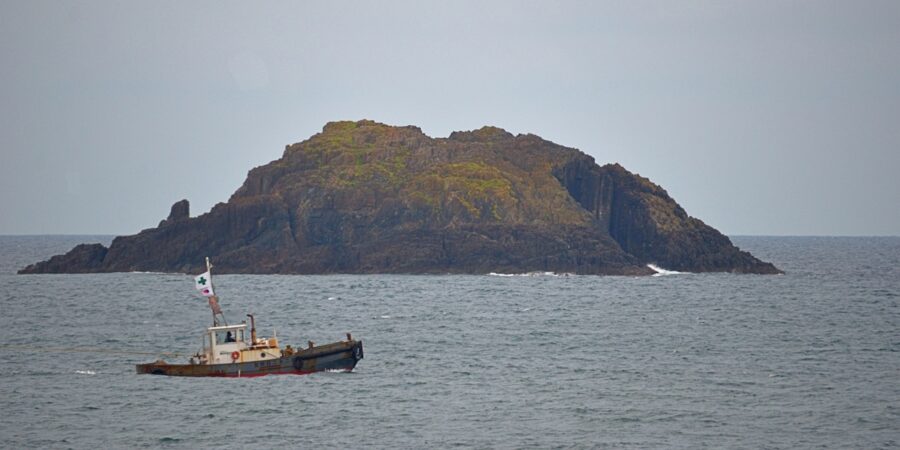
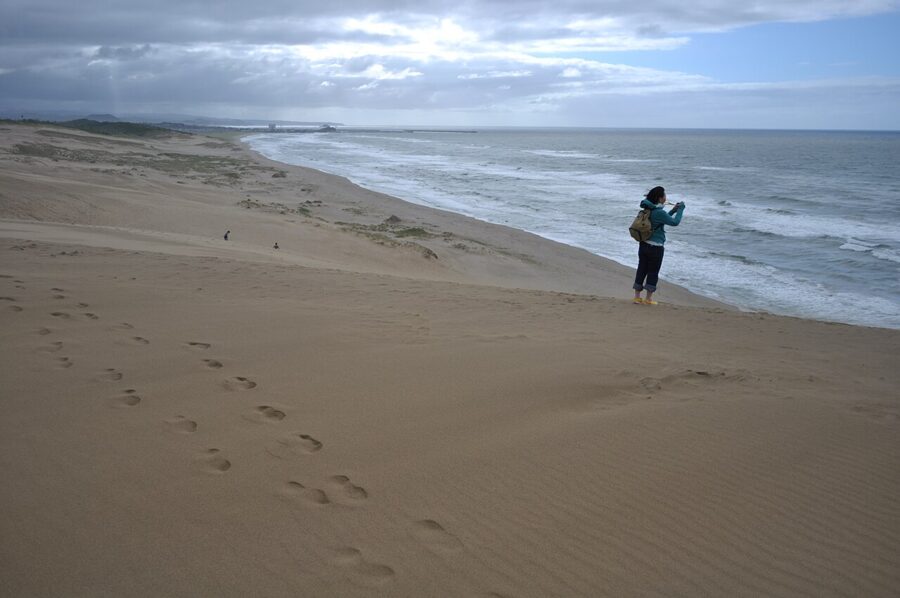
At the top the Sea of Japan is suddenly right below you. To the left you can pick out the mouth of the Sendai River and Tottori port; to the right the coast turns rocky towards Uradome. Offshore lies the low hump of Amashima island. On a clear day, the prefecture’s rangers say, you can see Daisen about 65 kilometres to the west.
You can walk down the seaward side to the beach, and plenty of people do. Just remember that you have to come back up, and that the slope on this side is steeper. Swimming off the dunes is banned by ordinance because the currents are dangerous; if you want a swim in summer, use the separate Tottori Sakyu bathing beach nearby.


The Oasis, the Suribachi and the ash
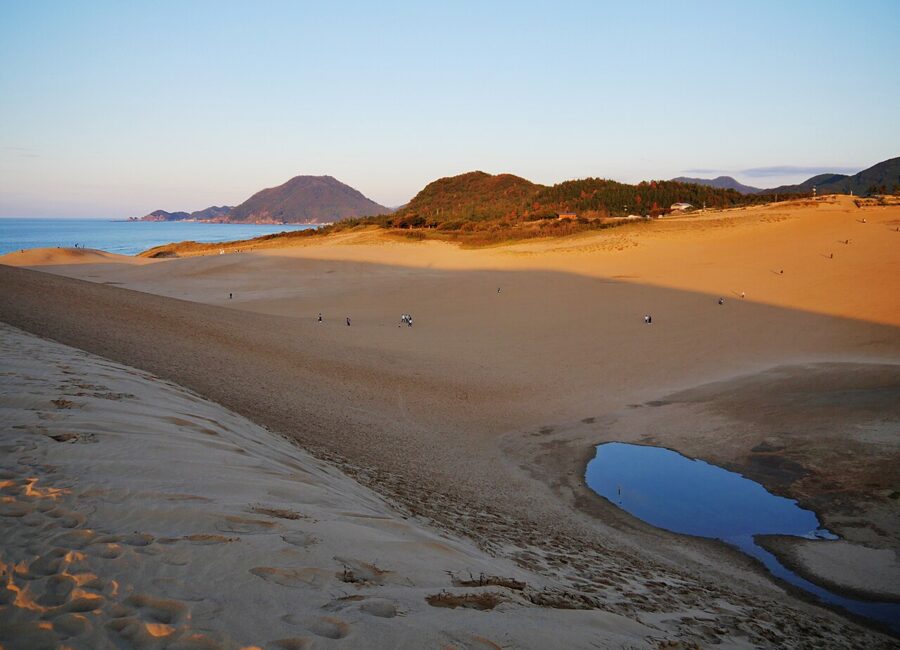
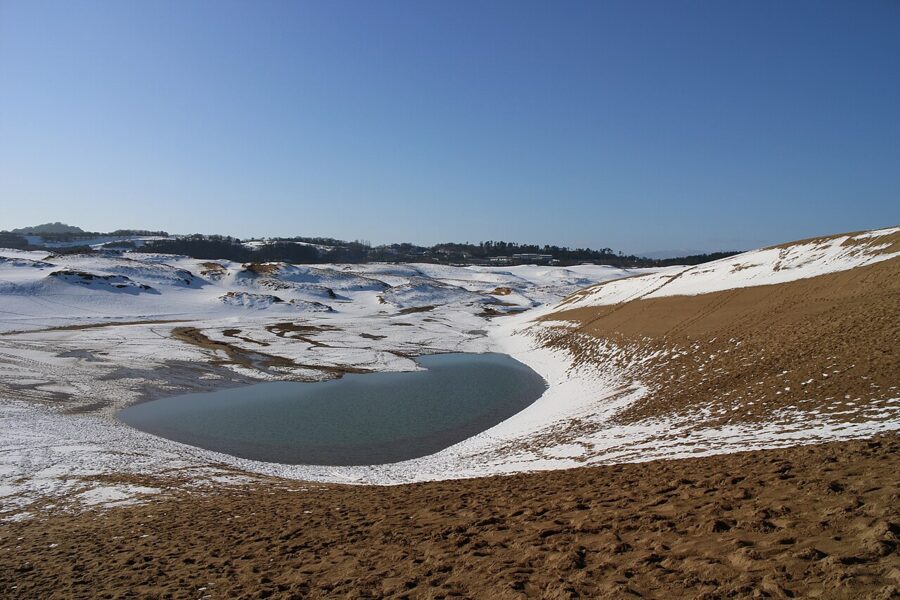
At the foot of Umanose a pool often appears, known simply as the Oasis. People ask where the water comes from; the answer is rain and snow that soaked into the sand and seeps out at the bottom. It usually shows from late autumn to spring and dries up in summer. Parts of the damp sand around it have been roped off to protect a rare tiger beetle that digs its burrows there, so keep to the open ground.
Further east is the Oigo Suribachi, the largest of several bowl-shaped hollows named after the Japanese mortar they resemble. Its walls slope at about 32 degrees with a drop of up to 20 metres. Nearby, where the wind has stripped the sand away, the old volcanic ash is exposed at the surface, and stone arrowheads and bits of pottery have turned up there. The rangers’ suggested route taking in all of these takes about an hour.


Rules worth knowing
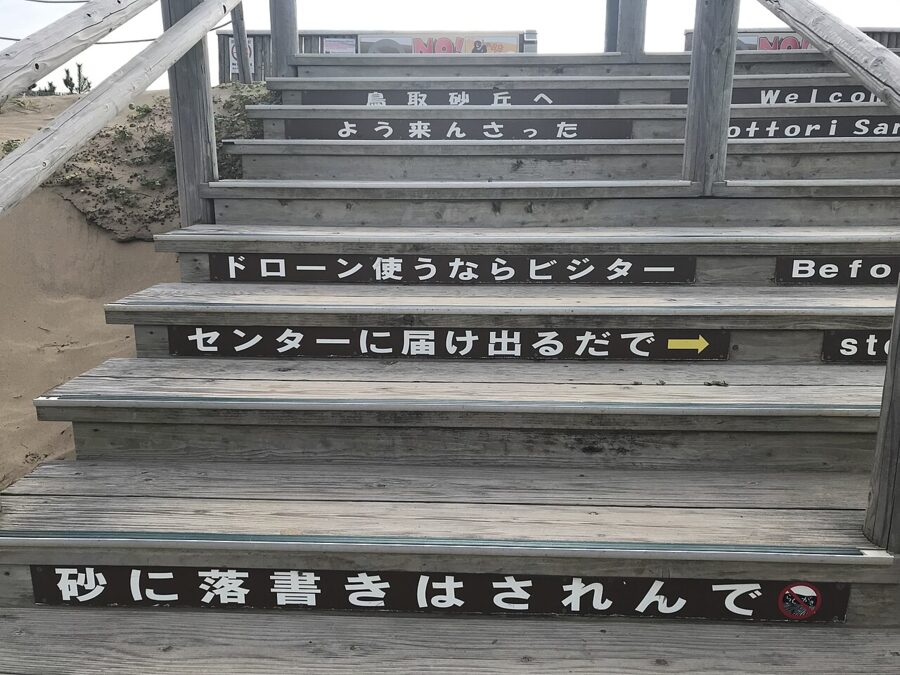
The rules on the dunes come from two sources. Under the Natural Parks Act you may not take sand home, drive or ride anything onto the sand, pitch a tent or put up signs, and the penalties run to a ¥500,000 fine or prison. The 2008 ordinance adds the everyday ones: no writing or drawing in the sand, no litter, no golf, no fireworks and no swimming, with fines of up to ¥50,000 for some of them.
The ban on writing in the sand is the one visitors break most, usually with a heart and two names. Sledding is allowed, but only east of Umanose, and you take your sled or cardboard home. Dogs on a lead are fine. Drones need notice to the visitor centre a week ahead, may fly only when the wind is 5 metres a second or less, and are not welcome at all during Golden Week and the mid-August Obon holiday.
The quieter west side
Most people never go beyond Umanose, but the western part of the dunes, towards Kodomo no Kuni park, is wilder and often empty, with cleaner ripples and more of the native plants and insects.
It also holds a cluster of poem stones. The novelist Arishima Takeo came here in 1923 and wrote a poem about finding his lonely self in the far dunes of Hamasaka; he took his own life about a month later. In 1930 the poet Yosano Akiko visited with her husband and wrote a verse of mourning for him, which is carved nearby.
Guided walks and the visitor centre
Start at the Tottori Sand Dunes Visitor Center, opened in 2018 in front of the car park. It is worth 20 minutes before you walk out. Inside there is a four-metre slice of real dune layers with the ash bands showing, a small wind tunnel that makes ripples on demand, and a little dome theatre called Sunakura that runs a seven-minute drone film every 20 minutes. Pick up the free walking map at the counter.
The centre’s guides also lead walks. The 60-minute east-side walk costs ¥1,500 per adult for groups of up to four, or ¥7,500 for a group of five to about 20, and is free for high school students and younger. Book at least three days ahead online or by phone and pay cash on the day. A longer two-hour walk on the west side runs on weekend afternoons between April and November, and on summer evenings a local guide group runs a night walk by torchlight; both are seasonal, so check before you plan around them.
Activities, with prices as of 2026
Camels
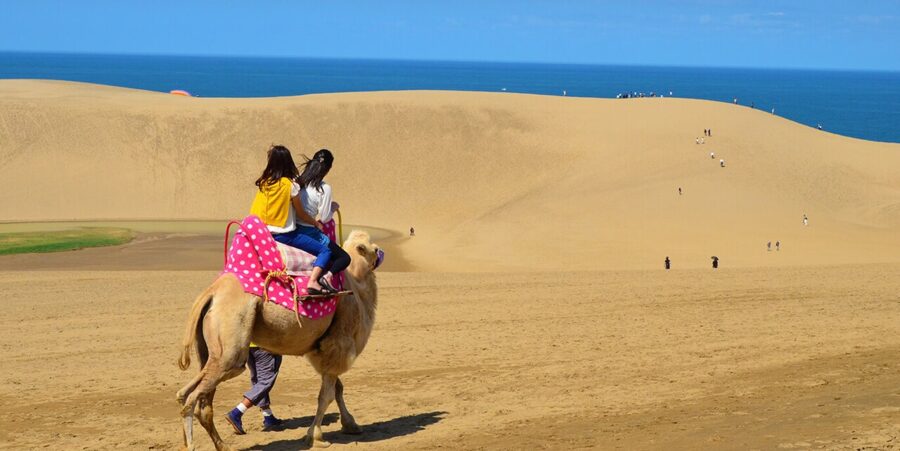
The camels belong to Rakudaya, the souvenir shop at the foot of the entrance steps. A short ride costs ¥1,600 (about US$11) for one person or ¥2,600 for two, and only circles near the stand, since camels are kept out of the protected area on Umanose. Sitting on a camel for a photo costs ¥650; standing beside one costs ¥100. There are no reservations.
Know before you go: since January 2024, and again in its notice for 2026, Rakudaya offers photos only on weekends, public holidays, school holidays, Golden Week and Silver Week, and says that weekdays are mostly photos too. Weather or the camels’ mood can close the stand early. Rakudaya’s hours are 09:30–16:00 from March to November (photos until 16:30) and 10:00–16:00 from December to February.

Sandboarding
The Tottori Sakyu Sandboard School claims to be the only place in Japan that teaches sandboarding, on slopes of about 30 degrees. Booked in English, a session costs ¥5,500 (about US$37) plus ¥500 insurance; the school says the English price includes a ¥1,000 multilingual support fee, and its Japanese page lists ¥4,500. Boarders must be ten or older. Women and children aged 3 to 9 can ride a sand slider, a sort of sledge, instead.
From March to September there are three sessions a day (09:30, 13:00 and 16:00), each about two hours; in October and November the school lists sessions at 12:30 and 15:00, and fewer in winter. You meet at Rakudaya 15 minutes before the start. The school does not rent boards on their own, and cancellation fees start at 30% a week ahead, so book once your plans are firm. Dress in clothes you do not mind ruining and bring socks.
Paragliding
The dunes are one of the gentlest places in Japan to try paragliding: steady sea breezes, nothing to hit and soft sand to land on. Beginners fly solo from the start, launching down a slope and floating 20 to 30 metres up while an instructor coaches from the ground.
The Tottori Sakyu Paraglider School (Sakyu Honpo) charges ¥11,000 (about US$73) for its half-day course, about three hours including the lesson, plus ¥1,000 at peak times; its “easy” course, where staff carry the gear up the slope for you, costs ¥14,500. It does offer a ¥18,000 tandem flight, but note that this takes off from Mount Reiseki, about 20 minutes’ drive inland, not from the dunes. It meets at the free car park near Kodomo no Kuni and asks for bookings a week ahead on weekdays and two days ahead at weekends.
Zero Paraglider School, running since 1986, sells half-day lessons from ¥8,000 plus a ¥500 safety fee, a family plan with staff carrying the gear from ¥12,000, and in summer a short one-hour course in the shade of the pines on the west side from ¥4,000. Its half-day sessions run roughly 08:30–11:00 and 14:30–16:30, shifted earlier and later in July and August. Both schools fly only when the wind allows.
Fat bikes and Segways
Bicycles are banned on the dunes except on licensed tours. Camel Cycle Club runs guided fat-bike tours, with tyres about twice as wide as a mountain bike’s, for ¥8,000 per person, minimum two people, booked by 15:00 the day before. The tour takes about two hours: a lesson and an hour on the sand, then a woodland trail, a stretch of beach and a cycle path back. The guide takes photos and hands them over free.
Sakyu Segway takes off-road Segways across the quiet west side on a course of about 6.5 kilometres: from ¥7,800 for about 90 minutes, or ¥9,800 for a 150-minute course that goes closer to the sea (a 120-minute version, from ¥8,800, runs in winter). Riders should be about 16 to 70, and the tours stop from late June to late September because of the heat. Sunrise and sunset yoga on the sand and smartphone photo tours with a local guide are also on offer; the visitor centre lists them all.

The Sand Museum and its Spain exhibition
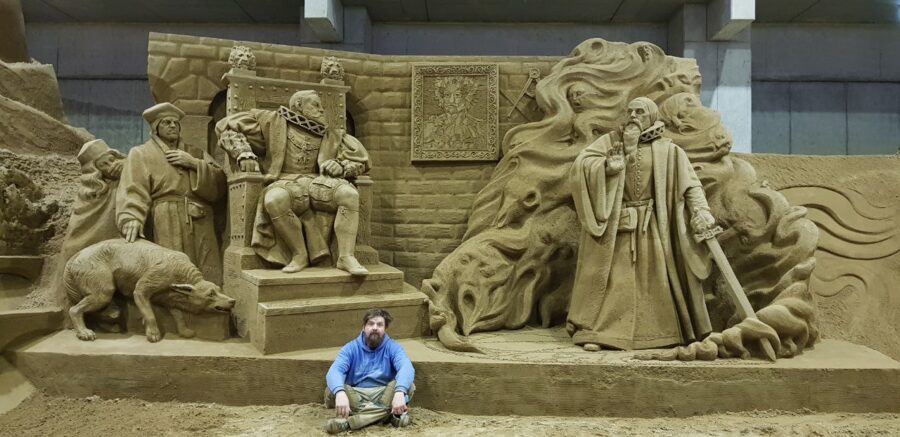
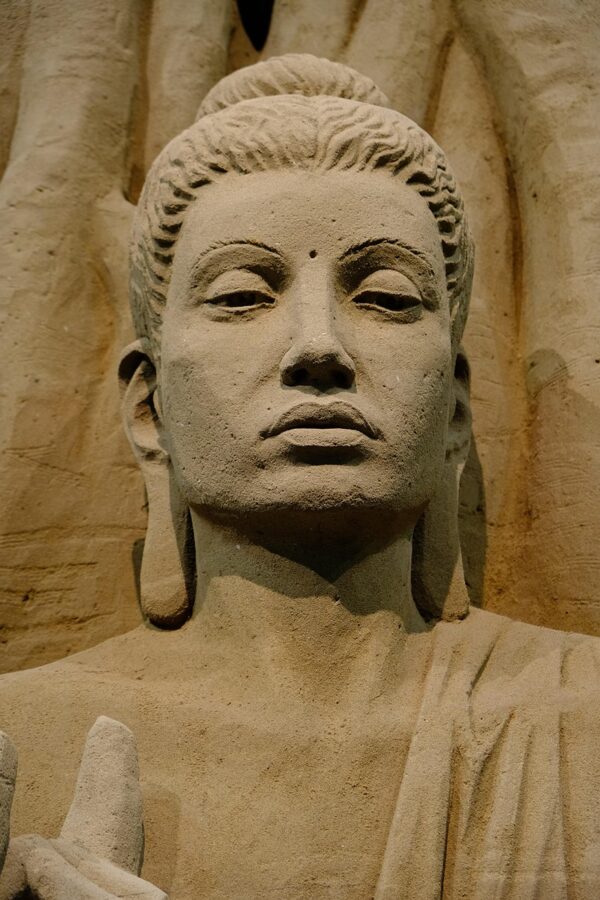
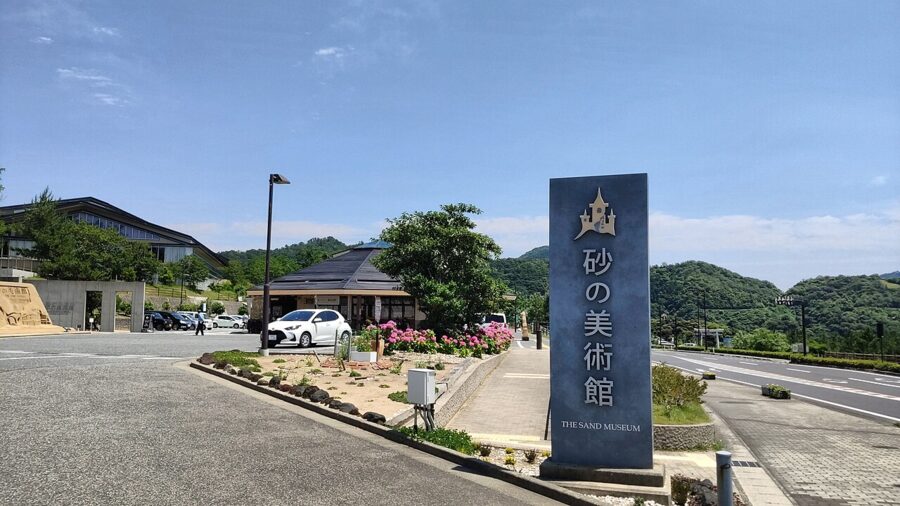
The Sand Museum (砂の美術館) sits on the hill just above the dunes, and it is better than its name suggests. Sculptors from around the world are invited each year to carve enormous scenes from nothing but sand and water, under the producer Katsuhiko Chaen. When the exhibition closes, every piece is knocked back into sand and the sand is reused for the next one.
The project began in 2006 with an outdoor show, moved into big tents, and in 2012 got its own building, billed as the world’s first indoor museum for sand sculpture. Each year takes a country or region under the banner “Sand Travel Around the World”. The 2025 exhibition was Japan; 2026 is Spain.
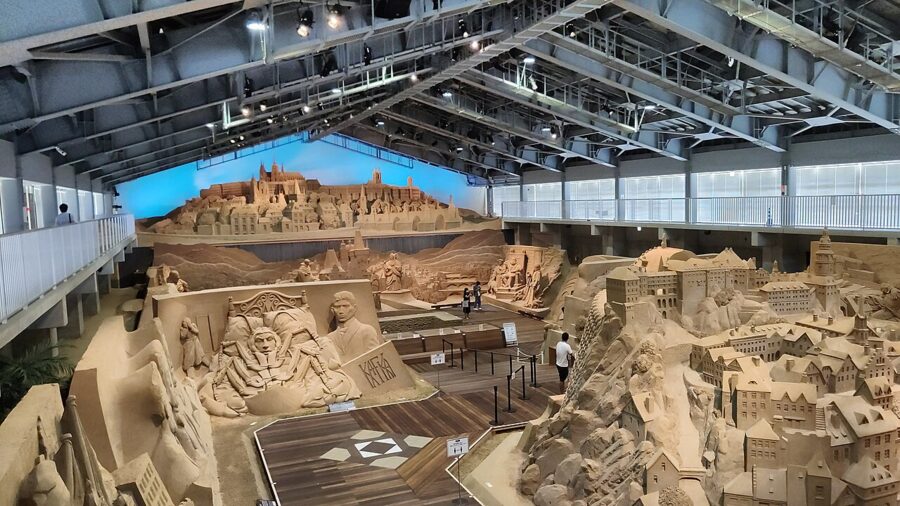
The 17th exhibition, “Sand Travel Around the World: Spain”, runs from 24 April 2026 to 3 January 2027 with 19 works. The theme marks the centenary of Antoni Gaudí’s death in 1926, so the Sagrada Família is the centrepiece, carved in detail by the Italian sculptor Leonardo Ugolini, with a second work on its Nativity Façade. Around it are Casa Milà and Casa Batlló, Park Güell, the Visigoths, Al-Andalus, the fall of Granada, Columbus, Don Quixote and his windmills, Goya’s The Third of May 1808, the bombing of Guernica, flamenco and Spanish food. The museum’s visitor information has the details and a printable guide to the works in English.
| Sand Museum, as of 2026 | |
|---|---|
| Hours | 09:00–18:00 (last entry 17:30), every day during the exhibition, New Year included |
| Admission | ¥800 (about US$5); ¥400 for school-age children; under-school-age free |
| Season pass | ¥1,400 adults, ¥700 children, for repeat visits |
| Closed | 4 January to 22 April 2027, while the next exhibition is carved |
| Next exhibition | “Silk Road”, 23 April 2027 to 3 January 2028 |
| Parking | Free |
Allow 45 minutes to an hour. Photos are allowed for personal use, but not tripods or selfie sticks. There is a side gate from the observation car park by the Sakyu Center, open 10:00–15:00 on weekdays and 09:00–16:00 at weekends and on holidays.
If you are in Tottori before 6 December 2026, go late. Until then the museum runs projection mapping on its two largest pieces, the Alhambra with the Alcázar of Segovia and the fall of Granada, which together stand about 10 metres high and 20 metres wide. Shows start every 30 minutes from 16:00, last about eight minutes and are included in the normal ticket, and the museum stays open until 19:30 (20:00 on Fridays and Saturdays). There is also a flamenco performance among the sculptures on 13 December.

The Sakyu Center, the lift and lunch
The nearest car park to the dunes, in front of the visitor centre, costs ¥500 a day and has about 300 spaces. Up on the hill, the Sakyu Center observation building and the city car park beside it are free, and a chairlift links them with the dune entrance in about five minutes. The sightseeing lift runs 09:30–16:00, depending on season and weather, for ¥300 one way or ¥500 return (¥200 and ¥300 for children aged four and over); buy tickets from the machine at the top.
I would park or get off the bus up here, go out to the roof terrace for the view of the whole dune field laid out, and then ride down. Seen from above, the ridges, the Oasis and the green patches make sense in a way they do not from inside. The Sakyu Center also has a free foot-wash, though no towels.
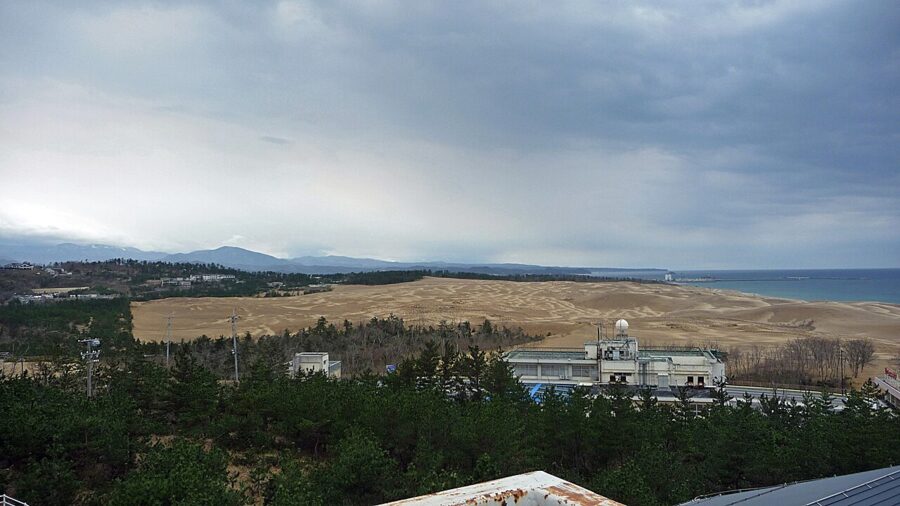

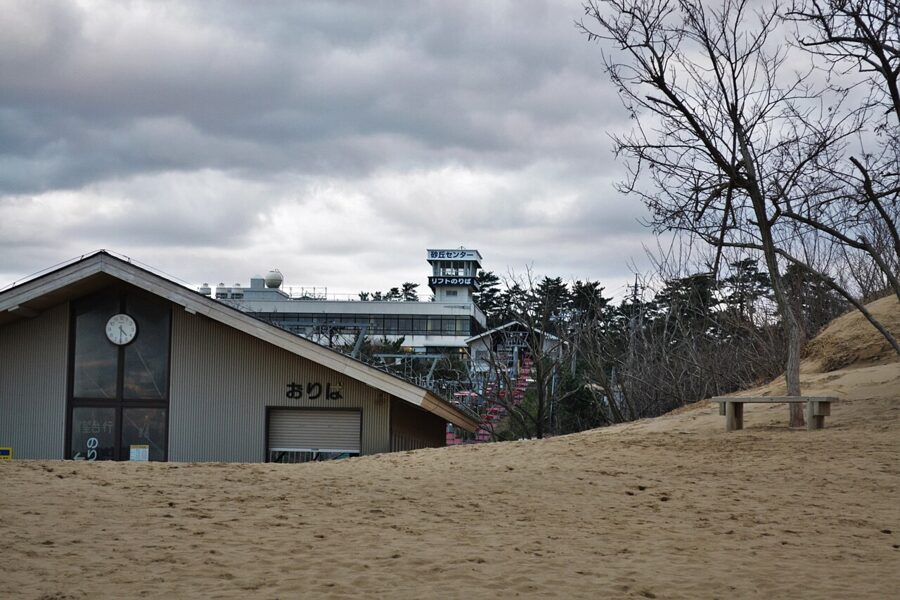

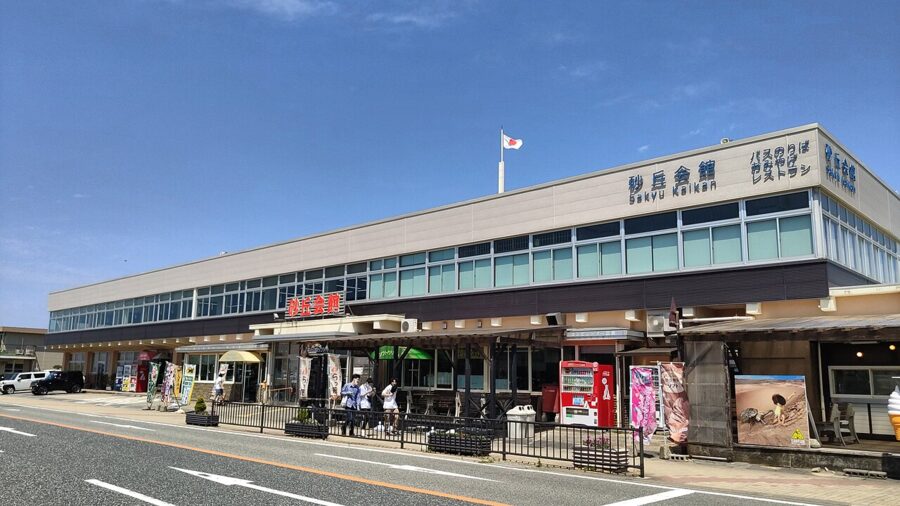
For food, the city’s list of places to eat by the dunes, updated in June 2026, starts with Sakyu Kaikan, the drive-in opposite the visitor centre, and the restaurant at the Sakyu Center, where seafood bowls with local white squid are the thing. Takahama Cafe, designed by Kengo Kuma, faces the entrance. The same list includes Sankaku Kōri, a shaved-ice shop opened in 2021 that makes its ice from Daisen spring water, and Cafe Restaurant Sukatto, which does a Tottori beef burger with a rakkyo shallot mustard mayonnaise.
Photography and the seasons
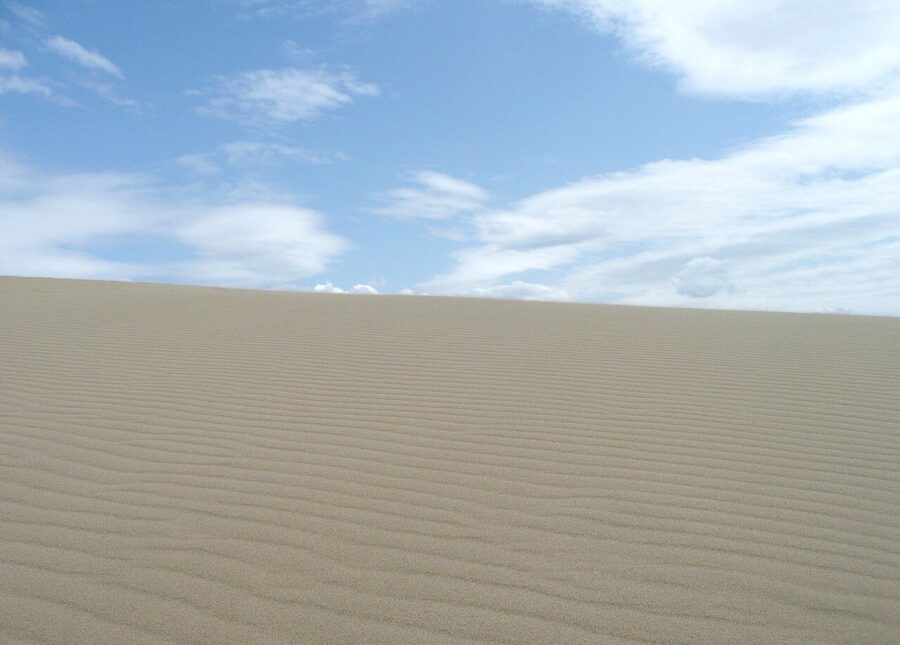
The dunes are a different place depending on the wind. The prefecture’s rangers explain the three effects most photographers come for. Wind ripples (風紋, fūmon) need a wind of 5 to 10 metres a second and sand that is dry and loose, so they are best early in the morning after a breezy night.
Sand pillars (砂柱, sachū) form when a wind of more than 12 metres a second follows rain: a shell, a twig or a crust of silt shields a column of sand while everything around it blows away. Look for them between late autumn and early spring, and after summer typhoons. Sand curtains (砂簾, saren) are thin streaks that slide down a steep face as wet sand dries.
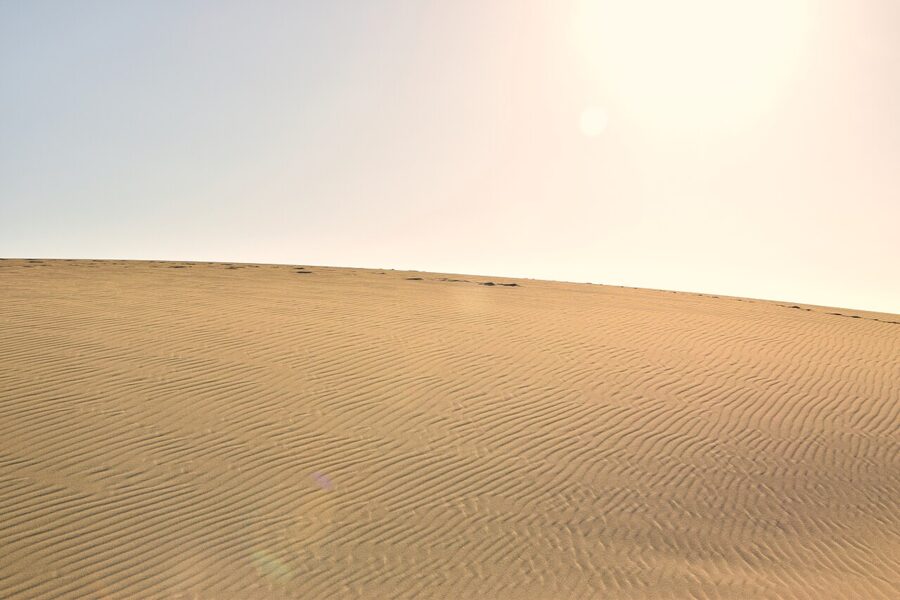

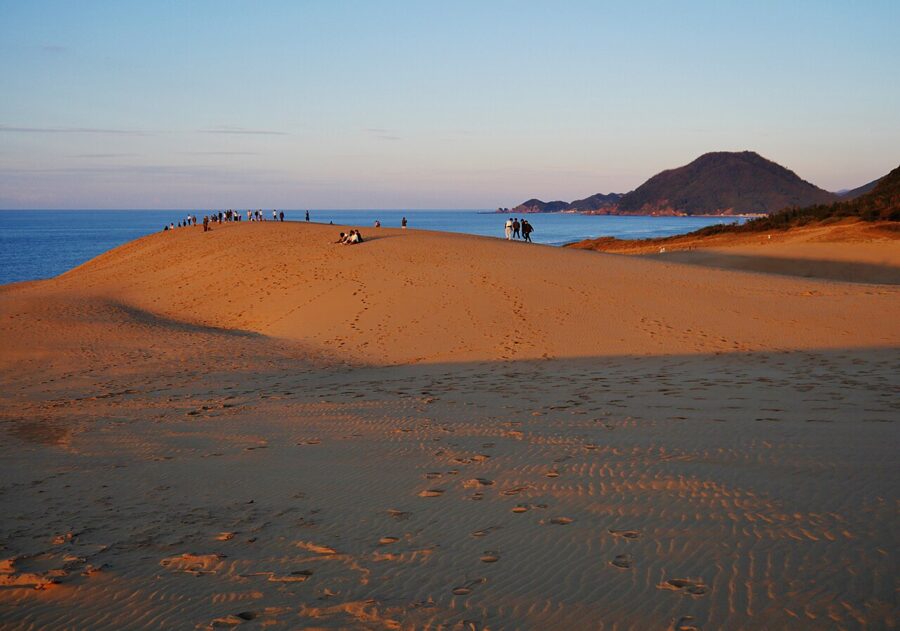
Light matters as much as wind. In the early morning and late afternoon the low sun throws every ridge and footprint into relief, and the sand turns from beige to gold. In summer the sun sets into the Sea of Japan, and after dark the lights of the squid boats come on along the horizon. Because the dunes never close and the city is small, they are also a good place for stars; Tottori likes to call itself the prefecture where you can catch stars.
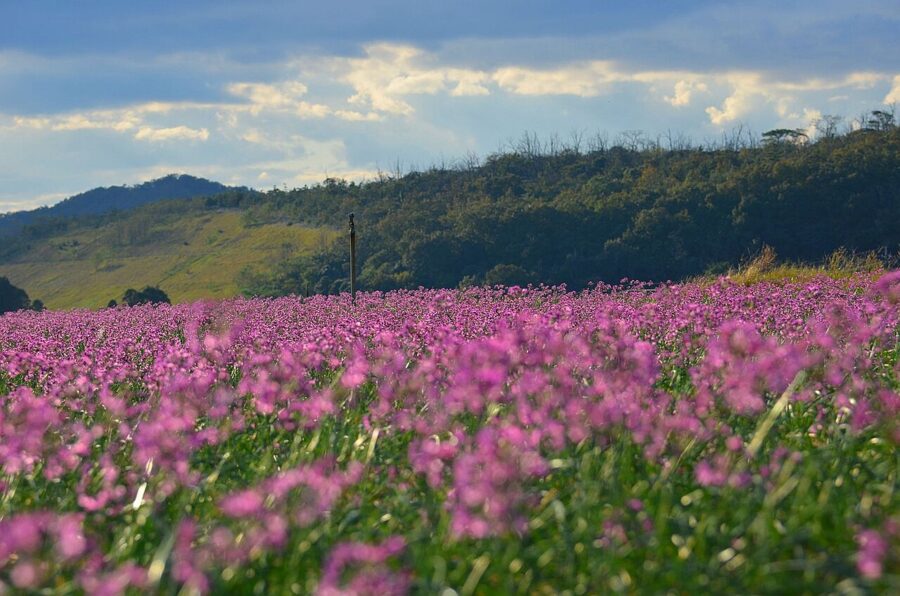
Season by season: spring brings the dune flowers, from the sedge kōbōmugi in April and May to beach morning glory in June and July. Summer is hot, busy and best at the ends of the day. Autumn is the most comfortable time to walk, with the rakkyo fields behind the dunes flowering purple from late October. Winter is often grey and windy, but snow on the dunes is spectacular, and from 21 November to 6 December 2026 the Tottori Sand Dunes Illusion lights up the area around the car park each evening.

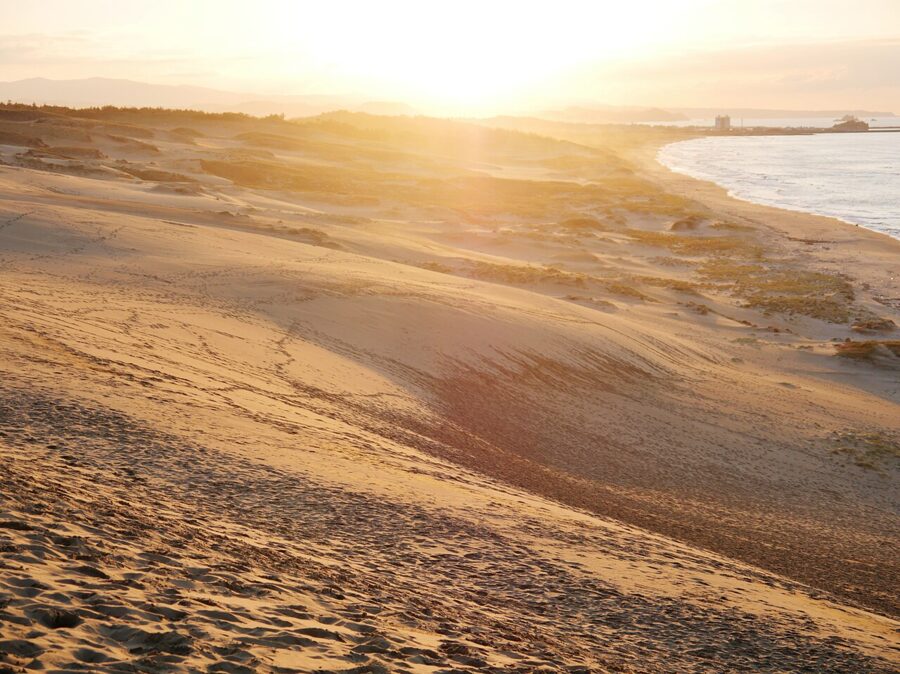

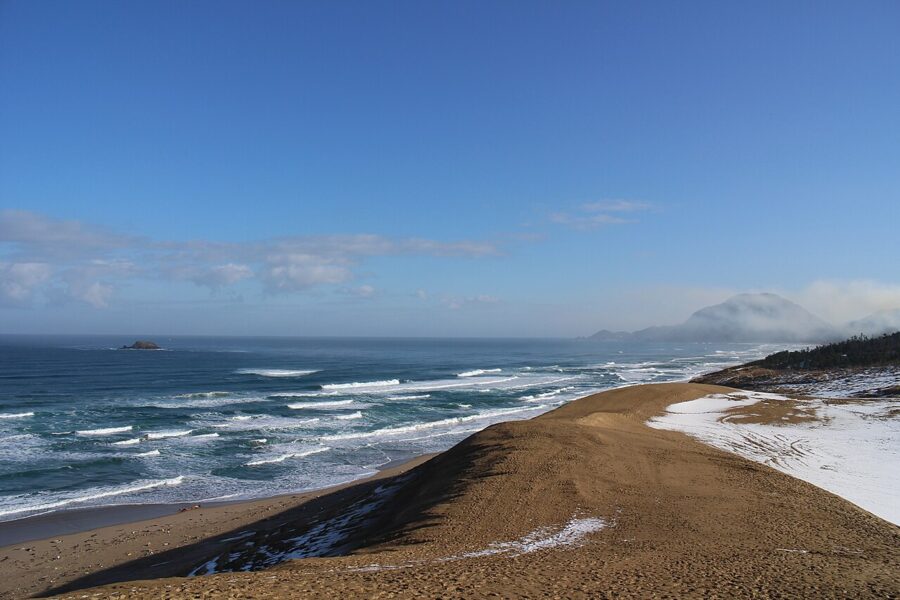

Two rules apply to cameras. Filming or photography with props, costumes or extra equipment (cosplay shoots included) needs notice to the visitor centre in advance, and anything too big for two people to carry needs a permit. An ordinary camera or phone needs nothing at all.
Nearby, in short
Just south of the dunes is Tanegaike (多鯰ヶ池), a pond formed when blowing sand dammed a valley. It has a small shrine to the goddess Benten, water lilies in summer, and kayak and stand-up paddleboard trips run by local outfits.
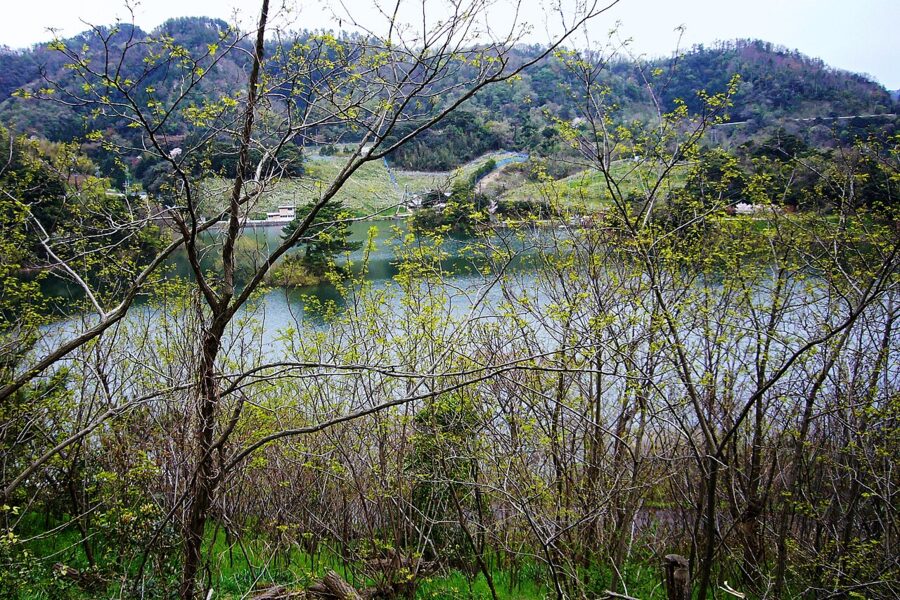

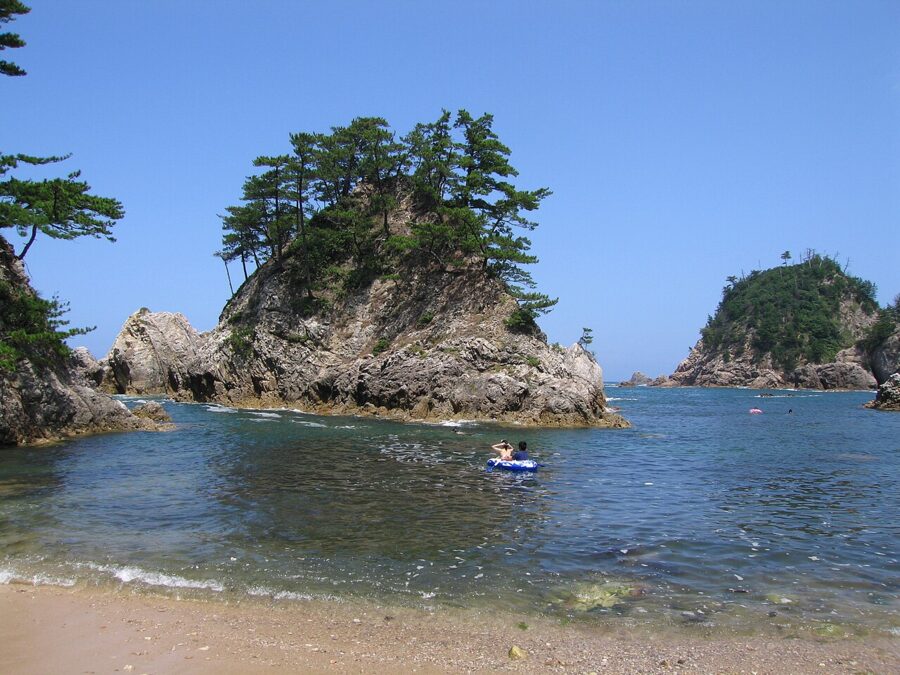
East of the dunes the coast changes completely. The Uradome coast (浦富海岸) in the town of Iwami is a run of granite cliffs and pine-topped islets, best seen from the island-cruise boats out of Ajiro, which leave hourly between March and November. Ten minutes by car from the dunes is the Sakyu Onsen Fureai Kaikan, a plain public bath with a glass-walled bathing room looking over the sea: ¥570 for visitors from outside the city, closed on Thursdays, open 10:00–21:00 from April to September and 10:00–20:00 from October to March (from 09:00 at weekends).

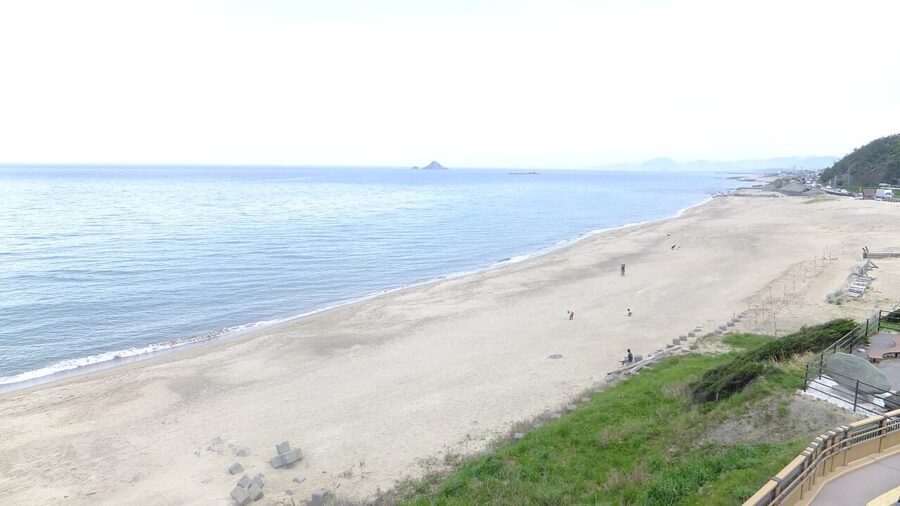
West of the city, Hakuto Shrine keeps the story of the white hare of Inaba from the Kojiki, Japan’s oldest chronicle, beside a long beach with the hare’s island just offshore. Buses take about 40 minutes from the station.

Where to stay nearby
Most people stay by Tottori Station, where the business hotels are and where every bus starts. It is the practical choice if you are moving on by train. But if the point is to be on the sand at dawn, sleep closer.
On the west side of the dunes, the Yamata Tottori Sakyu Station opened in April 2024 on the site of an older campground. It has three parts: Sayu, six heated dome tents for up to six people each, with an optional dinner-and-breakfast plan; Saiku, a campground with room for about 50 tents; and Saen, a guesthouse with dormitories and private rooms, 15 rooms in all, and a large shared bath. From here you can walk onto the quiet end of the dunes before anyone else arrives. Five minutes’ drive east, IWADO BASE offers tent stays, a sauna and a café on Iwado beach.
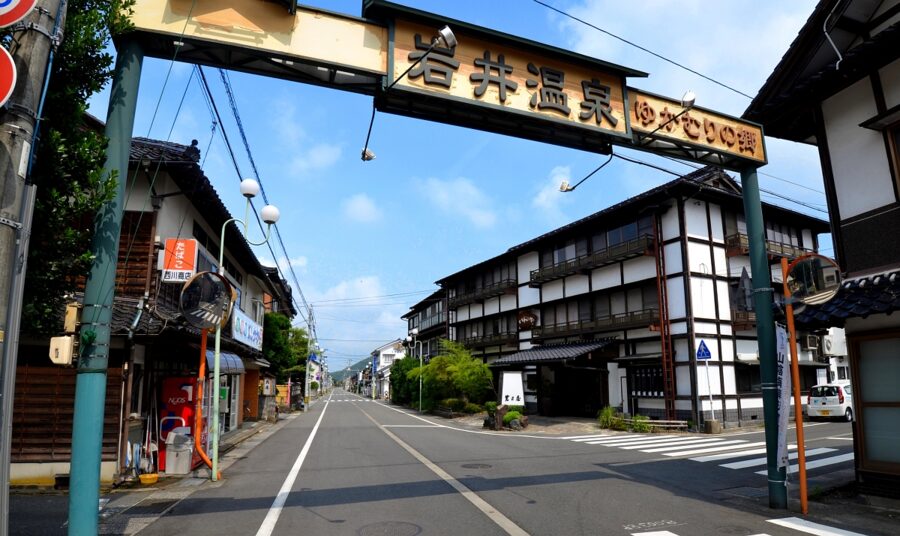
For a proper hot-spring inn, go to Iwai Onsen in Iwami, about half an hour’s drive east. It claims to be the oldest hot spring in the San’in region, known for yukamuri, the custom of pouring the hot water over a towel on your head with a ladle. Iwaiya, a wooden three-storey inn about 150 years old, keeps the old style, with tatami throughout and the spring water running straight from the source.
Getting there from Tottori Station
Everything starts at the bus terminal outside the north exit of Tottori Station. The city’s access guide has the timetable, last revised on 1 April 2026.
- Route bus 39, Tottori Sakyu line, from stand 0: about 22 minutes, ¥380, IC cards accepted. Get off at Sakyu Center Tenbōdai for the lift and the observation deck, at Suna no Bijutsukan-mae for the Sand Museum, or ride to the end, Sakyu Kaikan, for the dune entrance. The last bus back to the station leaves Sakyu Kaikan at 18:30.
- Route buses 32 and 33, Iwami-Iwai line, from stand 3: same fare, stopping at Sakyu Higashiguchi, about five minutes’ walk from the Sand Museum, on the way to the Uradome boats.
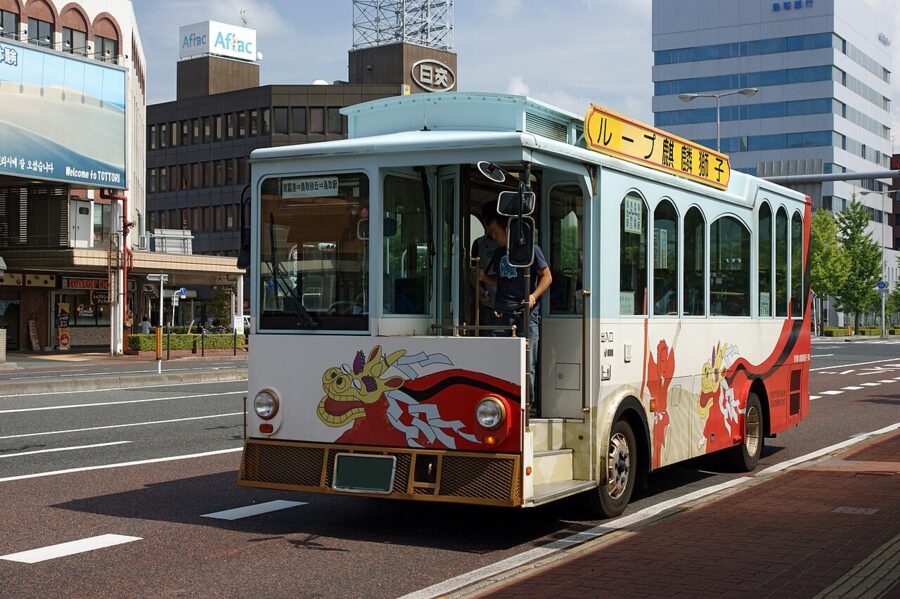
- The Loop Kirinjishi sightseeing bus runs on weekends, public holidays and 13–15 August (not New Year’s Day): about 20 minutes to the dunes on a 75-minute circuit that also takes in Karo port and the castle ruins. ¥400 a ride or ¥700 for a day pass, and since 21 March 2026 it takes IC cards.
- Taxi: about 15 minutes and roughly ¥2,900.
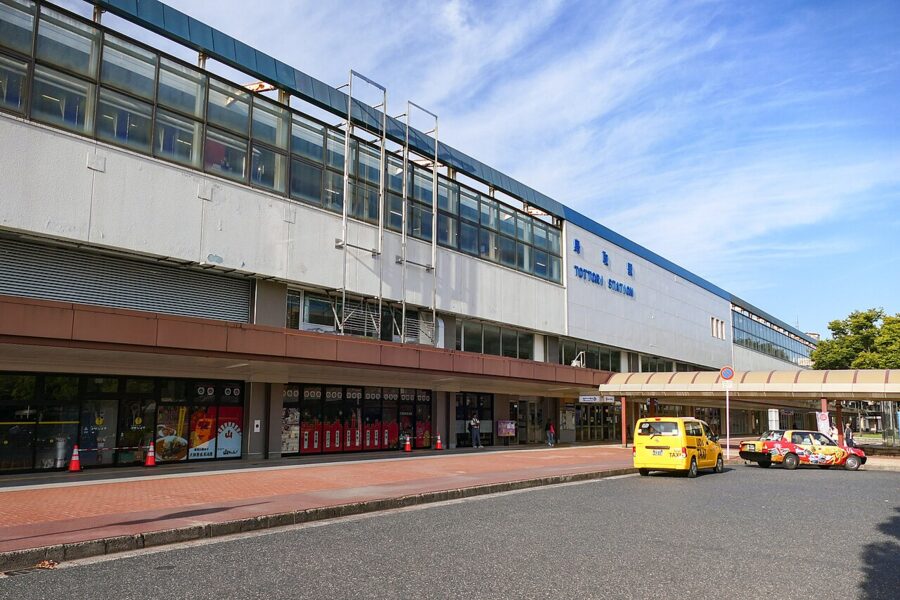
From the airport there is no direct bus to the dunes: take the ¥480 connecting bus to the station (about 20 minutes) and change, or a taxi straight there for about the same ¥2,900. By car, the dunes are about 20 minutes from the Tottori interchange.
Getting to Tottori itself takes about two and a half hours from Osaka on the Super Hakuto, or just under two hours from Okayama on the Super Inaba; JR West rail passes sets out which pass covers what on those routes. Tottori is also the eastern start of the coastal line west to Yonago, Matsue and Izumo, described in the journey along the San’in coast.

However you arrive, give the dunes the edge of the day. Sleep on the west side or catch an early 39 bus, walk out while the ripples are still sharp, and be on top of Umanose before the camels come out at half past nine.